Claude Monet « POETICKS

Archive for the ‘Claude Monet’ Category

Entry 1078 — An Analysis of a Mathexpressive Poem

Friday, April 19th, 2013

A few people have told me (I don’t know how seriously) that they have not been able to figure out all the pieces I have in my latest entry in my Scientific American blog, and a few of mine colleagues even claim I can’t multiply.  Ergo, I have an excuse to blither about one of my poems.  I’ve chosen one I think the easiest to defend.  First, though, here’s Monet’s The Regatta at Argenteuil.  It’s important for one trying to understand my poem to know of it because it is central to the poem (as the third poem in my triptych makes clear with a full reproduction of it).

TheRegattaAtArgenteuil

Okay, to begin with the simplicities of the poem below, a person encountering it must be aware that it is a long division example.  That is indicated by two symbols: the one with the word, “poem,” inside it, and the line   under the sailboat.  The first, so far as I’m aware, has no formal name, so I call it a dividend shed.  The line is a remainder line.  The two together, along with the placement of the other elements of the poem, one where a long division’s quotient would be, one where its divisor would be, one where the product of the two would be, and one under the remainder line where a remainder would be, clinch the poem’s definition as long division.

MonetBoats1-FinalCopy
Now, then, anyone remembering his long division from grade school, should understand that the poem is claiming five things:

(1) that the text the painter who is unsleeping a day long ago multiplied times the scribbled sketch, or whatever it is to the left of the dividend shed equals the sailboat shown;

(2) that the sailboat is larger in value that either the painter or the sketch;

(3) that the addition of the letter fragments under the remainder line to the sailboat image makes the sailboat equal the poem referred to above it;

(4) that the the sailboat should be considered almost equal to the poem;

(5) that the letter fragments, or whatever it is that they represent must be less in value than any of the other elements of the poem with the possible exception of the quotient.

(2) and (5) are decidedly less important than the other three, but can still be important.

I could easily claim that the poem is wholly accurate mathematically by giving the painter a value of 2, the sketch a value of 7, the sailboat a value of 14, the fragmented letters a value of 3 and the poem a value of 17.  Arbitrary?  Sure–but by definition as Grummanomical values of the elements mathematically correct however silly.  (And I would contend that if I had time, I could given them Grummanomical poetic values most people would find acceptable, and–in fact–I believe one of the virtues of such a poem is that it will compel some to consider such things–at least to the extent of wondering how much value to give a painter’s activity, how much to a sketch, and whether a poem is genuinely better than either, or the like.)

7into17

I am including the above in my entry to help those a little fuzzy about long division (and I was definitely not unfuzzy about it when I began making long division poems, and still sometimes have to stop and think for more than a few minutes at times to figure out just what one of my creations is doing).   My poem imitates it in every respect except that it does what it does with non-numerical terms rather than with numbers.  I hope, however, that someone encountering it without knowing much or anything about such poems will at least find things to like in it such as the little poem about the painter, or the idea of the childish sketch as perhaps the basis of what would become a Grand Painting.  Some, I believe, would enjoy recognizing the sailboat as the one in Monet’s masterpiece, too.  But what is most important aesthetically about the work is what it does as a mathematical operation.  That operation must make poetic sense if the work is to be effective.  Needles to say, I claim it does.

To consider the question, we must break down the long division operation the poem depicts into its components.  First of all, there is the multiplication of the sketch by what the painter is doing to get the sailboat–the painting of the sailboat, that is, sketch times something done by a painter almost having to yield a picture of some sort.  Does this make sense?  Clearly, a painter must carry out an operation on some initial sketch or idea or equivalent thereof to get into a painting, so I don’t see how one can wholly reject painter operating on sketch yields portion of painting as analogous to . . . 2 operating on 7 to yield 14.  But there is more to it than that, if only to those of us who think of multiplication as magic, and are still in touch with the way we felt when the idea that 2 times 7 could make 14 was new to us.  That is, just after we had internalized the remarkable mechanism for carrying out multiplication.  For us, the poem’s painter is using his painting mechanism to hugely enlarge a sketch the way the operation of multiplication (usually) hugely enlarges a number.  Doing so in a kind of concealed magical way unlike mere addition does.  A three-dimensional way.

At this point, the question arises as to whether the sailboat nearly equal to a poem.  That’s obviously a subjective matter.  Those who like sailboats (and poems) will tend to say yes.  Note, by the way, that “poem” here does not mean what I say it mean verosophically, but as what one of my dictionaries has it: “something suggesting a poem.”  Here the context–a work of art–makes it impossible to take the word literally,–and moreover, of taking it to mean not just something suggesting a poem, but something suggestion a master-poem.

Well, not quite here: the penciled informality of the word, “poem,” counters the idea that a super-poem is being referred to, and the sailboat is only a black and white portion of a great painting, not a great painting by itself.  We know it’s on its way to being that, but the multiplication is only telling us of it as a pleasant step, not anywhere close to being a realized goal.

The remainder, fragmented words, add very little to it, but we will later see that they are fragments of the phrase, “the faint sound of the unarrestable steps of Time.”  Again, it’s a subjective matter as to whether these words could deepen anything sufficiently to enable it to suggest a poem.  I say it does.  But even if not, I think it would be hard to claim that the addition of such words to a visual image could not be called a plausible attempt to mathematically increase the image’s value.

In conclusion, I claim that the poem carries out the operation of long division in two steps, one multiplicative, the other additive, to valuable aesthetic effect.  Elsewhere I have shown how, according to my thinking, it will put someone one appreciative of it into a Manywhere-at-Once partly in the verbal section of his brain and partly in the mathematical section of it.  The next poem in the triptych goes somewhat further; the sequence’s final poem brings everything to a climax–I hope.

.

Entry 931 — Continuing the Monet Sequence

Friday, November 23rd, 2012

Finally into my creative-flow zone this morning after thinking I never again would be, I produced the following, which is the fourth frame in a sequence devoted to Monet I hope to continue:

Here’s the frame just before the above one, to provide context:

I’ve had it here before, I’m pretty sure, but if you look carefully, you’ll see a few small changes I’ve made to it since then.  I still think it’s stupendously fine.  Urp.

.

Carly Berwick « POETICKS

Archive for the ‘Carly Berwick’ Category

Entry 1107 — ARTnews “Critic’s Pick”

Saturday, June 1st, 2013

This also is from the June issue of ARTnews. 

CriticsPickJune2013

Okay, Weatherly is a fine craftsman, and his still life is interesting–a fine expression of  a now widely-accepted value of superior art: its reminding us of the ability of the ordinary to provide aesthetic delight.  But nothing more.  Thinking about why brought to mind Williams’s red wheelbarrow, but much better.  Or does it?  I think so because both works present ordinary objects sensitively-arranged.  But Williams’s arrangement is also a poem.   Weatherly presents a cup, Williams a wheelbarrow–and something made of words, beautifully-made of words.

.

Rachel Nackman « POETICKS

Archive for the ‘Rachel Nackman’ Category

Entry 857 — A Crossword

Monday, September 10th, 2012

Stephen Dean: “Untitled (Crossword),” 1996–from http://www.artequalstext.com/stephen-dean.


I’m not sure what to say about this.  Emily Sessions says interesting things about it and similar pieces by Dean at the website I stole the above from (which has two other Dean works–and, as I’ve mentioned here before, a large quantity of combinations of text and graphics that visual poets should definitely take a look at.  The website, which is curated by Rachel Nackman, will soon be updated, I understand.

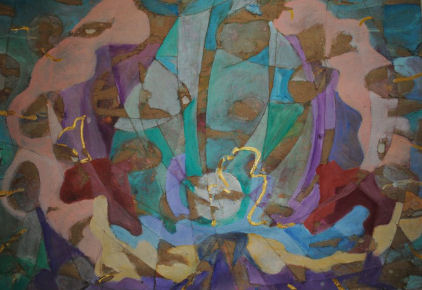
After reflection, I’ve classified this as a visimage (work of visual art). Whereas Emily Sessions thinks of it as an entrance to an underlying universe of colors, it seems to me an act of–well–desecration; Dean has stolen the crossword grid from anyone who wanted to solve it. His repayment, needless to say, more than makes up for the crime (the crossword, after all, will still be available in many other copies of the newspaper it’s in) by doing what Sessions says it does–although it seems more an overlaying of another universe than an entrance into one, for me.  Klee seems to me the magician these magick squares are most in the tradition of.  But they enter the day-to-day of social interactivity in a way Klee’s works do not (as Sessions points out).

My thought at this point, as I consider the work for the first time from my critical zone, is that it surprises one out of a readiness to obey rules, pursue a goal, use analysis–in the familiar context of a newspaper’s entertainment section–and into . . . colors, nothing more. Or, to elaborate, into a purely aesthetic experience one can flow unanalytically, goallessly, freely with.  Yet, a final, numbered order remains ever-so-slightly  visible . . . this newness is safe.

.

Hal Larsen « POETICKS

Archive for the ‘Hal Larsen’ Category

Entry 1131– Desires II

Monday, June 24th, 2013

I spent three hours on the next installment of my Scientific American blog.  It’s almost ready, but I feel done for the day.  So, I tried an experiment: I pulled out an issue of ARTnews from one of my many stacks of the magazine, intending to use the first work in it that I liked here.  October 1996.  I found only one work by a contemporary I even liked:

DesiresII

I was unfamiliar with the painter–although I must have seen this work before. .

William T. Wiley « POETICKS

Archive for the ‘William T. Wiley’ Category

Entry 1139 — William T. Wiley

Tuesday, July 2nd, 2013

It’s late, so I’m just posting the following from the February 1998 issue of ARTnews due to my ongoing interest in visiotextual art I don’t think much of but that gets written up much more frequently than the similar work done by people calling it “visual poetry.”

Learning&Education

.

Nina Katcadourian « POETICKS

Archive for the ‘Nina Katcadourian’ Category

Entry 1110 — Commercial Visiotextual Art

Tuesday, June 4th, 2013

One of my very lazy entries, just two steals from ARTnews.

MoeBroker1

This one is an example of what many Spidertangle artists would call “asemic poetry,” but which, unlike just about everything with that tag, gets into New York galleries or the equivalent.  Why?  It certainly is no better than much of the pieces shown at Spidertangle, although I do like it–the colors and shapes much more than the scribbling.  Is it only because made by certified painters rather than people coming out of, or too associated with, poets.  For one thing, artists like Brooker never think of their work as poetry of any kind.

ArtTalkJune2013

A related example that I don’t at all like.  In the spirit of Jenny Holzer.  Yeah, makes yuh think but who in the world would hand it on their walls?  On the other hand, like the Weatherly Dixie Cups, these bookspines could work as elements of my long divisions.  That, needless to say, would complicate them beyond all possibility of being written up in ARTnews.

.

Counter

Frederick John Mulhaupt « POETICKS

Archive for the ‘Frederick John Mulhaupt’ Category

Entry 847 — “February’s Sun”

Friday, August 31st, 2012

The following painting is here because I happened to come across a copy of American Art Review I had gotten free as a trial offer with it on the cover of the magazine, and I thought I could use it to make make (again) one of my standard points, the fact that an artwork may be extremely well-done and enjoyable but not important.  I extremely like this one (painted around a hundred years ago):

I’d be very happy to have the original on one of my walls.  But there must be hundreds of paintings of winter streams in a forest as well-executed as this, and a million photographs as visually effective albeit lacking in what paint does aside from contribution shape and color to a painting–and the evidence of human skill, which is–properly–one source of one’s appreciation of a painting.  But it provides no new angle on reality.  And that, for me, is the only culturateurically important thing any artwork can do.  Qualitative increase versus quantitative increase of the known world.  Continuing a tradition well is a fine thing, but starting a fresh one is superior to it, even starting it poorly.  Hence, I subscribe to ARTnews, not American Art Review, because ARTnews continues much more recently-born traditions, and sometimes hints of ones now being born.

I wonder why there are no poetry magazines as good for poetry as ARTnews is for visimagery (i.e., visual art).  Or do I over-rate ARTnews because I’m not as knowledgeable about visimagery as I am about poetry?  Or because poetry is still evolving whereas visimagery, having achieved non-representationality, has nowhere left to evolve.  But there is no magazine of wide circulation devoted only to poetry except, perhaps, Poetry, and it is many more years behind the times than ARTnews is–or American Art Review.

Still, as a Connecticut boy stuck in Florida for almost thirty years after fifteen in Southern California, I must say I really do like “February’s Sun.”

.

Lee Hall « POETICKS

Archive for the ‘Lee Hall’ Category

Entry 1152 — A Painting By Lee Hall

Monday, July 15th, 2013

The following is from an ad in the latest issue of ARTnews:

SeaMist&OcracokeDune

I’d never heard of Lee Hall until I saw this.   The Jerald Melberg Gallery in Charlotte, North Carolina, is representing her.  I thought the blurb said close to all I could have about her piece.

I wonder what the ethics concerning posting ads without permission is, as I often do (since I much more frequently like the visimages in ARTnews’s ads than the ones in its articles).  Surely they should be happy I’m getting their ad around.  But I consider everything I steal for use here the equivalent of bringing a copy of ARTnews to a friend’s house and showing him something in it I like.   I feel I should be given scholar’s privilege, too.  Nonetheless, I do feel a bit of guilt about the steals.

.

Entry 608 — Collage for a Mathemaku « POETICKS

Entry 608 — Collage for a Mathemaku

Once again two trips to take care of one chore: I took my revision of “Mathemaku for Scott Helmes” and its frame, which I was afraid to try fool with, to a frames guy I’ve done business with before, but his place wasn’t where it had been. A nice lady in the beauty shop next to where it was told me where to find it. Happily, it wasn’t far away. DIGRESSION: I used to be contemptuous of the way “hopefully” was used until “happily” made it okay for me–which I mention because I often try to remember other adverbs like “hopefully” and never can (there are several).

I found my frame guy but his place of business was locked although his door said he opened at ten each day but Sunday, and it was near eleven. I waited a little while, thinking he was probably just late. There was no sign on the door or in the window indicating what might have happened. At length I crossed the street. That’s where the Arts & Humanities Council office was. I wanted to drop off the large unwieldy frame. (I was on my bike, needless to say, so worried I might damage the frame. Well, Olivia, Judy the executive secretary’s assistant, was kind enough to let me dump what I had there. Back home, I tried to call my frame guy. I couldn’t find the name of his place, The Rose Gallery, in the phone book but found something called “Creative Framing,” or something, that seemed to be about where the Rose Gallery was, so I called the number for that. An operator told me the number was no longer in service. Great. I tried to get a number that would work fromthe Visual Arts Center, but the girl I talked to didn’t have it. Finally, after three tries, I got it from information; the first two times I was given the old number. Fortunately, when I called the new number my frame man was there. He’d been late because of something he’d had to do with his son. After making sure Olivia wouldn’t be away form the office for lunch (she had locked my stuff in Judy’s office, and Judy is in New York), I rode my bike to the Arts & Humanities Council’s office, got my stuff and took it to the Rose Gallery. Which was locked! Gah.

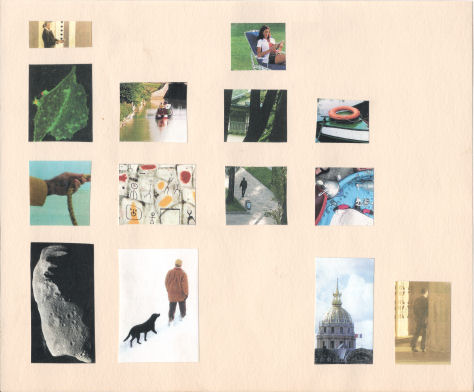
Well, almost at once, the frame guy showed up. He’d gone somewhere to collect his mail, which wasn’t delivered to his door but to a box somewhere near. Everything then when well. I now have “Mathemaku for Scott Helmes” nicely framed. It looks good. (It always amazes me how good a frame can make a piece look.) The collage below was an attempt to do what Scott was doing at the time (8 or 9 years ago); I was never happy with it, but think it’s okay. It represents “nothing going on” . . . I think. In my piece, I add “the deepest grammar of January” to it to get “STONE.” It may not be my best mathemaku but, not counting sequences, it’s my largest. I’m wondering if there will be some who like it better than my other long divisions. To add variety to the exhibition is the main reason I’m including it. 
Diary Entry

Wednesday, 28 December 2011, 5 P.M.  More gab at Spidertangle, most of which I used to take care of the day’s blog entry.  A trip early in the morning to get copies of one of my long division poems–because my own printer wasn’t doing a good job of printing, due–I now believe–to insufficient ink, although my computer told me it had plenty of ink.  That job, and a little grocery shopping taken care of, I got home only to find out I’d forgotten to collect my flash drive from the people at Staples.  I went back for it a couple of hours ago.  I feel worn out, as always.  I haven’t done anything with my reply to Jake (but yesterday, a little tinkering I did with it seemed to me just what it needed to merge to large blocks of it into a reasonably coherent, flowing whole, so I think I’m close to getting it done).

.

Leave a Reply