Archive for the ‘Basho’ Category
Entry 1248 — What a Poem Is
Thursday, October 24th, 2013
I can’t seem to get into this value-of-poetry topic so for now will simply deal with the terminology I came up with several days ago and thought would get me going deeper. I’ve pretty much junked all of my previous related terminology. The new terminology should cover everything it did.
First of all I have ordained that a poem hath:
Fundamental Constituents:
1. words as words, and punctuation marks and verbal symbols like the ampersand and mathematical symbols like the square root sign, or the verbal constituents of poetry;
2. words as sounds, or the auditory constituents of poetry–which can, in the case of sound poetry, include averbal sounds;
3. words as printed objects, or the visual constituents of poetry–which can, in the case of visual poetry, include averbal graphics.
I tentatively would also include negative space, by which I mean not only the blank page words are printed on but the silence their sounds can be said to be printed on, as fundamental constituents of poetry.
Every poem contains all four of these constituents. Taken together, they form the poem’s denotative layer, which expresses what the poem explicitly means. That layer in turn generates the poem’s connotative layer, which expresses what most people would find it implicitly to mean. Note: if the poem is plurexpressive–a visual or sound poem, for instance–its graphics or sounds would contribute to both layers: a drawing of a house would denote a house, for example, and the sound of a gunshot would denote a gunshot. (“Gunshout,” I mistyped that as, at first. Aren’t words fun?!)
The two layers together make up what I’m now calling a poem’s expressifice. (“Boulder”–“bolder” with a u added. Sorry, I began wondering if I could–oops, that’s “cold” with a u added–make a Kostelanetzian list of words like “gunshout.” I didn’t intend for the longer word to be a regular wourd. . . .)
Back to “expressifice.” It is responsible for what a poem says. Okay, nothing new except the Grummanisms so far. Recently, and this is an area I must but probably won’t research, there has been some grappling with the idea of “conceptual poetry” that I have found important and interesting, but confusing. My next “poetifice” is the conceptifice. My Merriam Webster’s Collegiate Dictionary provides a definition of “concept” that I find satisfactory for my purposes: “an abstract or generic idea generalized from particular instances.” In a poem, it would be close to what I’ve used the term, “unifying principal,” for. A poem’s “meaning” seems to me a near-synonym for it, too.
I can’t see that it’s any less “expressed” by a poem than connotations are, and I mention that because my impression is that those discussing conceptual poetry generally oppose it to “expressive poetry,” by which they basically mean “what a poem says” rather than the meaning of what a poem manifests.
It now occurs to me that what the conceptual poets are doing is minimalizing what I call their poems’ expressifices to magnify their conceptifices. If so, my term should be more useful than I at first thought it would be. I feel it of value anyway because of the great difference between what it can be said to express and what the expressifice can.
As I wrote that, I realized that the entire conceptifice of many poems, particularly the most popular ones is not very ideational–is, in fact, just a large connotation. Basho’s famous frogpond (“frogpound?”) can help here, I think (and I’m a bit foggy about where I’m going, but think I’m getting to someplace worth getting to). Here’s my translation of it:
‘
old pond . . . . . . the sound of a frog splashing in
.
This poem may have more valid, interactive unifying principals per word-count than any other poem ever made. So its conceptifice includes the idea of “the contentment the quiet portions of the natural world can provide one.” Or is that an image? In any case, it seems different in kind to a seond idea it clearly presents: “the wide range in magnitude (in all meanings of the word) of the universe’s moments.” We feel the first, we . . . ideate? the second–while feeling it, yes, but in a another way, in another place in our brains, than we do the serenity the first component of the poem’s conceptifice is about. Poetry, and poetry-become-philosophy.
I will have to come back to this.
The final three poetifices are the aesthifice, the anthrofice and the utilifice. These have to do the meaningfulness of a poem’s initial meanings. Every poem has all three of these, but usually one is emphasized at the expense of the other two.
The aesthifice has no meaning, it just is. (See MacLeish.) It is meaningful for its expression of sensual beauty. It can’t help but express other things, but they are trivial compared with the beauty of its sounds and/or sensual imagery and/or feelings it is most concerned with. In my notes about it I mention “beauty of constituents,” “imagery” (and “deep imagery,” possibly. “freshness of expression,” “archetypality,”display of skill” and “patterning.” There are more, probably many more.
The anthrofice has no meaning, either, but is primarily concerned with human beings, their actions and emotions. It expresses what I call “anthroceptual beauty,” the beauty of human love, for instance. Narrative poetry aims for anthrofices, lyric for aesthifices. Then there’s the utilifice. It does mean. A rhymed text you value because of what you learned from it will feature a utilifice. Beauty of any significance is besides the point, what counts is that what one gets goes beyond what the poem is–the poem is a helpful step toward attaining something more valuable than it whereas a lyric or narrative poem is art for art’s sake. In short, I categorize a “poem” whose utilifice is dominant as a form of utilitry–either informrature if conveying information, or advocature if telling people what to do. Lyric and narrative poems are forms of art.
If I weren’t such a lump, I’d now apply the above to actual poems. As a matter of fact, that’s what I want to do in my November Scientific American blog entry. Right now, though, here’s a rhyme that isn’t a poem:
Count that day lost Whose low descending sun Views from thy hand No worthy action done.
It’s from a wall of my high school cafeteria. I don’t know who wrote it, but I like it a lot-–and believe in it! A pretty rhyme but didactic, so not a poem. Its function is not to provide pleasure but to instill (however pleasantly) a valuable rule of conduct.
All of a poem’s poetifices taken together are a . . . poem, a lyrical poem if the poem’s aesthifice is dominant, a narrative poem is its anthrofice is dominant, and a utilitarian poem is its utilifice is dominant.
* * *
Well, I did a lot better than I thought at the start. It needs more work but I’m satisfied with it as is.
.
Entry 1059 — Break from MATO Analysis
Sunday, March 31st, 2013
I had a slush-brained day yesterday, so only did a little work on my discussion of Manywhere-at-Once. Then, while doing a little putting of mine house in order, I came across this. It wasn’t till I got to the word “aesthcipient,” which no one uses but me that I recognition the piece as mine. At that point I was wondering who else had written so insightfully about Basho’s old pond haiku, which it clearly concerned. I’m not sure where it’s from, but I’m sure it was written more than twenty years ago. Nice to know I could sometimes write so well even way back then!

.
Entry 1012 — Basho Poem, Last Visit
Tuesday, February 12th, 2013
I suddenly realized yesterday that I had my secret messages reversed: the one I thought should be the lower was above the other (as I visualize the piece). So I redid the poem. I dropped “and,” while I did so to suggest that what followed might be thought of as the pond, or an illustration of it–as it is intended to be a metaphor for it.

.
Entry 1011 — Back to My Cryptographiku
Monday, February 11th, 2013
I reduced the size of the message in code. Very Minor, it would seem, but I think it improves the thing significantly! It looks better to me, but the main thing is that it suggests through its reduced size, the secret nature of the message. Historical note: when I first made a cryptographiku ten or more years ago, I thought I was really on to something. Within a year or two, I already felt I’d exhausted the form. I’d made six or seven cryptographic poems, and used coded material in a few other poems. I did think the cryptophor (coding employed metaphorically) was an effective device that might remain in the poetry tool kit, but that a poem whose central aesthetic effect depended on one had little future. I still think it may not, but my Basho poem is a new use of the form so gives me hope others will be able to find other new ways of using it.
Psychologically, I find it interesting that I suddenly, pretty much out of nowhere, had the idea for this new kind of cryptophor of mine (which, I will now reveal, involves a method of coding two messages at once–to suggest layers of hidden meanings rather than just a single under-meaning) after giving up on the device. My experience suggests how long it can take the subconscious to take an invention, my cryptophor, one step further. At least five years.

In this poem, to continue, the cryptophor suggests the entrance into another world that Basho’s frog’s dive is, and without anyone’s plunge into real, or equivalents of, ponds . . . I think its meaningfulness makes my poem at least a good one, and its metaphoric use of “doubling coding” makes it important enough to be considered major. If I’m wrong, all my poetry has been a waste of time. Oh, except for the pleasure of creativity I’ve derived from it. But I have a need to make a significant contribution to the culture of my time, not just do things I enjoy, although I’d see no point in making significant contributions to the culture of my time if I didn’t get creative pleasure from the process. If that were possible: I don’t think anyone can do anything of cultural value doing something he doesn’t enjoy. (Something verosophical or artistic.)
.
Entry 1010 — Major or Worthless?
Sunday, February 10th, 2013
Okay, everybody, I claim that this poem, “Cryptographiku for Basho,” which I finished this morning after having the preliminary idea for it several days ago, is either a Major Poem or worthless:

For obvious reasons, I tend to go for the former (and I’m not on any pills at the moment). Discussion on this should follow tomorrow.
(Note: I now have a category you can click to below that has a clue in it for solving this poem–but it will appear under this entry, too.)
.
Entry 673 — “Mathemaku for Basho”
Saturday, March 3rd, 2012
I’m not sure when I made this mathemaku–two or three years ago, is my guess. I’ve probably posted it before, but this is a touched up, slightly altered new version:

It’s built around a famous haiku by Basho: “on a withered branch/ a crow has settled;/autumn nightfall.” The Japanese in my rendering translates as “autumn fnightfall.” My divisor comes out of who-knows-where, but my remainder alludes to a distant sail in a rendering of a Chinese poem by Ezra Pound. My quotient is a fragment of a map of Norwalk Harbor on Long Island Sound overlaid with portions of a Sam Fancis painting severely reworked in Paint Shop. The sub-dividend product consists of the SamFrancisfied Harbor in full, and the background graphics are also alterations of portions of the Francis painting. Fadings, fragmentations, disappearings, endings . . .
I don’t consider this one of my A works, but would be satisfied if all my works seemed as good to me as it.
Entry 372 — Mathemaku Still in Progress
Tuesday, February 8th, 2011
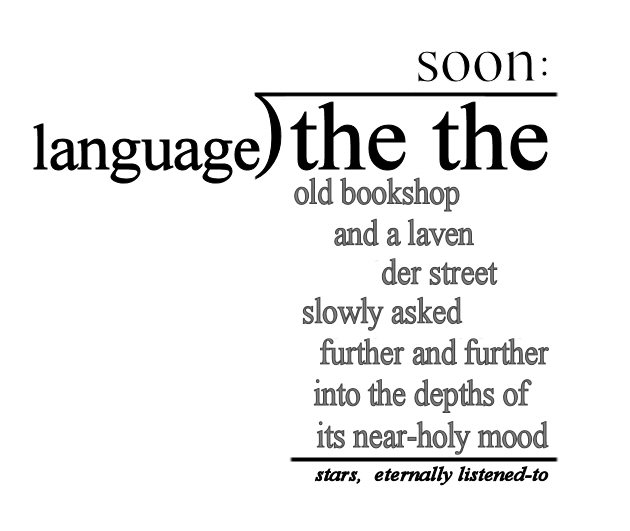 If I ever come to be seen worth wide critical attention as a poet, I should be easy to write about, locked into so few flourishes as I am, such as “the the” and–now in this piece, Basho’s “old pond.” I was wondering whether I should go with “the bookshop’s mood or “a bookshop’s mood” when Basho struck. I love it!
Just one word and a trivial re-arrangement of words, but I consider it major. (At times like this I truly truly don’t care that how much less the world’s opinion of my work is than mine.)
We must add another allusion to my technalysis of this poem, describing it as solidifying the poem’s unifying principal (and archetypality), Basho’s “old pond” being, for one thing, a juxtaphor for eternity. Strengthening its haiku-tone, as well. But mainly (I hope) making the mood presented (and the mood built) a pond. Water, quietude, sounds of nature . . .
Oh, “old” gives the poem another euphony/assonance, too.
It also now has a bit of ornamental pond-color. Although the letters of the sub-dividend product are a much lighter gray on my other computer than they are on this one, the one I use to view my blog.
Entry 44 — A Mathemaku & Some Poetics Notes
Tuesday, December 15th, 2009
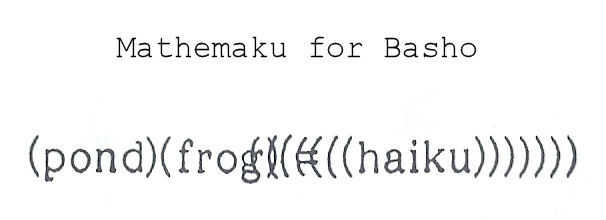
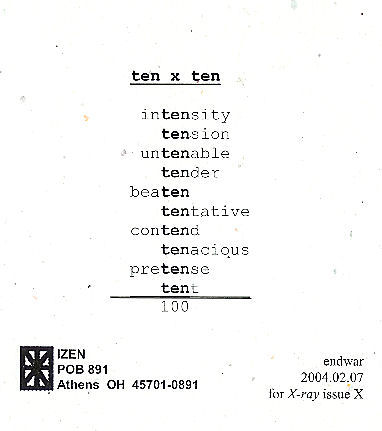
The following, which is from #691, is one of my earlier mathemaku. It’s simple to understand: just think ripples, and remember that in strict mathematical equations, what’s on one side of an equals sign is upposed to stay there, and what it might mean metaphorically if it did not.
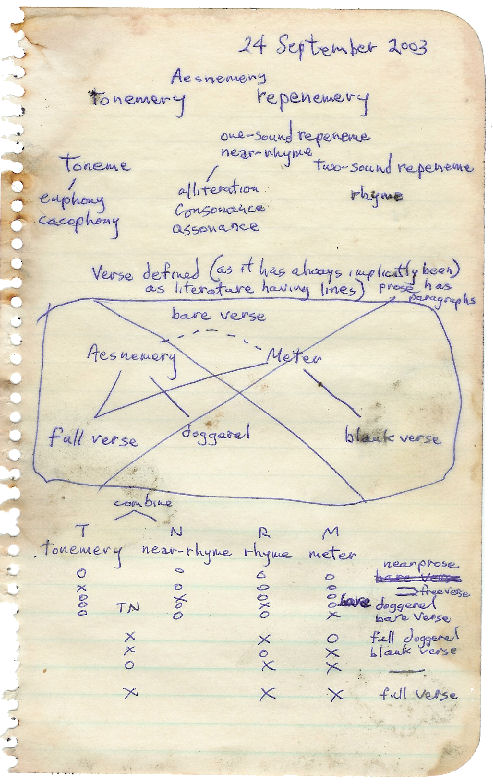
Next we have a page I scribbled some notes on in 2003 that makes good sense to me at this time, although I never took the notes into any kind of essay, that I recall:
And now, after two simple uploads, I’m too worn-out to do anything else, believe it or not.


 Communist Evolution
 NoNo
NoNo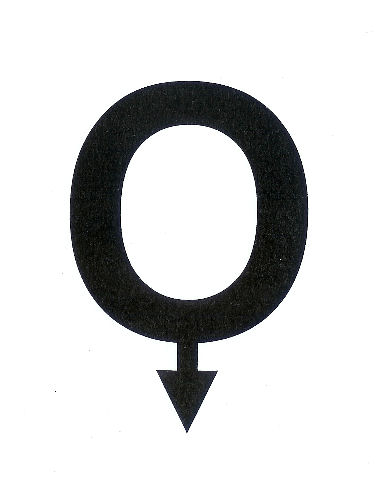 Transgender
 As I announced when I first posted this, I am hoping to publish an anthology of mathematical poems, like this one, so if you have one or know of one, send me a copy of it, or tell me about it.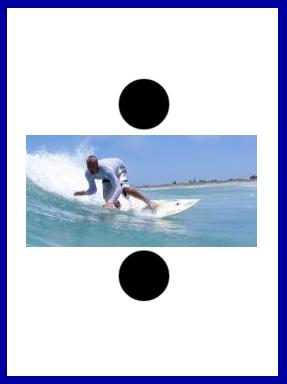

note term in title– intermedia
SHE
walking down Houston
in a wet-dress clinging
to that image with-in
& with-out
in a single word:
pure-poetry-in-motion
not a single need/want to cut-&-paste
I admit I was thinking of your show as a collection of visual poetry, Karl. I fear most people will mistake it as such. But my problem is not with it but with the extremely wide-spread notion, which I fear your introduction to your show does little to address, that an artwork need not have words or even textual elements to be a visual poem.
Ed: a poem can be a metaphor for a woman but it can’t be a woman.
yeah & thank Gawd
(whoever she may be)
for the difference
or
in the immortal words of
(what’s her name) :
“I never saw a poem as lovely as a tree”
the last time I kissed “her” I got a mouth-full of wet oil-based paint
of
a Blood-Red persuasion
so
I called her bluff and named her DIOTIMA
525 pages later she turned from ink into stone …
full moon
I think I’m in love
with a rock
bob,
given the wide spectrum of modern and post modern art, your demands are older than 100 years in the rear view mirror. look at art and music on the experimental frontiers: single colored canvases over 50 years ago, music scores of one note hours long over 50 years ago. films of a building days long . . .
u forget poetic gesture (jest), accent, etc not being words but very poetic. u r being very literal and o so very non visual. can not fractured sounds of speech be made visual with broken letters not words . . .
also y i am now using “sound illumination” to get away from nit pickers.
is not the actual heading of the entire collection “illuminated script”? it is a door wide open to possibilities to illuminate mind(s).
Just saw this post of your today, Karl. Not sure what you’re talking about. You have a bad habit of avoiding specifics.
Of course “fractured sounds of speech” can “be made visual.” So what? If they do nothing semantic, they are not poetry, by everyone’s definition of poetry for thousands of years. Sure, gestures can be “poetic.” So can kangaroos. Which means any word can be used metaphorically. But in verosophy the purpose is to define things objectively, unmetaphorically. Only then can words be used to communicate knowledge.
I continue not to see what “sound illumination” or “illuminated script” mean–without definitions attached.
–Bob