Archive for the ‘Knowlecular Psychology’ Category
Entry 346 — The Definition of Visual Poetry, Yet Again
Thursday, January 13th, 2011
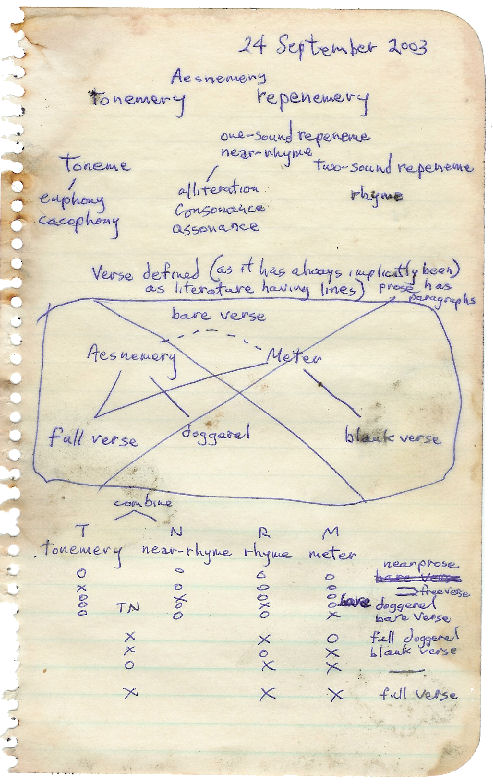
In a comment to the entry Geof Huth made to his blog about my taxonomy, Kaz Maslanka said, “I like what I understand to be Karl Kempton and Karl Young’s definition of: ‘Visual Poetry is a Poetry that has to be seen.’ This is such a simple yet powerful definition that seems to me to be true in every case of vizpo that I have seen.”
My definition is not so simple–because while the double-Karl definition probably does cover every case of visual poetry, it fails to distinguish certain works that I do not consider visual poetry: illustrated poems and captioned or labeled visimages; ordinary poems whose visual appearance has been improved by calligraphy or special graphic touches like ornate capitals at the beginning of stanzas–poetry, in other words that has been graphically decorated enough to make it more pleasing but not enough to significantly increase its aesthetic effect; certain infraverbal texts like Joyce’s “cropse,” which must be seen to be appreciated but are not visual, if by “visual” we mean “of any special interest to the eye.” Of course, the definition works for those for whom just about any combination of textual and graphic material is visual poetry–but then we would still need a special term for artworks in which the interrelation of words and graphics causes has a significant aesthetic effect (or is intended to). For that, the double-Karl definition won’t work, and that more than any of the other combinations of text and graphics is what requires definition. Because, in my view, only that will jolt an engagent in both the reading section and the seeing section of his brain simultaneously, or nearly simultaneously.
This latter, by the way, is only one example of the way that my taxonomy of poetry is, like a proper theory of science, falsifiable. Eventually superior forms of cat-scans will be able to determine where in the brain different forms of poetry are appreciated. I claim each of the main kinds I classify will have a unique brainprint. Moreover, that brainprint will prove close to exactly what one would expect it to be: visual poems, by my definition, will have a visioverbal brainprint (which will be different from textual designs’ visiotextual brainprint); linguexclusive poems will have a purely verbal brainprint–initially, for most of them will give rise to visual imagery; avisual mathematical poems will have a purely verbomathematical brainprint, but visiomathematical poems will have a visioverbomathematical brainprint. The brainprints of more specialized poems–particular kinds of visual poems should–if my taxonomy is valid and my theory of psychology right–each have its own unique visioverbal brainprint.
One brainprint that especially intrigues is the one a cryptographic poem would have. It’d have to be verbal, of course, but also something caused by a conceptual part of the brain I haven’t worked out yet. Okay, crazy maybe, but don’t be too sure about that until it’s tested.
Entry 276 — The Irratioplex
Saturday, November 6th, 2010
Another day in the null zone for me, perhaps because I’m going without the pain pills I’ve been on for my bad hip as an experiment. I played tennis this morning without any more of the slight hip pain I’ve been having with the pain pills. That was nice but since I got home from that and a little marketing (for socks and new sneakers), I I’ve been feeling blah. A nap didn’t help.
Meanwhile, I’m been feeling bitter about my reputation as a defender of Shakespeare. SHAKSPER, an Internet discussion group I’m in, has for several days been discussing the proper reaction to a movie coming out called Anonymous, in which the Earl of Oxford is depicted as Shakespeare–and as Queen Elizabeth’s son–and Southampton is depicted as Oxford and Elizabeth’s son. I think it may destroy Oxfordianism the way the preposterous codes found in Shakespeare’s plays “proving” Bacon wrote them pretty much destroyed Baconism.
What irks me is that several who comment at SHAKSPER mentioned James Shapiro’s recent book on the authorship question, and books and articles on it by others, but not my book. No doubt I’m biased, but I consider my book the best refutation of anti-Stratfordianism in print, and the only one that presents a serious theory of what makes people become anti-Stratfordianism–whether valid or not. Yet the Shakespeare establishment, and their little followers at the two authorship sites I participate in don’t mention me, or respond to my posts to SHAKSPER. Maybe they don’t want it known that our side has a crank like me on it. A crank, morover, who calls anti-Stratfordians “psitchotics.”
Nonetheless, my attempt to understand what causes reasonably intelligent people to become psitchotics where Shakespeare is concerned, and–more important–find a way to express my finding entertainingly and coherently, continues, with a minor development today, the new term “irratioplex.” This I pronounce ehr RAH shuh plehks. Do I misspell it? Possibly, but “irratiplex” doesn’t do it for me.
And irratioplex is an irrational knowleplex. There are several. Two of them are the rigidniplex and the enthusiaplex. I now maintain that all anti-Stratfordians are afflicted with one or the other of these two irratioplexes. The new term allows me to couple them as victims of irratioplexes, then show how they differ from one another by virtue of their (slightly) different irratioplexes. The rigidniks’ irratioplex is forced on them by their innate psychology; the enthusiasts’ (who are frrewenders) acquire their irratioplexes during fits of enthiuiasm, making them quickly too strong thereafter to resist. Both irratioplexes act the same once active. both nearly impossible for their victims’ to resist.
My new strategy for the description of wacks is to concentrate on irratioplexes in general, proceed to rigidniplexes and enthusiaplexes in general, then to how the latter two specifically enslave their victims to anti-Stratfordianism.
Entry 269 — Problem-Solving
Saturday, October 30th, 2010
When faced with a mess as bad as my attempt to work of how we process language is in, as shown by yesterday’s entry, and with no idea what to do about it, a sound reaction is to drop it and go on to something else, with or without exclamations of despair. Or one can try anyway to do something about it. What I think is a clever response is to think of it as A General Problem, and try to work up procedures that may be of value in solving it. That way, you can imagine that you are working out a Method of Attack which may help others, or yourself in the future–even if it fails, since then it will indicate actions not to repeat. At the same time you can deal with a possibly intractable problem from a distance that takes some of the pressure off you.
So, my first thought is to focus on one element of the problem, with my main intent being to clarify what it is and what I need to understand in order to make sense of it rather than go all out fully to explain it. First question: where to begin. To decide that, I think I need to list all the elements involved. That, in fact, was mainly what I was trying to do yesterday. (Phooey. That means I have to read what I wrote yesterday!)
Okay, thew elements seem to be the word-flows: heard, read, said (formerly “spoken,” but “said” rhymes with “read,” so I like it better) and . . . mathematical (because I can’t think of a nice short, or even long, verb to use–assuming “heard,” “read” and “said” are verbs, something unimportant but would like to know). “Mathed.” No, not really, but it’s a temptation.
My problem now is that I have this intuition that I ought to be dealing with more than the four word-flows so far named. One might be the grammatical word-flow. I want to add a rhythmical word-flow, but tend to consider rhythm too insignificant compared to the others to merit a word-flow. I don’t like “rhythmical” as an adjective here, either. Maybe I’ll try “word-beat-flow”. . .
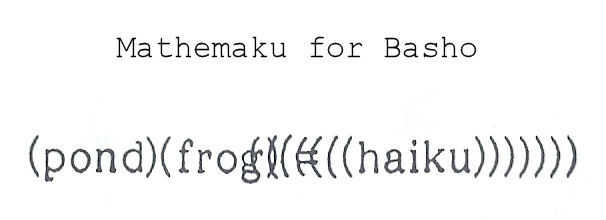
I’m going to think about it. I may try to finish a portion of a mathemaku I’m working on, too. I was going to use it today but found it as difficult to get in shape as the linguistics. I know I can get it in shape, though–it’ll just take a lot of drudgery.
Entry 268 — More Thoughts on Linguistics, Sputterfully
Friday, October 29th, 2010
Gosh, kids, I’m finding out that language-Processing is pretty durned complicated. One thing that makes it so is its having to do with responding in kind to its input, something that doesn’t happen elsewhere in the brain, that I can think of right now, so now strikes me as particularly interesting. I had to take a break from thinking about it to clear my synapses. I think they’re clear now, but I still feel over-matched by my opponent. I’m not conceding the game, though.
First, another coinage: Ultilinguiceptuality. That’s where all the “word-flows” occurring in the Ultilinguiceptual Awareness, or final language-processing area in the brain, end up. I propose, very tentatively, that four word-flows can arise in the cerebrum, the heard word-flow, the read word-flow, the spoken word-flow and the mathematical word-flow.
Some of what I’m now saying may contradict previous statements of mine. But this is definitely a sketch-in-progress.
The heard word-flow starts in the auditory pre-awareness in which a syllable-identifier sensitive to sounds representing language. When the syllable-identifiers identifies an incoming datum as a syllable (which includes what I call “nulletters”–but may call “nullybles”–for pauses between syllables that are those part of the word-flow), it forms a verbiceptual percept of the datum. This percept it relays to a second linguistic-identificatioon mechanism which determines whether the percept is rhythmiceptual and metriceptual, If either, a rhythmiceptual or metriceptual percept will be fashioned, or both, and sent with the verbiceptual perceptto the verbiceptual subawareness in the linguiceptual subawareness of the Reducticeptual Awareness. The activation of the m-cells in the verbiceptual sub-awareness will be experienced as the heard word-flow.
The pre-visual awareness cointains a texteme-identifier that separates signals from stimuli that are letters and other textual data from visual data and constructs lexiceptual percepts from them which are sent to the pre-lexiceptual subawareness where a grammar identifier mechanism will tag strings of letters nouns, verbs, prepostitions and other parts of speech. At the same time the mechanism will determine the inflection to be given verbs and give them tags indicating what tense they are. The tags will actually be accompanying percepts. The linguiceptual percepts and their “tags” will end in the lexiceptual sub-awareness of the linguiceptual subawareness of the Reducticeptual Awareness, froming the the read word-flow.
When a person speaks, sensors in the neck pass on data to the dicticeptual sub-awareness where they activate m-cells having to do with the sounds the vocal cords have just made. The subject will experience the spoken word-flow. All word-flows active at a given time will join in the ultilinguistic subawareness to form the total word-flow. Here they will interact with input from most of the awarenesses in the Protoceptual Awareness to permit words to connect with what they symbolically represent.
Warning, what I’ve just written is a blur. Consider it an extreme first draft intended to show the complexities involved with trying to figure out how the brain processes language. It makes no sense. But it is now in a form I hope I can think about effectively enough to make a better clutter–to think about until I make a still better one, and so on, until I have something that makes sense. To me, if to no one else. I’ve succeeded in doing that before, so maybe I can again, although this may be the most complicated problem I’ve yet dealt with.
Later note: I forgot about the mathematical word-flow. I posit an identifier that sorts mathematical textemes from non-mathematical textemes, and sends them to a purely mathematical awareness outside the linguiceptual awareness, but sends all the mathematical textemes along with non-mathematical textemes to the linguiceptual wareness hwere they participate as words–that is, amathematically.
Also note that I am confusing stimuli with results of stimuli, and probably with transmitted energy, and neuro-transmitters. My next task, it would seem, will be getting that straightened out–because it’s a straight-forward job which should not be difficult, although it may take a while.
Entry 267 — A Project Expansion
Thursday, October 28th, 2010
A problem of people like me is the tendency of our projects to expand. A form of impracticality. It’s struck me again. I want simply to self-publish my taxonomy of poetry, mainly so my Runaway Spoon Press will get a title into print for the twenty-third year in a row, but also because it’s worth getting into print. Immediately, it became a taxonomy of more then just poetry, although I’m not sure just what more. Except that it would include things like “utilitry,” or man-made items to make life easier rather than better. And the taxonomy didn’t start with poetry or literature but at the very beginning with reality, then matter and mind.
It is now expanding through a definition of poetry that I’ve decided requires me to explain how our nervous systems process poetry . . . which requires me to describe how they process words. That now has been trying to figure out and coherently describe my theory of an innate grammar. Which, I’ve just discovered, means I must tackle the process of generalization. I’m excited by that, because I think it has led to a concept of a process that makes generalizations automatic that I hadn’t previously come close to thinking might be in the mix. If I can make my idea of it work, it would elegantly explain quite a few things that our brains do.
But it makes me fear I’ll never get my taxonomy done.
I’ll keep you informed.
Entry 266 — The Pre-Awareness Revisited
Wednesday, October 27th, 2010
Long after the first organisms with protoceptuality came into being, and some of them had developed other awarenesses, the most advanced of them found it biologically useful to split their protoceptual aware-nesses in two. One of these remained the protoceptual awareness, the other became the pre-awareness.
The Pre-Awareness gradually become quite complex in the higher species, becoming for us a sort of confederacy of primary pre-awarenesses, one for each of the senses. Each primary pre-awareness has become in turn a confederacy of specialized secondary pre-awarenesses such as the visiolinguistic pre-awareness in the visual pre-awareness and the audiolinguistic pre-awareness in the auditory pre-awareness. Each incoming perceptual cluster (or “pre-knowlecule,” or “knowlecule-in-progress,” by which I mean cluster of percepts, or “atoms of perception,” which have the potential to form full-scale pieces of knowledge such as the visual appearance of a robin, that I call “knowlecules”) enters one of the primary pre-awarenesses, from which it is sent to all the many secondary pre-awarenesses within that primary pre-awareness.
The secondary pre-awarenesses, in turn, screen the pre-knowlecules entering them, accepting for further processing those they are designed to, rejecting all others. The visiolinguistic pre-awareness thus accepts percepts that pass its tests for textuality, and reject all others; the audiolinguistic pre-awareness tests for speech; and so on. All this, remember, is as my theory describes it. However, much of conventional neurophysiuology, especially concerning mechanisms in the eyes and areas between the eyes and the visual center in the brain (which is in the occipital lobe, if I remember rightly) has established the existence of such processes, although few, probably, act too much like my hypothetical ones. Some do act like mine, processes in the eyes or just behind them, for instance, that recognize circles and lines. It is a fault of mine that I can’t match my hypothetical processes to the known ones due to lack of familiarity with conventional terminology. Another fault of mine is that I can’t draw on the evidence conventional science has turned up to support what I say about my theory’s processes. I feel my time is much more valuably spent on thinking my way to undiscovered processes, incompletely understood known processes, and how they might be organized than on work anyone in the field could do, though.
Ideally, I could call on grad students to take care of these side-jobs, or even, if grants ever went to people actually significantly furthering knowledge, take care of them myself (which I think would be fun doing) because freed from all the things that are screwing up my life because of impoverishment, including I firmly believe my bouts of blah.
Okay, that’s it for my whining–for today, at any rate.
Back to the Pre-Awareness, which I need to give its full name, to wit: “protoceptual pre-awareness. Aside from being a relay station for reports from all the senses, glands and muscles, the protoceptual pre-awareness has an area, the visual pre-awarreness, that I hypothesize as having broken off from the visual awareness fairly early on to become a visual detail-awareness center. It contained processes that identified significant visual details such as the human figure, the human face, landscape features, motion, geometrical shape, and so forth. Eventually when human beings began marking things, and the marks became ideograms and then letters, a texteme-identifier became one of the processes that evolved in the visual pre-awareness. Textemes are the smallest units of textual meaning in my linguistics. Basically letters, numerals and punctuation marks. The basis of language, and hence of poetry.
Similarly, an auditory pre-awareness evolved with a syllable-identifier sensitive to sounds representing language. This word-identifier and the texteme-identifier transmitted energy to the Linguiceptual Awareness in the reducticeptual awareness. This area is divided into lesser sub-awarenesses, five of which are the Lexiceptual, the Verbiceptual, Dicticeptual, Vocaceptual, Rhythmiceptual and Metriceptual. The first is an charge of the written word, the second of the spoken word, the third of vocalization, the fourth of the rhythm of speech and the fifth of the meter of speech. All five of the linguiceptual sub-awarenesses transmit to a further sub-awareness, the Linguassociative Awareness, which receives input from most of the awarenesses in the Protoceptual Awareness to permit words to connect with what they symbolically represent.
There are also grammatical awarenesses in the linguiceptual awareness. These are too complicated for me to deal with right now.
Entry 264 — On the Ten Awarenesses, Again
Monday, October 25th, 2010
I’ve been reworking my thoughts on the ten awarenesses (or abilities or intelligences, whatever you want to call them) that I so far posit, as part of the essay I’m writing on the taxonomy of poetry I’ve devel- oped. Some of them will play role in my taxonomy. Kinds of poetry, for instance, will be partially defined by what areas of the brain–what awarenesses, that is–they primarily activate. I haven’t added much to what I previously posted here at my blog, but I added a few guesses about the evolution of the awarenesses that I consider rather interesting.
The Ten Awarenesses
I’ll begin with the protoceptual awareness because it was almost certainly the first, or “proto” awareness to evolve. Hence, it was the ancestor of the other nine awarenesses, and the one all forms of life have in some form. As, I believe, most real theoretical psychologists would agree. Some but far from all would also agree with my belief in multiple awarenesses, although probably not with my specific choice of them. It has much in common with and was no doubt influenced by Howard Gardner’s theory of multiple intelligences. It is much more advanced and much less superficial than his, however.
The protoceptual awareness deals with reality in the raw: directly with what’s out there, in other words–visual, auditory, tactile, olfactory, gustatory stimuli. It also deals directly with what’s inside its possessor, muscular and hormonal states. Hence, I divide it into three sub-awarenesses, the Sensoriceptual, Viscraceptual and Musclaceptual Awarenesses. The other nine awarenesses are (2) the Behavraceptual Awareness, (3) the Evaluceptual Awareness, (4) the Cartoceptual Awareness, (5) the Anthroceptual Awareness, (6) the Sagaceptual Awareness, (7) the Objecticeptual Awareness, (8) the Reducticeptual Awareness, (9) the Scienceptual Awareness, and (10) the Compreceptual Awareness.
24 May 2011 note: I may return to “fundaceptual” from “protoceptual.” I dropped “fundaceptual” to free “funda” up for use in another coinage of mine, but can’t remember now what coinage it was. I’m also considering “execuceptual” in place of “behavraceptual.”
The Behavraceptual Awareness is concerned with causing behavior, and telling you of it. It is the only awareness that does anything but store memories, and cause remembering.
At this point, I need to make a metaphysical digression. I could skip it, because it is irrelevant, but I want to be thorough. When I speak of “you,” I actually mean what I call your “urwareness,” or fundamental conxciousness of the universe, which is somehow connected to “your” body.” It does nothing but observe what your brain tells is in “your” environment and what actions “your” brain has taken. Your urwareness, no doubt, will think it was the one causing said actions, it will have had nothing to do with them, however; it will merely have observed what the brain it is attached to chose to do and did.
I believe all this because I can conceive of no way mind could have any influence on matter, since it is itself immaterial, or by definition without material effect. The question as to how it connects in any manner to anything material is leave as an Eternal Unanswerable–a simpler unanswerable since it’s only about how an awareness can be aware of matter, not about that and how it can tell matter what to do, which matter can easily do by following the law of cause and effect without any input.
But “I” am sure “you,” like my urwareness, will feel more comfortable believing that “you” initiate “your” behavior. No problem: I can, and will hereafter, drop the italics (which I’ve been dispensing with till now, anyway), and advance from the position that behavraceptual awareness is concerned with carrying out your orders and describing to you what you have made it do in each instance.
The Evaluceptual Awareness has, like the protoceptual awareness, been around forever, I believe, although–unlike the protoceptual awareness–it need not have been. It measures the ratio of pain to pleasure one experiences during an “instacon” (or instant of consciousness) and causes one to feel one or the other, or neither, depending on the value of that ratio. In other words, it is in charge of our emotional state.
The Cartoceptual Awareness tells one where one is in space and time. I imagine this was another early awareness, but not as early as the three preceding ones.
The Sagaceptual Awareness is one’s awareness of oneself as the protagonist of some narrative in which one has a goal one tries to achieve. It evolved to help motivate an organism to become aware of consequential goals such as escaping a predator or defeating and devouring prey and persist in the achievement of it, something which, again, would probably have developed early in our rise to humanhood.
The Objecticeptual Awareness is sensitive to inanimate objects. My guess is that it began a few eons after the protoceptual awareness did, in order to separate neutral entities in the environment for entities which might be predator or prey.
Sensitivity to the latter entities, as distinct from objects was the basis of what become the Anthroceptual Awareness, which has to do with our experience of ourselves as individuals and as social beings (so is divided into two sub-awareness, the egoceptual awareness and the socioceptual awareness). The “society” it is sensitive to includes many other life-forms, some of which no doubt cohabit the society of living beings, and the company of objects that the objecticaptual awareness is concerned with.
The Reducticeptual Awareness is basically our conceptual intelligence. It reduces protoceptual data to abstract symbols like words and numbers and deals with them (and has many sub-awarenesses). It would seem to have come late, biologically. On the other hand, there were probably primitive forms of it early on, such as a sense of the difference between one and many.
The Scienceptual Awareness deals with cause and effect, and may be the latest of our awarenesses to have evolved.
Finally, there is the Compreceptual Awareness,which is our awareness of our entire personal reality. I’m still vague about it, but tend to believe it did not precede the protoceptual awareness but later formed when some ancient life-form’s number of separate awarenesses required some general intelligence to co:ordinate their doings.
Entry 252 — 12 October 2010 Report
Tuesday, October 12th, 2010
I did more work on my essay concerning aesthetics. I’m burned out on it now, but it’s still not right. I have to leave it for a while. I’m burned out on about everything, it would appear. Can’t think of anything concerning poetry I feel like writing about. My heath seems okay, and I’m not sleepy. The pain pills I’ve been taking have helped with that, and with my hip, which held up moderately well earlier when I played tennis. I think I’ll need hip replacement surgery, anyway. I want to get a shot for my hip before I do, though. I’m hopeful that will be enough to get me back to feeling the way I think I should.
Possible rough draft currently taking shape:
.
. Poem, Nearing the Center
.
. Swans wrinkled
. against Poem’s current memory of
. Excalibur
. multiplied by lake-grey branches
. simpling deeper than winter.
. A bridge hand glows
. through a made finesse
. toward game bid and made
. in the wake of
. Brillo pads renewing the white shine
. of a toilet bowl.
. Holy smoke
. so slowly centering
. the universe
. as the next hand is dealt.
. Model T’s coming off the
. assembly line
. proving mankind
. ocean-eminent
.
.
.
Entry 251 — “Homage to Shakespeare”
Monday, October 11th, 2010
I keep directing my Shakespeare authorship friends and enemies to this poem, but none has commented on it, that I recall. I tend to think Shakespeare fans rarely are much interested in newer forms of poetry. I made it around twenty years ago. It was the first of my visual poems to get accepted for Kaldron, the leading American visual poetry magazine of the time (but international in scope). Unfortu- nately, I can’t show it large enough for the small print to be visible her.
Here’s an annotated detail of it showing what the small print says.
Entry 250 — Going in Reverse
Monday, October 11th, 2010
I now know more about pleasure and pain than I understand. My problem, I think, is that what I know seems right, but I can’t organize it into any kind of neat, accessible package. The thing bothering me is what beauty is. I once pegged it as simply the right ratio of pleasure to pain a stimulus produces. Then I remembered something obvious to almost everyone but me: that there are stimuli that are automatically perceived by healthy minds as beautiful. Nothing wrong with two kinds of beauty, but the two seemed to me too different from one another to share a name. Next thing you know, I’d have to accept an elegant mathematical proof as beautiful. Okay in bull sessions, but not if one is concerned with useful serious communication since a term loses its linguistic value to the degree that it can be applied to significantly different things.
So, how about calling the stimulus with the proper familiarity to unfamiliarity ratio . . . ? I can’t think of anything. There’s the beauty our instincts are sensitive to, and the truth our instincts about what contradicts, what harmonizes, are sensitive to. Empathy would be what our instincts derive pleasure from when interacting with others–that which is anthroceptually pleasurable, in terms of knowlecular psychology. There’s good, too, or the pleasure–instinctive in many cases–we feel when we, or others, act in a manner we consider moral.
Okay, folks, I have to turn to neologization, again. “Assimlatry.” That is now my term for any stimulus causes that has the right r/f ratio (or “resolution/frustration” ratio, resolution being what happens when a psychevent leads to the familiar, frustration being what happens when it leads to unfamiliarity). “Assimlatrous” is the adjectival form. Yes, grotesque terms, but naming is the first step toward understanding, and essential.
There’s also the need for the instinctive pleasure one feels when achieving a goal. “Triumph” may be sufficient. No, I think “success” better. And “resolution” for “assimilatry.” No, no” “comprehension” is the perfect name for it! So, I have the following pairing on my list of kinds of pleasure and pain (with which of my theory’s awareness’s is involved in each case):
instinct-based evaluception
beauty/ ugliness: fundaceptual evaluception
empathy/ hostility: personal anthroceptual evaluception
good/ bad: moral anthroceptual evaluception
success/ failure: sagaceptual evaluception
logic-based evaluception
truth/ error: reducticeptual evaluception
experience-based evaluception
comprehension/ perplexity: combiceptual evaluception
I think I may be getting somewhere, after all. And, wow, a list of terms none of which is a coinage! (I mean aside from the names of my awarenesses.)


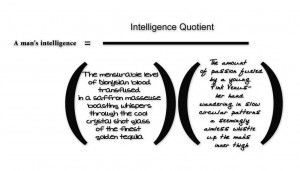
Oops, you may need a magnifying glass. My choice of reproduction seems to be the size above, or four times as large. Anyway, it’s called “A Man’s Intelligence” and may be more informrature–a specimen of informratry–than poetry. Let me quote what it says: “A man’s Intelligence” equals “intelligence Quotient” divided by the product of “The measurable level of Dionysian blood transfused in a saffron masseuse boasting whispers through the cool crystal shot glass of the finest golden tequila” times “The amount of passion fueled by a young pink Venus–her hand wandering in slow circular patterns, a seemingly aimless whistle up the man’s inner thigh.”
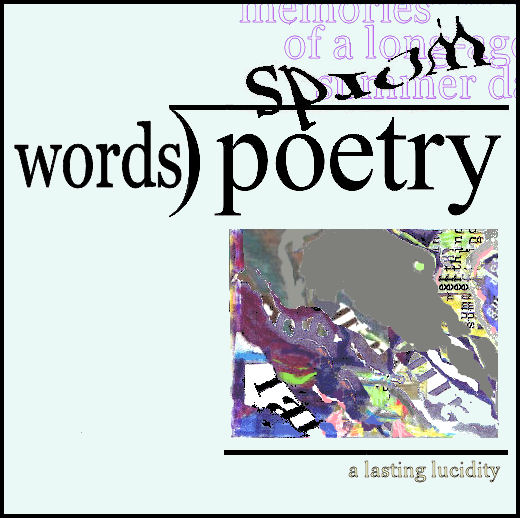
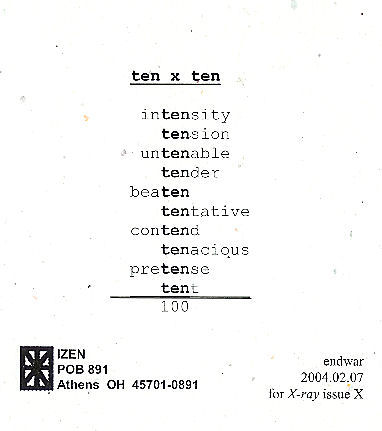
As I announced when I first posted this, I am hoping to publish an antho- logy of mathematical poems, like this one, so if you have one or know of one, send me a copy of it, or tell me about it.


the word ‘poetry’ within the two word term ‘visual poetry’ frames the discussion. we are not saying visual calligraphy nor graphics poetry, nor comix poetry etc.
as long as you focus on your self centered lexicon rather than seek an universal point of viewing, all this is perhaps a talking passed each other.
to continue: because of the steady decline since its peak in the early 1990′s, and because the term visual poetry was coined circa 1965 to break away from the limits of what became concrete poetry, i now prefer the use of sound illumination or illuminated language/s to cover all the visual (must see to fully grasp) use of language that can be composed. the best visual poetry is but a small subset as a result of what took place in the 1990’s. the following is a very abridged outline as to my shift.
just as concrete became cliché, what has become american vizpo/vispo (a term i used since the late 1970′s onward in my correspondence as an abbreviation for visual poetry), much american vispo, since the mid 1990’s attempted take over by a certain click of the language poets, has become neo/retro concrete. many american visual poets aloud themselves to be hypnotized (or consciously gave themselves over) by a perceived center of power of the moment to serve in order to gain recognition and or power, rather than serve the eternal muse of poetry.
vispo is now a cliché. it is no wonder the title of a forthcoming anthology is called the last vispo anthology. the editors themselves not only unconsciously have announced its death but also date its birth as 1950’s concrete movement (: “The Last Vispo Anthology extends the dialectic between art and literature that began with the concrete poetry movement fifty years ago.”) they themselves and those within this particular group consciousness admit they work in a temporal moment without homage to the eternal muse.
visual poetry roots are many thousands of years deep. illuminated language and its ancestral pictorial pictographic petroglyphic images even deeper. those not knowing history are condemned to repeat it. that is obviously true for those cutting history of this form off at 1950.
Interesting entirely unself-centered take on the history of visual poetry, Karl. But, as I point out, your definition of visual poetry is too general. If you disagree with that, you need to present an argument against it. You need to show, for instance, either that poems like “cropse” are visual poems, or why such poems need not be considered visual poems by your definition.
I would add that naming things for political reasons the way you say visual poetry was, retards the search for truth. But “visual poetry” is a good term. It is a good term because it specifies a kind of poetry that is specifically verbal and visual, and not, like concrete poetry, concrete in some other way, such as tactilely. That is why it is in my taxonomy. I would add that almost all concrete poetry is also visual poetry.
‘Visual Poetry is a Poetry that has to be seen.’ can be taken as a definition maybe. But lots of problems here, first of all, written poetry can be seen also. There is a form there and it is not always the same, especially after the free verse. Second, we have to ask maybe where a poem happens? This answer has to be relative. If it is in the paper, well, but what if it is in readers mind, relation to these signs (word, punctuation, structure etc)? If we can define where a poem happens, then we can talk about the eye and visual? But usually a poem happens between reader and the paper, reader “completes” the work as Duchamp mentioned.
Your problem with the definition can be taken care of easily by amending it to “Visual Poetry is a Poetry that has to be seen for full appreciation of its main aesthetic cargo.” The way a conventional poem looks on the page is not part of its main aesthetic cargo. Nor would the calligraphication of its letters be. The problems with it that I point out remain: it would cover too much that is not visual poetry, such as the pwoermd, “cropse,” and illustrated poems (which many artists who make them consider visual poems. A definition should always be as simple as possible, but simplicity rarely works.
As for where a poem happens, it seems clear to me that it happens in the mind. But rationally to define poetry, one needs to consider only what a poem is materially, which is generally word-shaped ink on a page, but which can include visual and other kinds of elements. And, of course, can be in the air as word-shaped sounds.
@Grumman; “The way a conventional poem looks on the page is not part of its main aesthetic cargo” How about thinking Mayakovski and other Russian Formalists and Futurists poems? I know these are not “conventional” but in a certain way they are modern now. How about haiku? and how about arabic or persian poetry for ages that has lot to do with the typography or calligraphy, ideograms etc where language or the sign is not just a carrier for meaning, it has the meaning only by itself. In western thinking these are not may be considered or not taken as main-frame but visual poetry has lots of roots with the “graphic-writing” history of the writing. If you are a verbal poet or as Ong say “verbomotor poet” these has minor importance but other way, every structural element has critical importance i guess. And how can we be sure that cargo, can be carried easily by any means and chance of the Language? Is poetry that good at that kind of information (communication)?
I think it’s a matter of a case by case decision whether a given poem’s aesthetic cargo is visual enough to make the poem a visual poem. I simply subjectively do not feel calligraphy (in most cases) does so. It’s decorative only. Spacing in poems isn’t enough, either, in my subjective view. I don’t see how haiku are visual. Chinese ideagrams may seem very visual to westerners but are essentially composed of symbols that are read, not seen.
As for language’s ability to carry an aesthetic cargo, I assume without the help of its visual arrangement and decoration, I simply subjectively believe that words can carry huge amounts of meaning and that in a good poem that meaning makes things like calligraphy minor.
One has to make subjective decisions like that or give up defining things. It seems to me that you are basically calling for a definition of visual poetry too broad to be useful. What isn’t visual poetry if haiku are or, apparently, any hand-written poem is?
i would have to say, the use of the phrase ‘eternal muse of poetry’ seems ridiculous here. taking wide sloppy swings at people you do nothing but miss and waste our time.
karl kempton sevişelim mi?
Concrete poem represents deep feeling