Entry 71 — A Broadside from the Past
Friday, December 19th, 2014
Here’s the latest image I got from Guy R. Beining:
It is part of a letter it grieves me to report on. He asks if I think I could sell works like it on my website, suggesting a price of $200 for this. I’d get a 33% commission on all sales. Gah. If I had any semblance of economic security, I’d buy this and four others sight unseen for $200 each. I grieve because I know I can’t sell anything here, at any price. I once offered 25 RASPbooks for $50 and Karl Kempton was the only one to buy a set (and he ain’t rich). No complaints, because I hardly ever buy anything of anyone else’s. Not only don’t I have the money to, but my concept-appreciation to ornament-appreciation (like the feel of hardened acylic, etc., even the size of an image) is much higher than most lovers of visimagery’s (i.e., “visual art”), so Internet access rather than physical ownership is enough for me in almost all cases.
Of course, I also grieve because Guy’s stuff should be in bigTime museums with articles in ARTnews about it. If he can’t get the recognition he deserves, who can? Or am I so out of it that I don’t see how much better New York stuff is than the above?
I wish I had time to really deal with the above critically, but the year is about to end, and I have so much to do! For instance, I still haven’t finished either of my next two columns for Small Press Review, and I’ve had full-length fairly decent rough drafts of both of them ready for a final attack for over a week. Wotta life.
.
Sunday, March 10th, 2013
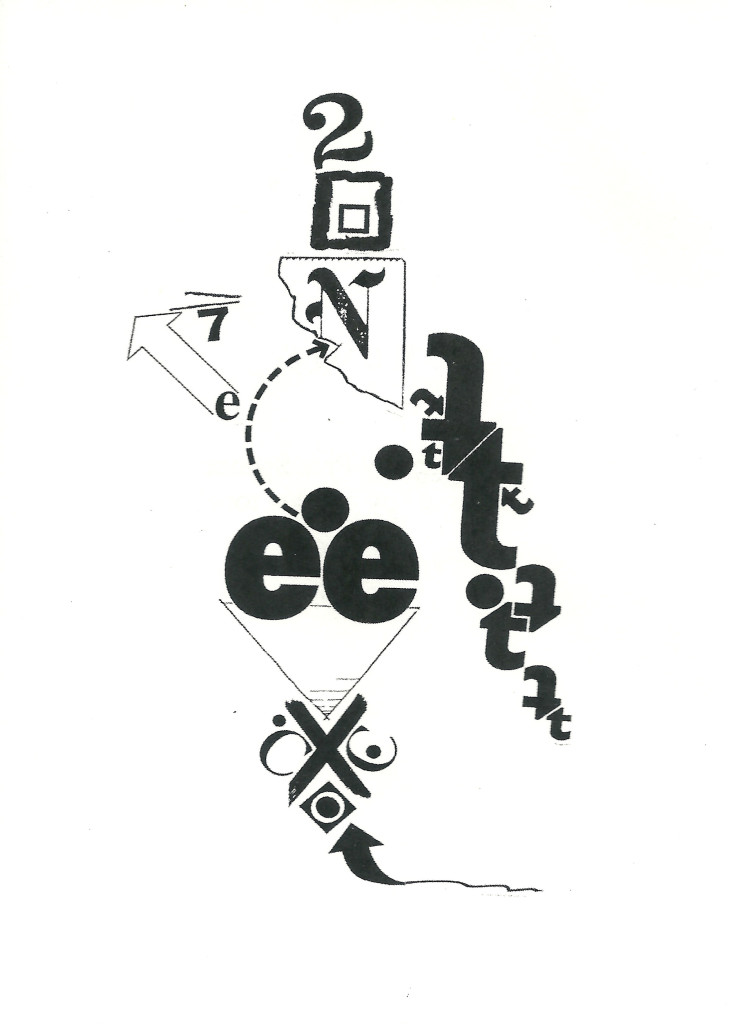
Back to this collage by Pete Spence and remixer Andrew Topel–mainly to get another entry out of the way without much work, but also to provide . . . an insight:
I’m a bit more out of it even than usual because of stupid daylight savings, but also because yesterday I had to put in a lot of worrisome work on the latest installment of my Scientific American guest blog that kept me up past my bedtime. The entry is here.
One interesting thing about it that I think will amuse those who have been following my career here and at New-Poetry the entry’s mention of a poem by none other than Rita Dove (inclusion of the full text of her poem would probably have cost too much)–and I praise it inordinately! I really didn’t want to do a favor for such an exemplar of all I’m against in the poetry scene, but I loved the poem! What can I say?
A thought out of nowhere: it occurred to me while thinking about creative person’s apparent susceptibility to bipolarism in some form or another that I was a “lifetime-phase” manic-depressive in that I was in my manic phase–relatively high-energy and confident–self-despising in a manic way, by which I mean I was angry with myself not sad about myself, and that I went into my depressed phase around sixty, aided no doubt by being hit with prostate cancer at 57, and have since been always tired, except when I’ve taken my zoom-dose (hydrocodone plus caffeine). My thyroid conked out along the way. My theory: that I used up my endocrine system due to my mania, leaving me unable to generate any kind of energy without the help of drugs. I’m exaggerating, I’m certain, but I think there may be more than a little truth in what I’m saying.
Okay, now for the insight I’m sure you’ve been impatiently awaiting. I take the Spence/Topel work to be a wonderful evocation of mathematical voyaging which begins, for me with the t’s, the famed symbol of “time,” and here forming plus-signs–and arrows helping the two actual arrows in the piece (and the triangle) represent the directive character of mathematics this piece involves, but leading away from the voyage as time approaches zero. The voyage, it is quickly apparent, begins at the bottom with the hand-drawn X the voyage seems being taken to determine the “N” of. which, we see, is rather regally exotic. Decimal points, e’s for energy, and 2 c’s for constants along the way, but with the triangle in opposition, and another arrow to remind us (energetically) of the incompleteness of the solution we’re headed toward, as does the separating equals-sign near the arrow’s head. An exciting map–of a fully dimensional adventure, for me, because of the 2 and the 7, which combine to equal 3 cubed.
The interpretation I just unspooled is unquestionably subjective. I offer it merely to indicate where one person let the work take him–based with a fair amount of reason on what’s there in the work. I hope it also suggests that the work, for being able to suggest so much–the voyage a mathematical attempt to solve something can be–the work is a superior one. It should inspire other interpretations, some entirely different, but none inconsistent in some general way with mine.
.
Saturday, March 9th, 2013
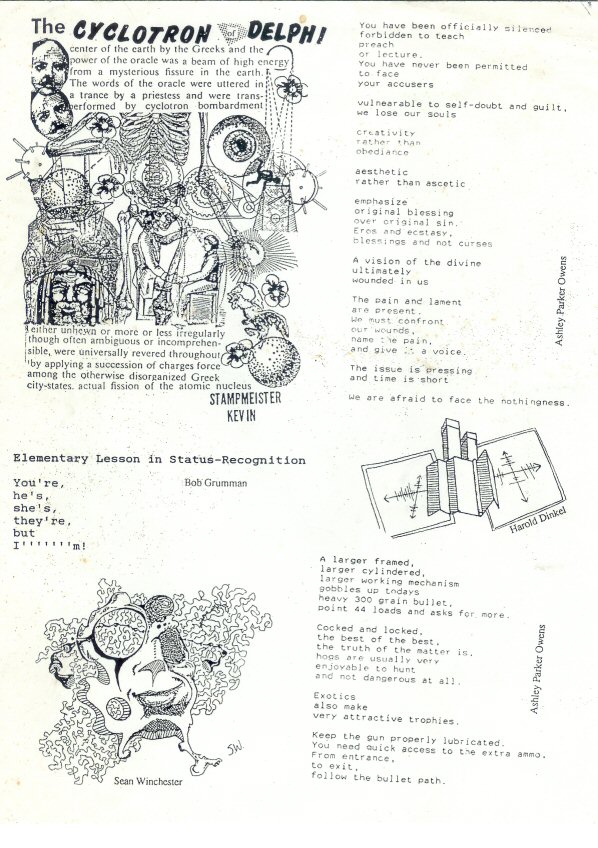
These are the first two pieces in Remix, a little booklet published by avantacular press that Andrew Topel just sent me:
They are collages by Pete Spence that have been remixed by Andrew.
.
Thursday, December 26th, 2013
Here are the title page of Carol Stetser’s Time & Again and its final two pages:
Quite a richly concentrated historian of the West, I’d say.
.
Wednesday, December 25th, 2013
The third pair of pages from Carol Stetser’s Time Again:
Pssst: Merry Christmas, everyone!
.
Sunday, December 15th, 2013
The first two pages in Carol Stetser’s Time Again:
Each wonderful as a stand-alone, but look how beautifully they work together!
.
Sunday, March 10th, 2013
Back to this collage by Pete Spence and remixer Andrew Topel–mainly to get another entry out of the way without much work, but also to provide . . . an insight:
I’m a bit more out of it even than usual because of stupid daylight savings, but also because yesterday I had to put in a lot of worrisome work on the latest installment of my Scientific American guest blog that kept me up past my bedtime. The entry is here.
One interesting thing about it that I think will amuse those who have been following my career here and at New-Poetry the entry’s mention of a poem by none other than Rita Dove (inclusion of the full text of her poem would probably have cost too much)–and I praise it inordinately! I really didn’t want to do a favor for such an exemplar of all I’m against in the poetry scene, but I loved the poem! What can I say?
A thought out of nowhere: it occurred to me while thinking about creative person’s apparent susceptibility to bipolarism in some form or another that I was a “lifetime-phase” manic-depressive in that I was in my manic phase–relatively high-energy and confident–self-despising in a manic way, by which I mean I was angry with myself not sad about myself, and that I went into my depressed phase around sixty, aided no doubt by being hit with prostate cancer at 57, and have since been always tired, except when I’ve taken my zoom-dose (hydrocodone plus caffeine). My thyroid conked out along the way. My theory: that I used up my endocrine system due to my mania, leaving me unable to generate any kind of energy without the help of drugs. I’m exaggerating, I’m certain, but I think there may be more than a little truth in what I’m saying.
Okay, now for the insight I’m sure you’ve been impatiently awaiting. I take the Spence/Topel work to be a wonderful evocation of mathematical voyaging which begins, for me with the t’s, the famed symbol of “time,” and here forming plus-signs–and arrows helping the two actual arrows in the piece (and the triangle) represent the directive character of mathematics this piece involves, but leading away from the voyage as time approaches zero. The voyage, it is quickly apparent, begins at the bottom with the hand-drawn X the voyage seems being taken to determine the “N” of. which, we see, is rather regally exotic. Decimal points, e’s for energy, and 2 c’s for constants along the way, but with the triangle in opposition, and another arrow to remind us (energetically) of the incompleteness of the solution we’re headed toward, as does the separating equals-sign near the arrow’s head. An exciting map–of a fully dimensional adventure, for me, because of the 2 and the 7, which combine to equal 3 cubed.
The interpretation I just unspooled is unquestionably subjective. I offer it merely to indicate where one person let the work take him–based with a fair amount of reason on what’s there in the work. I hope it also suggests that the work, for being able to suggest so much–the voyage a mathematical attempt to solve something can be–the work is a superior one. It should inspire other interpretations, some entirely different, but none inconsistent in some general way with mine.
.
Saturday, March 9th, 2013
These are the first two pieces in Remix, a little booklet published by avantacular press that Andrew Topel just sent me:
They are collages by Pete Spence that have been remixed by Andrew.
.
Monday, January 11th, 2010
Friday, December 19th, 2014
Here’s the latest image I got from Guy R. Beining:
It is part of a letter it grieves me to report on. He asks if I think I could sell works like it on my website, suggesting a price of $200 for this. I’d get a 33% commission on all sales. Gah. If I had any semblance of economic security, I’d buy this and four others sight unseen for $200 each. I grieve because I know I can’t sell anything here, at any price. I once offered 25 RASPbooks for $50 and Karl Kempton was the only one to buy a set (and he ain’t rich). No complaints, because I hardly ever buy anything of anyone else’s. Not only don’t I have the money to, but my concept-appreciation to ornament-appreciation (like the feel of hardened acylic, etc., even the size of an image) is much higher than most lovers of visimagery’s (i.e., “visual art”), so Internet access rather than physical ownership is enough for me in almost all cases.
Of course, I also grieve because Guy’s stuff should be in bigTime museums with articles in ARTnews about it. If he can’t get the recognition he deserves, who can? Or am I so out of it that I don’t see how much better New York stuff is than the above?
I wish I had time to really deal with the above critically, but the year is about to end, and I have so much to do! For instance, I still haven’t finished either of my next two columns for Small Press Review, and I’ve had full-length fairly decent rough drafts of both of them ready for a final attack for over a week. Wotta life.
.
Tuesday, November 18th, 2014
I was so busy with Shakespeare authorship matters today that I didn’t have time for a real blog entry. Instead, this< which is something I just emailed to the local paper I read:
I’m posting it on the off-chance posterity will be interested in my choices and this commentary. First of all, I made Dilbert my favorite because it far and away is, of the choices, and probably of all the strips I know about, even Mary Worth (Sarcasm since, those of you not familiar with this strip, it not only is pure soap opera, but soap opera without dramatic interest and with less narrative change per frame than you’d believe possible; actually, that makes it worth keeping–it’s sometimes hilariously bad). I listed Mutts in my favorites although it is often vilely sentimental and not often very funny because once in a while is it very funny, and once in a while it seems an excellent haiku to me. I like its flavor of the old Thimble Theatre, hangout of Popeye. I also fear it may get kicked out of the funnies, and most of the others, although usually better than it, are very similar. Sally Forth I put down for fear it might need my vote, too. It’s rarely really funny but, for me, almost always gently amusing. Again, it’s one of the few strips on the paper that has much individuality.
Zits and Baby Blues would have been numbers 2 and 3 if I thought they needed my vote. Both seem funny to me more often than not, and I like how often they suggest how different males and females are from each other.
I have little to say about the three on my list of ones I could live without: For Better or Worse is okay but we’re getting reruns, and once was enough. A new strip to me that has only been in the paper a couple of weeks is Wumo. It has so far always seemed almost-funny but misfiring. Imitation Gary Larsen but never as right on as he almost always was.
.
Tuesday, October 21st, 2014
I don’t know where the day went, but it included my first physical therapy session. It was just an evaluation of my problem, which my physical therapist and her trainee assistant agree is due to my back, and ought to be amenable to pt exercises that I’ll begin doing tomorrow. I bought some cat food, too. I read some. I forgot about doing this entry until almost bedtime, which is why it’s just the two photographs below from Backwater Graveyard Twilight, a collection of poems and photographs by t. kilgore splake I recently got a review copy of:
The (first-rate) photographs here are representative of his work as a photographer. A quite good poet, too, he reminds me of Bukowski and Kerouac. I’d come across his name before but not his poetry, that I remember.
.
Thursday, October 9th, 2014
Directly below is the cover featuring the design Craig Kaplan and I came up with for the latest issue of The Journal of Mathematics and the Arts. Beneath it, from the bottom up, are my initial rough draft for the cover, then two drafts of mine (from several) combining ideas of Craig’s and mine. The poem is my “Mathemaku No. 10.”
From down&dirty to fairly high-grade commercial art, it seems to me. Two equal but different expressions of aesthetic taste. If we had gone with my initial version, I would have wanted to boost its resolution and possibly made the heart-sequence more like the sequence in the one just above it–i.e., made the upward movement less predictable. I hadn’t realized when I made my first version that the lay-out of the cover was rigidly the way it is in the top image: image in square to top right, name of publication, image in square to bottom right. I’d have a single image take up the entire page with the publication data on top of it around two thirds of the way up. Different strolks for different fokes. Also a good demonstration of why I’ve never made any money from what I’ve done in the arts.
.
Saturday, August 23rd, 2014
Friday, August 22nd, 2014
Thursday, August 21st, 2014
All I can say about this is that the ink drawing is typical Beining, and I really like it. Tubes instead of lines (wires?) in places seems to me brilliant, for some reason. I have no idea how original it is. It suggests subdermal invasion, but–possibly only to me–tubing and wiring that strange biological accidents leak out of. Of course, the page (the second half of which is outside the end of the book) is mainly a highly sophisticated adventure of theme and variation.
.
Wednesday, August 6th, 2014
I was stiff and sore today, but spent several hours on the cover for the Jouranl of Mathematics and the Arts I’ve been working on lately. It will be in two parts. The swirl below didn’t make the cut, but it’s kind of interesting:
The second graphic will have a great big heart as frame to my Mathemaku No. 19,, the quotient of which is a heart. Whee.
.
Sunday, July 20th, 2014
I call this “The Quantity Composition in Orange, Green and Blue to the Power of X”:
I threw it together the other day when I was having trouble uploading graphics to see if I could upload it. I was unable to. It’s here mainly because I want to get this entry out of the way quickly and get working on something Very Important–as yet unidentified. But I also find it intriguing. It makes me wonder what the image on the left would equal if raised to the power of x + 1, for instance. Or to i/x. I think if I were teaching a class in visimagery to college math students, I might make one of their assignments solving for the composition in orange, green and blue raised to the power of x = 1, and another assignment changing the exponent involved to something else of their choice and solving the resulting equation.
Note: I consider this technically a visiomathematical poem, but a very poor one because just dahdahed-together. I feel I could make a thousand similar poems in a single day, and there’d be no sane way to idenify the best of them. But it’d be fun!
To make it effective, I believe one would have to find some way of making the equation metaphorically plausible.
.
Saturday, July 19th, 2014
Sunday, March 10th, 2013
Back to this collage by Pete Spence and remixer Andrew Topel–mainly to get another entry out of the way without much work, but also to provide . . . an insight:
I’m a bit more out of it even than usual because of stupid daylight savings, but also because yesterday I had to put in a lot of worrisome work on the latest installment of my Scientific American guest blog that kept me up past my bedtime. The entry is here.
One interesting thing about it that I think will amuse those who have been following my career here and at New-Poetry the entry’s mention of a poem by none other than Rita Dove (inclusion of the full text of her poem would probably have cost too much)–and I praise it inordinately! I really didn’t want to do a favor for such an exemplar of all I’m against in the poetry scene, but I loved the poem! What can I say?
A thought out of nowhere: it occurred to me while thinking about creative person’s apparent susceptibility to bipolarism in some form or another that I was a “lifetime-phase” manic-depressive in that I was in my manic phase–relatively high-energy and confident–self-despising in a manic way, by which I mean I was angry with myself not sad about myself, and that I went into my depressed phase around sixty, aided no doubt by being hit with prostate cancer at 57, and have since been always tired, except when I’ve taken my zoom-dose (hydrocodone plus caffeine). My thyroid conked out along the way. My theory: that I used up my endocrine system due to my mania, leaving me unable to generate any kind of energy without the help of drugs. I’m exaggerating, I’m certain, but I think there may be more than a little truth in what I’m saying.
Okay, now for the insight I’m sure you’ve been impatiently awaiting. I take the Spence/Topel work to be a wonderful evocation of mathematical voyaging which begins, for me with the t’s, the famed symbol of “time,” and here forming plus-signs–and arrows helping the two actual arrows in the piece (and the triangle) represent the directive character of mathematics this piece involves, but leading away from the voyage as time approaches zero. The voyage, it is quickly apparent, begins at the bottom with the hand-drawn X the voyage seems being taken to determine the “N” of. which, we see, is rather regally exotic. Decimal points, e’s for energy, and 2 c’s for constants along the way, but with the triangle in opposition, and another arrow to remind us (energetically) of the incompleteness of the solution we’re headed toward, as does the separating equals-sign near the arrow’s head. An exciting map–of a fully dimensional adventure, for me, because of the 2 and the 7, which combine to equal 3 cubed.
The interpretation I just unspooled is unquestionably subjective. I offer it merely to indicate where one person let the work take him–based with a fair amount of reason on what’s there in the work. I hope it also suggests that the work, for being able to suggest so much–the voyage a mathematical attempt to solve something can be–the work is a superior one. It should inspire other interpretations, some entirely different, but none inconsistent in some general way with mine.
.
Saturday, March 9th, 2013
These are the first two pieces in Remix, a little booklet published by avantacular press that Andrew Topel just sent me:
They are collages by Pete Spence that have been remixed by Andrew.
.
Friday, November 30th, 2012
Today the tenth frame of Andrew Topel’s sequence, Music of the Spheres. At first I thought the sequence was pure visimagery (i.e., visual art, only) but the planets depicted all contain alphabets, and the largest one of this frame spells out “BEGIN,” so the sequence as a whole is a visual poem about . . . The Word? In any event, ’tis a fine piece of work! (That I’ve only begun to absorb.)
(Note: when I first posted this entry about a month ago, I apparently forgot to post Andrew’s poem, or did and the computer did something to it. Apologies, in any case.)
.
Thursday, November 8th, 2012
Today I have another specimen of collaboration for you, something by Matthew Stolte and Andrew Topel from their ATORVTTK:
This is “just” a collage, but–frankly–I can’t yet begin to interpret it. That’s after the brief scan that is enough for me usually to see an entrance to some kind of meaning. Actually, the problem here might be to many entrances at once–which is definitely not a fault but a virtue that forces a pleruser to take a long time to unconfuse into proper appreciation. I can tell at a glance that this work (which is the first unit in a long sequence) is not slotched together. But I haven’t time yet to unconfuse, just time to enjoy the surface fun of the piece.
.
Thursday, November 26th, 2009
azily back to old blogs again, this time beginning this mathematical poem by Andrew Topel taken from #641:

A very slightly revised version of one of the mathemaku in yesterday’s entry not worth posting here was the feature in my next entry. Then some minor autobiography. In #644 & #645 I posted 3 more of Andrew Topel’s addition poems, including:

On September 24, 1997, I started my first blog, an actual log for my poetry website, Comprepoetica. In entries #646 through #651 I reprinted my (few) entries. OF great historical interest, no doubt, but too boring to post here.
bob, you should put up yr short intro essay from that seattle small press sheet you did with joe keppler, trudy mercer, and ezra mark.
I vaguely remember what you’re referring to, Nico. Red Lines is the magazine you’re referring to, yes? I have them carefully stored somewhere, but both my butlers quit, and they were the only ones who kept track of that sort of thing.
–Bob