Ekphrasis « POETICKS

Archive for the ‘Ekphrasis’ Category

Entry 968 — Another Form Rejection

Sunday, December 30th, 2012

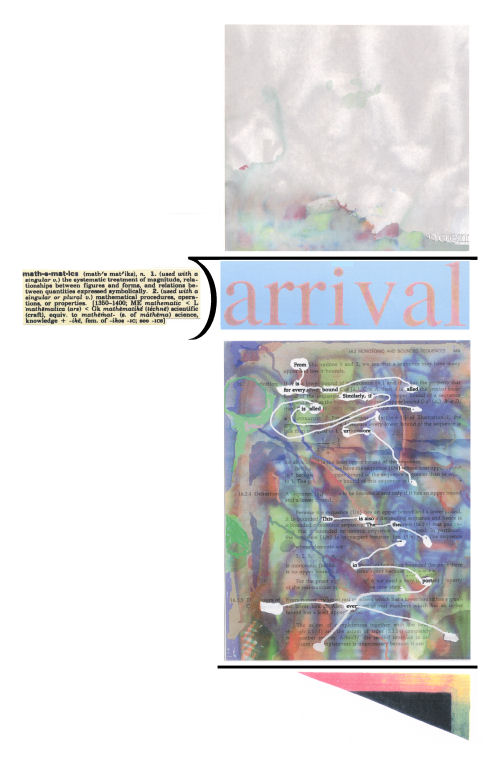
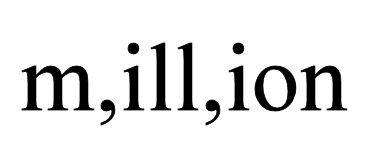
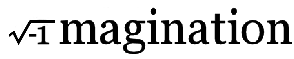
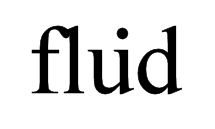
I’m as petty as they come, but I have trouble letting mediocrities and sub-mediocrities with power in poetry or any other cultural field, however little, get away with dim-minded opposition to work in their field that is . . . different.  Like my “An Arithmepoetic Analysis of Monet’s ‘The Regatta at Argenteuil,’ Frame 4″:

A week after I mailed it to Ekphrasis, I got it (and my cover letter and my business card) back with this:

.
According to its website, “Ekphrasis is a poetry journal looking for well-crafted poems, the main content of which addresses individual works from any artistic genre. . . . Acceptable ekphrastic verse transcends mere description: it stands as transformative critical statement, an original gloss on the individual art piece it addresses.”  Sorry, folks, but I really can’t see how my poem could be a more transformative critical statement than it is.  I sincerely doubt that anything published in Ekphrasis is as much as a tenth as effectively transformative as it.

Am I over-reacting to a rejection?  No.  The editors may just not like Monet, or mathematics, or the like.  What I am over-reacting to is their telling me they “carefully reviewed” my poem.  I suspect they glanced at it, failed to recognize it as the sort of conventional crap the poetry establishment favors, and immediately put it in my SASE and sent it back to me.  Or they actually spent more than a moment puzzling over it, and–at best–form-rejected it because too weak of character to write me a short note saying they couldn’t understand it.  In other words, they tried to carefully review it but lacked the competence to do so.  Actually, what they should have done, and I wonder if any editor of a poetry periodical with a circulation of more than a few hundred would ever think of doing, is written me to find out what the poem is doing.  Could they possibly have failed to see that it may have been good if only they could understand it instead of certainly poor because they couldn’t understand it?

Here’s what the thing is doing which without question makes it a superior artwork (a masterpiece, as far as I’m concerned), unless I am without question a terribly feeble-minded sub-mediocrity: it makes the multiplication of a perfect place and time for sailing by Monet a metaphor for the creation of a window into everflowing existence that reveals the splendor of a moment of existence (the moment containing the ideal conditions for sailing), and the addition of a millennia-long welcomeness to what the window reveals a metaphor for a simple observation–to the power of minus two times i, the square root of minus one, which is imaginary, and does something very strange to the simple observation.  (It makes it something outside normal reality, it makes it art.)  Along the way, it contrasts a hand-written, conventionally-worded text that emphasizes the quotidian nature of sailing while at the same time suggesting the feeling of being bourne upward that sailing can produce due to the slant of the text’s lines with a formally-printed, italicized poetically-worded text about how Monet’s painting welcomes you into the window the poem shows it to open.)

Is my self-serving analysis invalid?  I defy anyone in the poetry establishment to show me why.

Is it idiotic of me to waste time with a rant like this against a very trivial foe?  I think not.  It is natural to respond with either anger or sadness to rejection.  As a mentally healthy male, I can’t avoid responding with anger, and anger, unlike sadness, compels one to action.  Or smouldering frustration.  Preferring the former, I have chosen this entry as my action.  Which makes me feel good.  But I believe it will make others constantly form-rejected by their inferiors, like I, feel vicariously pleased.  Most important, it makes my position against the status quo public–or, more accurately, potentially public–i.e., out where it might be seen.  If seen, there’s always the chance it will have some valuable effect, if only to get one of two innocent poetry people to discover how much larger the poetry world is than the poetry establishment wants them to know.

It gave me an excuse to critique my poem, and I love critiquing my poems more than making them.  It was encouraging to find I was able to make a case in favor of my poem that seemed as good as it did to me.  It made me feel good, too, for once again revealing myself as (very possibly) the only poet in the world telling the world why a poem of his is superior.

.

Entry 386 — 4 Mathemaku from c. 2005 « POETICKS

Entry 386 — 4 Mathemaku from c. 2005

As of part of my continuing neurotic habit of adding small projects to my over-extendedness, I began going through my old blog entries to find out when I made various mathemaku of mine, for I posted all of them at my blog, I think, as I finished them (and even when sketching some of them, as well as when revising them).  I’m now up to my 600th entry.   I was happily reminded of the many frames I’ve done for my Long Division of Poetry sequence: around thirty, I’m pretty sure.  I found one sub-sequence that I quite like and don’t think I’ve ever posted as a sequence:

.

.

.

I’m not sure whether or not the following frame should be considered at extension of this little sequence.  Originally, I added it simply because I thought it nice, but not worth an entry to itself.  Now I begin to see how it may connect to the other two. . . .

.

Not that any woman ever drove me to drink.  Wait, women were the reason I drank: I only went to bars for the strippers, except the few times I wanted to watch Lakers’ games before I had a television.  I drank more beers (always beers though I never liked the taste of beer) than needed to cover the cost of being there mainly to make the strippers look good.

3 Responses to “Entry 386 — 4 Mathemaku from c. 2005”

  1. Kevin Kelly says:

    You’re going to upset the feminists with that last comment, mister. By the way, the copy editor in me tells me there is some grammatical hell going on in your opening graph for this entry — i.e. “now” disguised as “not,” and read the first sentence out loud to yourself. Regarding the mathemaku, I think the first one is perfect already, and the others are unnecessary.

  2. Bob Grumman says:

    Well, thanks for the copy editing, Kevin. As for your literary criticism, I’m afraid I have over 30 other divisions of “poetry” logic would require you to say were unnecessary. But no problem: now that you’re a Californian, your literary opinions don’t count no more.

    Note, despite your comment, I have approved you as a commenter here. Just shows what kind of person I am, right?

    –Robbit

  3. Kevin Kelly says:

    You seem to be implying that you can outperfect perfection. That’s so Grummanly of you.

Leave a Reply

Kinds of Poetry « POETICKS

Archive for the ‘Kinds of Poetry’ Category

Entry 670 — My Latest Mathemaku

Wednesday, February 29th, 2012

Just in case somebody found the secret word in “Revelation” but didn’t recognize it as a word, I should tell you that it is misspelled.

And here’s “The Best Investigations, No. 2,” my latest mathemaku:

I’m not sure whether I like it.  I just thought it appropriate to give science its due.  The quotient is what I’m unsure of.  I’m pretty sure I can fix it, if it needs fixing.

.

Entry 668 — A Visit to Haiku Canada Review

Monday, February 27th, 2012


Here’s a visual haiku I like from the latest issue of Haiku Canada Review (Volume 6, Number1):

Another haiku I liked was in a letter to Haiku Canada Review from Dina E. Cox:

                                             new snow
                                             I almost forget
                                             our quarrel

One last haiku I want to mention so I can make a negative remark is this, by Marshall Hryciuk:

                                    smudge of cloud
                                    boat’s murmur
                                    lost in the waves

My negative remark is not about Marshall’s poem, which I like a lot, but about the renku, an example of which Marshall’s poem begins. I can’t remember ever reading one that didn’t fairly quickly pall on me, although I’ve certain read ones which, like this one, were full of good and sometimes excellent material. I think it too difficult for a renku to stick closely enough to a particular topic (and it needn’t be a narrow one) for me to feel I have to hit my appreciation’s restart button too often. I believe, no doubt arrogantly, that the many people who like poems that jump around, lack the ability intensely to appreciate sufficiently to have trouble easing from one nice image to an unrelated nice image. Renku “stanzas” Of course, many of the best poems seem at first to lack what some would call inexorability and should be grazed at first rather than gobbled.  A renku’s “stanzas,” if any good, are too strong too allow an engagent like me to do that for more than five or six of them.

There were a lot of other good haiku in the issue.  Anyone interested in the form really should become a member of Haiku Canada.  (Note: you don’t have to be Canadian.)

.

Entry 667 — Re: “Revelation”

Sunday, February 26th, 2012

There’s little to say about the above except that I consider it a joke that can be taken to thoughts quite deep once you’ve carefully examined it.

A hint to solve it, written in reverse so you won’t accidentally see it and miss the fun of solving it without help: drow a rof kool.

.

Entry 666 — Some Boilerplate from Me on the Value of Criticism.

Saturday, February 25th, 2012

Here’s a quotation from Randall Jarrell that I completely disagree with: “Remember . . . that criticism is no more than (and no less than) the helpful remarks and the thoughtful and disinterested judgment of a reader, a loving and experienced and able reader, but only a reader. . . “  I say a great critic of a poem about daffodils, say, equals the creator of the poem–why should something brilliant about a poem about daffodils not be as valuable as something brilliant about daffodils?  I find Eliot the critic as worth reading as Eliot the Poet; Ditto Coleridge.  Hayden is as worth reading as most poets though not himself a poet.  I’m afraid I don’t think much of Jarrell as either a poet or critic.  I. A. Richards was a top-drawer critic, but not quite that as a poet–I vaguely remember that he wrote poetry, but I’m not sure of it.  William Empson’s criticism impresses me much more than his poetry.    Cleanth Brooks is an under-rated critic but not a poet.  Northrop Frye is another first-line critic who wrote no poetry that I know of.  Their names will last longer than a lot of poets once widley honored.

Bonus (which I will comment on tomorrow–and, yes, it is–among other things–a puzzle-poem):

.

Entry 664 — “Mathemaku in Praise of Reading, No. 1″

Thursday, February 23rd, 2012

In less than a week, I’ve be putting up another show.  This one will be in the school board building, so teachers will be passing by it.  Ergo, I’m trying to use pieces they may like, including the following:

I may have posted this before, and/or posted the much more elaborate, full color version of it I made . . . but now think too elaborate.

.

Entry 660 — Tiny Revision

Sunday, February 19th, 2012


I’m beginning to think this one is okay, after all.  One thing I’ve been meaning to point out in case any future students of poetry are ever drawn to my work is that I seem more and more lately to be recycling old images of mine–like the remainder in this piece, and the boats from Klee.  I consider this a step up, not down, because it’s a way of multiplying allusions.  It’s also a form of variations on themes.

Entry 659 — A Tribute to the Piano

Saturday, February 18th, 2012

I had high hopes for this one, which I composed yesterday.  I even thought I might work a sequence out of it, using the Klee ship “musical theme” as the first step of a visual symphony.  But I wasn’t satisfied with what I did with the ships.  As I worked with them, though, I came up with a lot of minor ideas I liked.  The main one was a suddenly conscious attempt to provide a metaphor for the coming of spring.  But I also liked breaking up what was originally as single framed image, and changing the sizes of each unit.  Grey-scaling the first two tiny ones seemed a nice touch, too.  And the escape of the final ship!  I didn’t like my dividend too well, either–after my initial enthusiasm for it (being a sucker for anything having to do with spring).  For some reason it doesn’t seem quite there, for me.  Maybe I’ll simplify it to, “a brook’s revived consideration of an April countryside.”  Yes, I think I was trying for too much. . . .

.

Entry 657 — My Motto as a Poetry Critic

Thursday, February 16th, 2012

 Thinking about what Tony Robinson had at his blog spurred me to this motto of my own (obnoxious) practice as a poetry critic: Try for maximal understanding of the nature and value of what I’m critiquing, fully committed to the advance of poetry, as I understand it, and expressed with the best balance of clarity and fresh language I can manage.  I originally continued with “–with no significant suppression of emotion, regardless of the tender feelings of the hyper-offendable,” but upon reflection found that nice to say but too secondary for this motto. 

Better: Using the the best balance of clarity and fresh language I can manage, try to express maximal understanding of the nature and value of what I’m critiquing, fully committed to the advance of poetry, as I see it.  Ah, but I now see that “the value of what I’m critiquing” would include what the latter does to advance poetry.  Ergo:  Try, using the the best balance of clarity and fresh language I can manage, to express maximal understanding of the nature and value of what I’m critiquing. 

And here’s a copy (an imperfect one) of my motto as a poet:

.

Entry 653 — A Response to Hal Johnson’s Poem

Sunday, February 12th, 2012


Here’s Hal Johnson’s visio-infraverbal poem again:

 ”Lost in thought” is the simplest explication of this, but a better reading focuses on thought that is opposed, disrupted, damaged and finally sent in the wrong direction back to its futile beginning.  With “ugh” and “tough” being disconcealed in the process further to suggest the losing struggle for meaning expressed.   In short, a deft pwoermd.  A visuaol one as well as infraverbal because you can see the word’s letters metaphorically enacting the struggle.

.

Entry 652 — An Infraverbal Poem by Hal Johnson

Saturday, February 11th, 2012


Here’s an infraverbal poem–actually a visio-infraverbal poem–Hal Johnson posted at New-Poetry:

    
 I’ll leave it for now as a puzzle.  Tomorrow I’ll reveal why it’s a first-rate poem.

 .

Entry 371 — My New Mathemaku, Updated « POETICKS

Entry 371 — My New Mathemaku, Updated

Updated, but probably not finished, although I consider the dividend set:

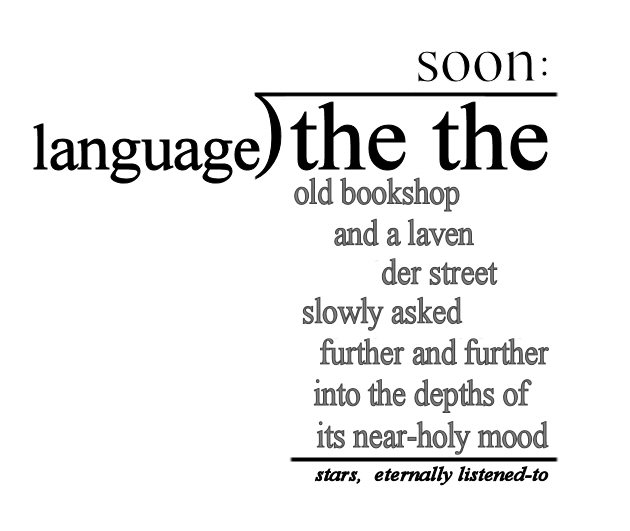
Now to my pluraphrase of this poem I have to add that the dividend is a quotation from Wallace Stevens’s “On the Dump,” one of my all-time favorite poems, so brings that poem’s concern with the nature of metaphor, (sensual) fascination with the seasons and the final essence of existence to it.  It’s another fresh expression, too, because still a shock to most minds, and certainly unexpected in this poem.  It also provides the poem, I think, with a unifying principle, the idea of language’s being on the precipice or “soon” to (“:”) bring one to the the making, at least to me, enough sense for a poem.

Incidentally, one thing a pluraphrase should do that I neglected to mention is determine a poem’s level of archetypality.   Mine seems to me, with “the the” now in it, to do that at the highest level with the search for the meaning of existence.  Stars are archetypal.  The struggle to express oneself seems to me moderately archetypal.

Leave a Reply

Entry 1116 — A Wordless Long Division Poem « POETICKS

Entry 1116 — A Wordless Long Division Poem

I hope to continue work on the poem I had notes for here yesterday but for some reason got working on the following instead of it this morning:

WordlessMathPoem02

It will be part of my next Scientific American blog entry.  I’ll be using it as part of another lesson in mathematical poetry taxonomy–an illustration of something without verbal language that is nonetheless a poem.

It seems to me appealingly goofy.  To understand it, you need to guess what the circle represents.  And the remainder.  And, just in case you forgot, pi times the length of a circle’s diameter gives you its circumference.

.

Leave a Reply

Alison Bielski « POETICKS

Posts Tagged ‘Alison Bielski’

Entry 31 — Old Blog Entries 663 through 670

Wednesday, December 2nd, 2009

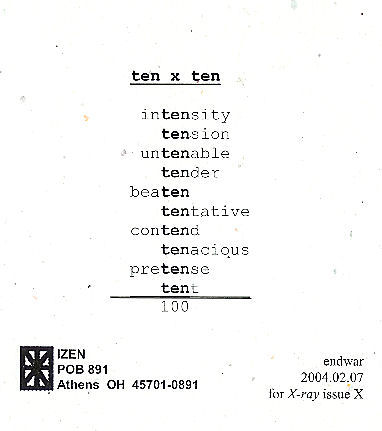
In #663, I presented my Odysseus Suite–but the reproduction is too crude for me to re-post it here.   My nest entry featured this, by Endwar:

TenByTenAs I announced when I first posted this, I am hoping to publish an antho- logy of mathematical poems, like this one, so if you have one or know of one, send me a copy of it, or tell me about it.

#665 had this by Marton Koppany, which I have to post here because it was dedicated to ME:

Odysseus

Hey, it’s mathematical, too.  The next entry, whose number I fear to state, concerned this:

Bielski-Haiku-BW

This is from Typewriter Poems, an anthology published by Something Else Press and Second Aeon back in 1972. It’s by Alison Bielski, An English woman born in 1925 whose work I’m unfamiliar with. I find this specimen a charmer . . . but am not sure what to make of it. Three lines, as in the classic haiku. The middle one is some sort of filter. Is “n” the “n” in so much mathematics? If so, what’s the poem saying? And where does the night and stars Hard for me not to assume come in? Pure mathematics below, a sort of practical mathematics above? That idea would work better for me if the n’s were in the lower group rather than in the other. Rather reluctantly, I have to conclude the poem is just a texteme design. I hope someone more clever sets me right, though. (I’m pretty sure I’ve seen later visio-textual works using the same filter idea–or whatever the the combination of +’s. =’s and n’s is, but can’t remember any details.)

It was back to my lifelong search for a word meaning “partaker of artwork” in #667–but I now believe “aesthimbiber,” which I thought of in a post earlier than #667, I believe, but dropped, may be the winner of my search.

Next entry topic was about what visual poets might do to capture a bigger audience.  I said nothing worth reposting on a topic going nowhere because visual poets, in general, are downright inimical to doing anything as base as trying to increase their audience.   One suggestion I had was to post canonical poems along with visual poems inspired by them, which I mention because in my next entry, I did just that, posting a Wordsworth sonnet and a visual poem I did based on and quoting part of it–and don’t re-post here because of space limitations.  I wrote about the two in the final entry in this set of ten old blog entries.

Poetry News « POETICKS

Archive for the ‘Poetry News’ Category

Entry 1227 — A New Anthology

Saturday, September 28th, 2013

Yesterday Jeff Side announced the e.publication of Shadows of the Future,  an anthology of otherstream poetry (or, in some cases–in my possibly excessively picky opinion–almost otherstream poetry) edited by Marc Vincenz, and published by Argotist Ebooks.  So I’m going to use this entry for some words about it instead of going on to the second part of my investigation of protozoa.  That I will do tomorrow, assuming I choose to continue my investigation (and I hope I do–nothing more valuable for the ol’ brain than a plunge into something you don’t know hardly nothin’ about).

Interesting.  When looking for what categories to assign this entry to, I found I had none for “Poetry.”  I do now.  So I can bring up that subject to tell you the anthology has 120 works, almost all of them poems by my definition, on 166 pages . . .

and here a digression to complain about my stupid computer (or, yeah, my stupid inability to know how use it):  I would like to be able to click from here to the anthology the way I can click from here to a file on my word processer or anywhere else but totally out of it.  There must be a way to save it as a regular file I can access on my word processer; if so, I’m ignorant of it.  So I have a second copy of this entry on the slot (can’t remember its name) with everything I can click to on it.  To get to the anthology, I go to that entry, and click the link in it to the anthology.  Very annoying.

Back to the anthology now.  Marc has a nice one-page forward in it.  Following it is a page-and-a-half introduction to it by me which is just my standard boilerplate about the refusal of the Establishment to so much as acknowledge the existence of the Otherstream.  Basically it’s a polemic intended to annoy estabniks enough to make them reply to it.  It has little chance of doing that but what else can I do?  I think it presents a good definition of the establishment, though.

My only real disappointment with the anthology is how little visual poetry is in it–but that was because, for some reason, few visual poets submitted anything to it.  There were visual poems by seven people–and textual poems by five people like mIEKAL aND who often do visual poetry.  In all, 37 had works in the anthology.  When going through it doing my counts, I spent a few minutes with my own poems.  One of them disturbed me:  I decided it was wrong!  Here is the wrong version:

Mapling


I doubt anyone but I would see what is wrong (crucially wrong, in my view) with this, but just for the fun of it, I won’t say more about it, nor show the corrected version for a while.

I’m too worn out from being too worn out to say much more about the anthology.  Before signing off, though, I want to recommend it strongly.  It’s an excellent tour of what’s going on in the vast countryside beyond the borders of the mainstream.  The vispo cover by David Chirot is worth the trouble of clicking to it alone!  That one work will give you more to wander through thoughts and feelings about by itself than the entirety of most mainstream anthologies of contemporary poetry.

.

Entry 874 — Have I Sold Out?

Thursday, September 27th, 2012

The other day I learned that the Harriet Blog run by Poetry had somehow come across my Scientific American guest blog and given it a nice positive write-up here.  The good of this is that it means a little more exposure for the otherstream, and more credibility for it with . . . well, those who ignore everything that is not properly certified by higher-ups.  The bad of it, of course, is its scaring me with the possibility that what I’m involved with is now at Poetry’s level.   That’s not a genuine worry.  If Harriet says something good about this blog, though, I will worry.  It’s got no seal of approval on it like “Scientific American.

To be honest, I’m pleased that the Harriet staff seems to have sincerely liked my blog entry.  People like those on it and the more advanced readers of Poetry are the audience I’m trying most to capture with my mathpo blog.  So, no more about it.

Entry 623 — My Decline « POETICKS

Entry 623 — My Decline

Well, according to astrology, I’ve begun to decline vocationally after reaching my peak a week or two ago.  It wasn’t much of a peak.  I got my art on display, but doubt that more than a handful of people have looked at it, and probably no more than one or two has really looked at it.  I haven’t been very productive, either.  I’m going to return to my Shakespeare book today (after a little head-start last night).  My intention is to either finish it, or–if I have significant trouble with it–switch to another project of mine, a non-fiction book that may be of general-interest but I’ll say no more about–to keep its theme, which is original, I think, and will be its main selling point, a secret.  I will say that it’s about life in general, not about Shakespeare, psychology or poetics. 

To make this entry more than a diary entry, here’s a poem of mine from a year or so ago.   I posted it then, but just now made a slight change to it, making a whole new poem.  I changed “full” to “certain.”  I decided the implication that I’d come to understand everything was dumb.  Now what kind of understanding I’d achieved is unclear, but should come across as Important.  I don’t know whether this poem became visual later; I don’t think it did.  I think it may work best as is, but who knows.

.

Leave a Reply

Entry 588 — Back to “the the” « POETICKS

Entry 588 — Back to “the the”

 A brand-new mathemaku I got the simple idea for a few days ago and made on my computer yesterday.  One thing I dislike a great deal about it is that it is an opinion poem–worse, the opinion is a political one.  But it has a nice graphic taken from my Long Division of Poetry series to which a photograph of outer space taken by the Hubble telescope has been added.  A central meaning of its remainder, which I stole from the fourth frame of my “Suite for Odysseus” is “mystery.”  As you all should know, its dividend, which I use in lots of poems, is from a poem by Wallace Stevens.


* * *

 Thursday, 8 December 2011, 3 P.M.  I’m in a good mood.  The poem above came out reasonably well, and smoothly–and gave me something for this blog entry.  It will probably be in my show, so counts as work done for that.  But I also got one of my piece for that into a frame that can be set on a counter, which counts indisputably as work for the show.   Meanwhile, I’ve disconnected completely from my Shakespeare book.  Next, I have to get a press release for the show done.  Should be easy but I’m having trouble pumping myself up to do it.

.

Leave a Reply

Entry 1227 — A New Anthology « POETICKS

Entry 1227 — A New Anthology

Yesterday Jeff Side announced the e.publication of Shadows of the Future,  an anthology of otherstream poetry (or, in some cases–in my possibly excessively picky opinion–almost otherstream poetry) edited by Marc Vincenz, and published by Argotist Ebooks.  So I’m going to use this entry for some words about it instead of going on to the second part of my investigation of protozoa.  That I will do tomorrow, assuming I choose to continue my investigation (and I hope I do–nothing more valuable for the ol’ brain than a plunge into something you don’t know hardly nothin’ about).

Interesting.  When looking for what categories to assign this entry to, I found I had none for “Poetry.”  I do now.  So I can bring up that subject to tell you the anthology has 120 works, almost all of them poems by my definition, on 166 pages . . .

and here a digression to complain about my stupid computer (or, yeah, my stupid inability to know how use it):  I would like to be able to click from here to the anthology the way I can click from here to a file on my word processer or anywhere else but totally out of it.  There must be a way to save it as a regular file I can access on my word processer; if so, I’m ignorant of it.  So I have a second copy of this entry on the slot (can’t remember its name) with everything I can click to on it.  To get to the anthology, I go to that entry, and click the link in it to the anthology.  Very annoying.

Back to the anthology now.  Marc has a nice one-page forward in it.  Following it is a page-and-a-half introduction to it by me which is just my standard boilerplate about the refusal of the Establishment to so much as acknowledge the existence of the Otherstream.  Basically it’s a polemic intended to annoy estabniks enough to make them reply to it.  It has little chance of doing that but what else can I do?  I think it presents a good definition of the establishment, though.

My only real disappointment with the anthology is how little visual poetry is in it–but that was because, for some reason, few visual poets submitted anything to it.  There were visual poems by seven people–and textual poems by five people like mIEKAL aND who often do visual poetry.  In all, 37 had works in the anthology.  When going through it doing my counts, I spent a few minutes with my own poems.  One of them disturbed me:  I decided it was wrong!  Here is the wrong version:

Mapling


I doubt anyone but I would see what is wrong (crucially wrong, in my view) with this, but just for the fun of it, I won’t say more about it, nor show the corrected version for a while.

I’m too worn out from being too worn out to say much more about the anthology.  Before signing off, though, I want to recommend it strongly.  It’s an excellent tour of what’s going on in the vast countryside beyond the borders of the mainstream.  The vispo cover by David Chirot is worth the trouble of clicking to it alone!  That one work will give you more to wander through thoughts and feelings about by itself than the entirety of most mainstream anthologies of contemporary poetry.

.

8 Responses to “Entry 1227 — A New Anthology”

  1. Ed Baker says:

    Bob,
    I just went through the ENTIRE anthology… what, 166 pages??
    non-stop garbage ! You used to be better than this….

  2. Bob Grumman says:

    Each to his own, Ed.

  3. karl kempton says:

    future looks bleak to me if this is a forecast. do not see much light coming out of the unconsciousness

  4. Bob Grumman says:

    Haw, I was worried that too much of my three pieces were giving off light out of my unconsciousness!

  5. karl kempton says:

    the scribbling was a side show to the shadow work

  6. Bob Grumman says:

    Not sure what you’re saying, Karl. What’s the “shadow work?”

  7. karl kempton says:

    shadow — shadow is unconsciousness

  8. Bob Grumman says:

    Now I need to know what the scribbling was–the texts? You ARE talking about my three pieces, yes? Everything in it is partially from the unconscious mind, and partially subjected to the critical consciousness. it seems to me, although I don’t really care where anything comes from, only that it seems to me to do something worthwhile.

Leave a Reply