Entry 1119 — Dead Poem « POETICKS

Entry 1119 — Dead Poem

Poem-in-progress:

13June-A-small

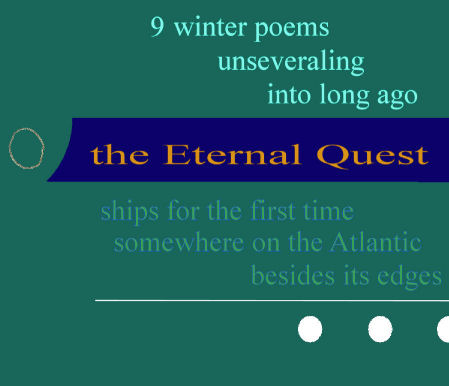
I struggled with this thing most of yesterday–in my head.  Just couldn’t get it right.  I couldn’t choose between having the private eye and the Atlantic as its center.  This morning, I kept foundering, finally giving up: hence the title of this entry.  I tried to cheer myself up by think how good an instructional failure it was.  Then something close to the above occurred to me that seemed to make some sense.  I’m not yet satisfied with it. but may accept it into Mine Oeuvre as is.

Meanwhile, I like my private eye image.  Haven’t been able to think what to do with it, though.  (Thanks, Conrad, for your positive comment on it, by the way.  You see the image just the way I do!)

.

Leave a Reply

Cor van den Heuvel « POETICKS

Archive for the ‘Cor van den Heuvel’ Category

Entry 48 — Full Effectiveness in Poetry

Saturday, December 19th, 2009

I’m skipping ahead to old blog entry #796 today to make a point about my recent cryptographiku. #796 has Cor van den Heuvel’s poem:

.                                               tundra

I go on in the entry to say I believe Eugen Gomringer’s “Silencio,” of 1954, was the first poem to make consequential  visiophorically expressive use of blank space:

.                      silencio silencio silencio  .                      silencio silencio silencio  .                      silencio          silencio  .                      silencio silencio silencio  .                      silencio silencio silencio

I finish my brief commentary but then opining that van den Heuvel’s poem was the first to make an entire page expressive, the first to make full-scale negative space its most important element. Rather than surround a meaningful parcel of negative space like Gomringer’s masterpiece, it is surrounded by meaningful negative space. I’m certainly not saying it thus surpasses Gomringer’s poem; what it does is equal it in a new way.

I consider it historically important also for being, so far as I know, the first single word to succeed entirely by itself in being a poem of the first level.

Then there’s my poem from 1966:

.                 at his desk
.                         the boy,

.                                writing his way into b wjwje tfdsfu xpsme

This claim to be the first poem in the world to use coding to significant metaphorical effect. Anyone who has followed what I’ve said about “The Four Seasons” should have no trouble deciphering this. I consider it successful as a poem because I believe anyone reasonably skillful at cyrptographical games will be able (at some point if not on a first reading) to emotionally (and sensually) understand/appreciate the main things it’s doing and saying during one reading of it–i.e., read it normally to the coded part, then translate that while at the same time being aware of it as coded material and understanding and appreciating the metaphor its being coded allows.

I’ve decided “The Four Seasons” can’t work like that. It is a clever gadget but not an effective poem because I can’t see anyone being able to make a flowing reading through it and emotionally (and sensually) understanding/appreciating everything that’s going on in it and what all its meanings add up to, even after study and several readings. Being able to understand it the way I do in my explanation of it not enough. This is a lesson from the traditional haiku, which must be felt as experience, known reducticeptually (intellectually), too, but only unconsciously–at the time of reading it as a poem rather than as an object of critical scrutiny, which is just as valid a way to read it but different.

Norman Friedman « POETICKS

Archive for the ‘Norman Friedman’ Category

Entry 1627 — Norman Friedman, RIP

Monday, November 10th, 2014

A day or two ago I got the sad news that Norman Friedman died on the 6th of November.  He for many years was probably the foremost critic of E. E. Cummings, one of my three favorite pre-1960 American poets.  Certainly I learned more than a little about Cummings (and poetics) from his writings over the years.  He was also a very nice man, as I found out when I met him at a literary conference where I presented a paper on Cummings several years ago.

This  morning curiosity about him sent me to Wikipedia where, to my shock, I was unable to find an entry on him.  Along the way, though, I found an essay of his on Cummings at jstor.org, a site you can read academic writings at for a fee. The fees are way more than I can afford but I took advantage of an offer allowing me to read three essays for free, so am now midway through Friedman’s “E. E. Cummings and His Critics,” (1962).

In his essay, Friedman is making an excellent case for Cummings as what academics should consider a serious poet–i.e., one with a serious outlook on life that he expresses in his poetry.  I suppose he is right but for me, “all” Cummings did was celebrate existence, using all the verbal means he could think of in order to able to do that maximally.

Oh, sure, he was diverted from this central concern to take on collectivism (which I applaud) and science (which I don’t applaud) but at his best he did the only thing I believe poets should do, which is use the whole of their language to celebrate existence–which I think requires them at the same time to show by contrast what’s wrong with it.  I think what I mean is that a poet should side with, and celebrate, beauty in his poetry, which he can’t do without opposing, and condemning, ugliness (at least implicitly) as when Basho celebrates the beauty of the many moments existence’s best moments combine in his old pond haiku while at the same time implicitly rejects–and I should have used “rejecting: instead of “condemning” earlier in this sentence–existence’s lesser moments, the one’s with only the present in them, or–worse–only some solely intellectual or solely unintellectual present in them.  Or nothing at all, unless the nothing that includes all isn’t what many of the greatest minimalist poems are about.  (Yeah, I’m going a little over-mystical there.)

You’re in luck.  I don’t have time right now to knock out several thousand words on the poetic moment I’m talking about.  The traditional haiku moment is an instance of it, but only one instance, whatever the wacked-out anti-Western idolizers of the Far East maintain.
.

AmazingCounters.com

Entry 182 — “Dash No. 1,” by Koppany « POETICKS

Entry 182 — “Dash No. 1,” by Koppany

This is one of the three pieces Marton Koppany sent me recently.   I’m posting it now (1) to take care of another entry with minimum effort, (2) because I like it a lot, and (3) to allow me to babble a bit more on my favorite topic, What Visual Poetry Is.

As those who know my work as a critic, I contend that a text cannot be a poem unless it has words that are of significant importance to what the text does aesthetically.  This piece contains no words, as most people understand the term.  Nonetheless, I’m prepared to claim it to be a poem.  Clearly, this piece is on what I call the borblur–the borderline between conceptual visimagery and visual poetry.  I call it the later because I believe all punctuation marks (and similar symbols such as those used in chemistry or mathematics) can act as words in certain unusual situations.

Specifically, when a punctuation mark in a work is sufficiently emphasized to make it difficult for someone “reading” the work to treat it as nothing more than a punctuation mark, it will become a word.  That is, it will not be skimmed through with little or no conscious notice–actually, with no vaonscous verbal notice, as with the dash I just used–but pondered consciously, possibly even indentified consciously as what it is, it will become a word.  It will denote as well as, or even perhap instead of, acting purely punctuationally.  In the case of the work above, I claim most people–at least most people familiar with the territory–will read the dash in it (even without the title of the piece), as “dash, short-cut,” then realize sensorily how it is making something rather large disappear, or realize how it works.  A simple but unexpected metaphor visualized.

The pun in English of “dash” as a verb meaning to go in a hurry is a very nice extra, entirely verbal extra.

Note: my only problem with the piece is its title, which I think too overt.  I’d prefer something more like “Punctuation Poem No. 63, or the like.  “Mountain subjected to Punctuation?”  No, but something like that, but more intelligent. . . .

3 Responses to “Entry 182 — “Dash No. 1,” by Koppany”

  1. Marton Koppany says:

    Thank you so much, Bob! I’m VERY glad you liked it and I’m grateful for your attention! The title serves only to slow the reading down in this case. It may be too overt, I’m not sure.

  2. nico says:

    what id like to know is what are the 2 pieces on each side of the dash. mirror images of torn paper? or are they 2 items that give a base to the top “mountain” piece? and does the “mountain contain within it – a dash? or does the dash signify the name of the “mountain. i like it and i like what you wrote, bob. marton, youre making work that’s moving in another direction – always a good thing. i always enjoy seeing, thinking about it.

  3. Marton Koppany says:

    Thank you so much for your words, Nico! (I’ve just come home from vacation and read your comment.) The two pieces on the two sides of the dash are identical: they’re the image of an iceberg, taken from the internet. I’d had a certain idea, and needed an iceberg for it. But I hadn’t guessed beforehand that they would look like a pair of shoes. I’m always in a dialogue with the “material”. This time the “material” really surprised me, and it took the initiative. The second surprise came from
    “Magic Wand” (of a simple image editor software). I wanted to insert a piece of mountain-like negative space (made of sky) between the two icebergs, but I did something wrong, and had to realize that the edges of the sky are “thawing” – in complete synchrony with the icebergs. (My original idea got an extra confirmation, which was stronger than mine.) I didn’t touch the image from that point on. DASH is the base of a mountain-like (and already thawing) negative space between two disappearing icebergs which are identical with each other. And the shoes belong together, and the negative space is their wearer. There’s no separate place or time for the thought “between” the two other thoughts. They “happen” at the very same moment and belong together.

    Or something like that. :-)

Leave a Reply

Entry 43 — Old Blog Entries #689 and #690 « POETICKS

Entry 43 — Old Blog Entries #689 and #690

Today I’m reproducing #689 and #690 in full–because I think they’re pretty good discussion, but not too long.

21 December 2005: I’ve been thinking a little about varieties of infraverbality. (By “infraverbality,” the reader should remember, I mean concern with what goes on in poetry beneath the level of words; it is mainly intentional misspelling for poetic effect.) I originally listed four: fissional, fusional, microherent and alphaconceptual.

In the first, one or more words are spelled with spaces–e.g., Karl Kempton’s “g u i dance.” In the second, one or more words consist of a combination of two or more words, or near-words–e.g., Lewis Carroll’s “slithy,” which combines “sli(m)y” and “lithe.” “Portmanteu words” are what they’re usually called.

In microherent infraverablity, words are mangled almost beyond recognition for poetic effect–e.g., my own just-created “pjkoenn” to suggest a jumble with the potention to become a poem.

In alphaconceptual infraverbality, something is altered in one or more words, or near-words, to add a conceptual effect of poetic importance. It is so rare I consider the term probably superfluous. A prime example is Aram Saroyan’s, “lighght,” which depends for its main poetic effect on the concept of silent letters. Ed Conti’s “galaxyz” is another example–since it has to do with the concept of alphabetical ordering.

I realized my list was too short after Michael Rothenberg asked me to make a selection of certain kinds of infraverbal poems for his webzine. The poems were to be like Richard Kostelanetz’s “ghost-poems,” which are single words each of which contains a second single word in consecutive letters within it as “ghosts” contains “host.” I got the idea of repeating my standard ploy of doing an essay on such poems that would use so many specimens as to act as an anthology. But what to call Richard’s poems? In a sense, they are fusional in that they consist of more than one word–but extra words are not merged with them–they occur within them naturally. I consider them enough different from words like “slithy” to have their own category. It took me a while to give it a name: it’s “natural.” (How’s that for creative neologizing?)

A sixth category of infraverbality I feel would be helpful is anagrammatical–for texts with words that contain all their proper letters but are jumbled. It could be argued that they are merely a variety of microherent infraverbality, but I prefer to restrict microherence to texts that have wrong letters but are not necessarily out of order. I’ve seen examples of anagrammatical infraverbal poems. I think I’ve made a few myself. But I can’t rememember any. An obvious way to use anagrammatical material would be–Ah, I now remember that Cummings uses it famously in his grasshopper poem (where, starting with “r-p-o-p-h-e-s-s-a-g-r,” he goes in three spellings to “grasshopper”). No doubt that’s why I have come to want a separate category for it.

22 December 2005: Something that has always seemed indicative of the insularity of both formal poets and language poets is how little they steal from each other. I see no reason a strict sonnet couldn’t be written using langpo “missyntacticality” or misspellings (like “lighght”). In fact, E. E. Cummings made many langpoetic sonnets that had the right meter and rhymed. I don’t think any contemporary language poet has made any kind of formal poem using langpoetic devices. Nor has a formal poet used a langpoetic device in one of his poems, although the freeversers more and more are availing themselves of langpo tricks.

I thought of one exception: rewritten classic poems that are garbled in one way or another, e.g., my own silly, just-now-written “Shawl-eye crumbpair (the 2!) as under daze.”  It’s not uncommon for poets to use computer programs to do this.

One of my conclusions seems to hold: that formalist poets ignore the devices of language poetry, even though those devices could easily be used in their poetry without compromising the latter’s adherence to meter and other formal requirements.

Leave a Reply

Mark Sonnenfeld « POETICKS

Archive for the ‘Mark Sonnenfeld’ Category

Entry 1699 — More Scraps

Wednesday, January 21st, 2015

Scrap #1: Yesterday’s mail included another chapbook from Mark Sonnenfeld, Check Check Done and Done, half of it devoted to poems by Mark and half to poems by Dory L. Williams.  Good reading but one thing in it by Dory L. Williams really knocked me out: to me, it’s an epigram, because a statement of an opinion, so according to my taxonomy a work of informrature.  Be that as it may, it’s as good an epigram as I’ve come across in years, if ever:

Covetness

If you want fame and money without real
achievement behind it, you’re not greedy enough.

Scrap #2:  After I posted yesterday’s entry, I remembered a central feature of Iowa Workshop Poetry I’d intended to mention before any other, but then forgot: it’s the recognition of the potential of ordinary subject matter for tranfiguringly successful poetry–as in Williams’s “The Red Wheelbarrow,” and in all the best haiku.   I am all for ordinary subject matter . . . but it can’t do much unless connected to archetypal matter one needs to be in one’s magniceptual awareness to be able to employ.  Williams’s poem is, finally, not about a wheelbarrow anywhere near as much as it is about Beauty.

Lesson for poets: keep explicit abstracts and generalities out of your poems as Ezra tells you to, but build you poems on them as I tell you to.  This, incidentally, you don’t necessarily have to consciously strive for, but you must be able to recognize when something worthily archetypal begins to show under your poem’s words so as to strengthen those words’ connection to it–and/or weaken the visibility of their path to it.  The archetypal foundation of the best poems is much more often understood in their engagents’ marrow long before it’s dealt with the reasoning parts of their higher faculties, if it ever is.  (Few poets have very large reducticeptual awarenesses or scienceptual awareness, which are where analysis is carried out.)

Possibly more important than the connection to the archetypal is the technique, the freshness of the technique employed to make that connection, which is usually metaphorical.

I’m just repeating old thoughts of mine, disorganizedly.   Jus’ tryin’ to make it through another blog entry.
.

AmazingCounters.com

Mainstream « POETICKS

Archive for the ‘Mainstream’ Category

Entry 1699 — More Scraps

Wednesday, January 21st, 2015

Scrap #1: Yesterday’s mail included another chapbook from Mark Sonnenfeld, Check Check Done and Done, half of it devoted to poems by Mark and half to poems by Dory L. Williams.  Good reading but one thing in it by Dory L. Williams really knocked me out: to me, it’s an epigram, because a statement of an opinion, so according to my taxonomy a work of informrature.  Be that as it may, it’s as good an epigram as I’ve come across in years, if ever:

Covetness

If you want fame and money without real
achievement behind it, you’re not greedy enough.

Scrap #2:  After I posted yesterday’s entry, I remembered a central feature of Iowa Workshop Poetry I’d intended to mention before any other, but then forgot: it’s the recognition of the potential of ordinary subject matter for tranfiguringly successful poetry–as in Williams’s “The Red Wheelbarrow,” and in all the best haiku.   I am all for ordinary subject matter . . . but it can’t do much unless connected to archetypal matter one needs to be in one’s magniceptual awareness to be able to employ.  Williams’s poem is, finally, not about a wheelbarrow anywhere near as much as it is about Beauty.

Lesson for poets: keep explicit abstracts and generalities out of your poems as Ezra tells you to, but build you poems on them as I tell you to.  This, incidentally, you don’t necessarily have to consciously strive for, but you must be able to recognize when something worthily archetypal begins to show under your poem’s words so as to strengthen those words’ connection to it–and/or weaken the visibility of their path to it.  The archetypal foundation of the best poems is much more often understood in their engagents’ marrow long before it’s dealt with the reasoning parts of their higher faculties, if it ever is.  (Few poets have very large reducticeptual awarenesses or scienceptual awareness, which are where analysis is carried out.)

Possibly more important than the connection to the archetypal is the technique, the freshness of the technique employed to make that connection, which is usually metaphorical.

I’m just repeating old thoughts of mine, disorganizedly.   Jus’ tryin’ to make it through another blog entry.
.

AmazingCounters.com

Entry 1471 — From an Internet Poetry Discussion

Sunday, June 1st, 2014

Another quickie today–to give me more time on my essay on Beauty, which is starting to come around!

I tend to see Poetrys finally getting around to accepting forms of visual poetry because, now that it has been a seriously-pursued variety of poetry for a hundred years in this country, they more or less have to.  So some of them have actually given it thoughtful examination–and found to their surprise that they like a portion of it.  The portion they like, will–it goes without saying, but I’ll say it, anyway–only be, in most cases, a notch above big and little but with time, and the help of young academics more able to appreciate it, they’ll come to appreciate it the way they now appreciate Pound and Joyce.  By then, of course, people like us will be doing who-knowz-wot, and grumbling at the gate-keepers.

I’m in the final analysis an optimist, but it does seem to me that the Establishment now rates the American poetry of the first half of the twentieth-century fairly accurately, albeit still not giving Cummings his due, but writing about all the poets of the time worth writing about, unless there are a few as concealed as Emily was that they’ve overlooked.

With that, I may have said all I have to say on this most interesting topic.

.

AmazingCounters.com

Entry 1284 — My Take on the NEA, 1995

Friday, November 29th, 2013

SPReditorial1SPReditorial2

Note: I did not get an NEA grant.  Does anyone think my chances would be better in 2014, 29 years later?

.

Entry 1101 — Kicking the Competition

Sunday, May 26th, 2013

Some will think I’m lying, but the truth is that I do not like deriding art I deem mediocre or worse, even when the favorable attention it gets in the BigWorld angers me.  But honesty requires a critic to cover everything he can, and evaluate it honestly.  Still, I wouldn’t have bothered with this page from the latest issue of ARTnews if I weren’t still too out of it and lazy to find something better for this entry (which I must get into my blog to get it going again).

OnePlusOneEqualsZero-small

Okay, it’s just an ad for a couple of artists trying to make it in the big city at a gallery that thinks it worth pushing.  I wish all involved well.  Despite the sorry mathematical poem.  Yes, I know it’s not meant seriously, it’s just being cute.  What bothers me, though, is that any gallery would be exhibiting work like the Davidson-Hues and not the far superior visual poetry that I and so many of my friends in visual poetry have been doing for years!

A large part of the blame must fall on us, for not going to big cities and marketing ourselves to every possible venue the way my friend Richard Kostelanetz has.  But I continue to maintain that in a culturally superior country we should not have to!  There should be various talent scouts and middle men to do that for us.  There are just about none.

.

Conceptual Poetry « POETICKS

Archive for the ‘Conceptual Poetry’ Category

Entry 1285 — The Conceptaphor

Saturday, November 30th, 2013

Those familiar with my poetics coinages will know about my use of “phor” as a suffix for “variety of equaphor,” “equaphor” itself being one of them–and meaning, basically, “analogy presented as an identity,” the metaphor being the classic example.  Hence, my latest means “conceptual metaphor.  And example is the dividend shed I use in my long division poems as a metaphor equating the poem it’s in to a mathematical machine, or–perhaps more exactly–equating  what happens to the dividend as an inevitable, absolutely valid, concrete process.  Similarly, a log division poem’s long division paraphernalia is a metaphor for the poem as a whole, equating it to a mathematical process.  The idea is to generate connotations counter to the sensual denotations and connotations the rest of the poem’s elements are generating. . . .  It’s hard to explain, but I know what I’m doing!

I figure I need the term now for three different pieces I’m writing: my next post-SciAm entry, a review of an anthology of mathematics-related poetry, and an essay on the value of such poetry.  In the meantime, I’m still working on a definition of conceptual poetry.  I may now have it: poetry making central use of a conceptaphor.  Or: poetry whose central aesthetic effect is due more to one or more conceptaphors than to anything else.  Conceptual Poem: poem built around a conceptaphor, or conceptaphorical cluster.  (I never get anything right the first time.  Well, rarely.)

 .

Entry 952 — Pronouncements & Blither, Part 13

Friday, December 14th, 2012

First of all, something I posted at Argotist Online: “Here’s a good discussion point: why are poets so unwilling to discuss poetry on the Internet? Do they discuss it in some length elsewhere? Perhaps they do like talking about it, but not where what they say will become part of a permanent record?”

Another: ““Is it possible for someone whose poetry is at the level of Pound’s or Yeats’s to publish his poetry anywhere more than a few will see it? Or have it intelligently reviewed in a publication reaching more than a hundred readers?”

Next, a corrected version of something I said in my last entry: “A poem is good in proportion to the ratio of the (unified) largeness of the beauty it evokes for its best engagents to the size of the poem.”

Finally, a work from Marton Koppany’s latest collection, Addenda–which I’m not yet ready to say anything about except that it’s terrific:

Addenda, by the way, is as certainly a major collection of poetry by a living author as any other collection I’ve seen in the past forty years.

.

Entry 948 — Pronouncements & Blither, Part 9

Monday, December 10th, 2012

.
Back at New-Poetry someone advanced a silly poem as the equal of the Sondheim.  At the same time a few shrugged off my case for the value of the latter as entirely subjective and thus of no importance.  Others made comments I considered equally inane.  So, yesterday evening, I responded with:
Would any of you who have been contributed to this thread (or only read portions of it) be willing (be brave enough) to carry out the following experiment:
.
(1) Select two poems, one you consider significantly better than the other;

 .
(2) Support your view with references to what is explicitly in each poem, bad and good (in your opinion)?

 .
Second challenge to those unwilling to do this because it would be meaninglessly subjective: be honest enough to go on record with the view that all poems are equally good.

 .
I’ve already half-done this with a very flawed quick reaction to the Sondheim poem indicating why I consider it at least not bad. (I now consider it a superior poem, having found more virtues in it by thinking of it more focusedly as a conceptual poem.) I will now say why—objectively, because supported by what’s objectively in or not in each of the two poems as opposed to anything that may be subjectively in them like sincerity.) I will now compare it with the other poem posted:

PHOTOSYNTHESIS
by Banana Jones
You have a head,
mountain goats eat fudge,
I spread toe jelly on my wrist,
Concrete angel,
You ain’t got nothing on me,
Oh right…
Babies come from vagina’s.
.
Sondheim inserts (_) into his poem, as I’m now sure it is, in accordance with a logical plan—i.e., after every word or phrase in order that a person doing the task of reading it will be able to check off each read bit of the poem. This slows the read (a virtue in the opinion of most I’m fairly sure) and also almost forces a reader to pay more than normal attention to each bit, and think about the task of reading. The poem explicitly tells the reader to take extra pains while he’s reading, so the claim that pressure to pay more than normal attention to one’s journey through the text seems to me objectively true. I feel I could support most of my reactions to the poem similarly, but am not up to doing that right now. My aim now is simply to compare this one thing the Sondheim text objectively does I believe any reasonable person would agree to what seems to me an absence of any thing like it.
.
The Jones poem does nothing according to any logic I can see. It jump-cuts from one clause-length narrative to another entirely unconnected to it in any meaningful sense (I say with a fair confidence that I am here being objective in the reasonable sense that (verbal) meaninglessness can be objectively defined as words arranged in such a way as to confuse a large majority of readers or listeners, and no defense of their meaningfulness will change any but a very few minds about that).
.
The Sondheim contains one fresh element, or perhaps can be said to carry out a fresh design; and every poem needs something fresh–objectively. If we start with the dogma that a poem needs to move one, and know objectively from a study of the effects of poetry on human beings that a poem that does absolutely nothing new will rarely move anyone, even those who claim to like some such poem.
 .
The Jones poem is not fresh—because although its particular images are wildly different from the images in conventional poems—they lack all coherence and therefore result in chaos—objectively result in it, I say, using the same argument I previously used—and chaos is never fresh however different its elements, one chaos being perceived by the sane as just about entirely the same as any other chaos. I think this observation important (and especially like it because it just occurred to me as I was writing this): the Sondheim is not chaos (although possibly not cohering here and there.
.
I think I could find some virtues in the Jones poem if I tried, but I’m sure they wouldn’t equal the virtues in the Sondheim I’ve already written about in this thread, and I’ve found more since then. I claim they are objectively superior to any virtues in the Jones I’m now intuitively aware of, but that’s admittedly just an assertion, but one made because I’m not up to a full dissertation on the two poems—here.
.
Frankly, I think that I’ve shown beyond reasonable doubt that the Sondheim is the better of the two poems. Which makes me think maybe my challenge would have been that someone show why they are equal. Or of what value any discussion of the merits of any poem is if we agree in advance than nobody’s opinion means anything. 
.

Entry 947 — Pronouncements & Blither, Part 8

Sunday, December 9th, 2012

Two days ago I posted what follows to a thread at New-Poetry concererning experimentality in which the poem discussed was inserted:

I threw the commentary following the text below (which is by Alan Sondheim) in one writing, and left it as is without checking it to try for an authentic initial response—although it’s not quite initial as I have skimmed the poem two or three times before writing about it.—Bob

when (_) you (_) read (_) this (_)

when (_) you (_) read (_) this (_) if (_) you (_) read (_)
this (_) please (_) do (_) check (_) where (_) you (_) do
(_) check (_) so (_) you (_) will (_) track (_) your (_)
reading (_) where (_) you (_) check (_) in (_) the (_)
midst (_) of (_) parentheses (_) in (_) the (_) midst (_)
of (_) bodies (_) you (_) will (_) check. (_) and (_) two
(_) you (_) will (_) know (_) you (_) have (_) then (_)
read (_) and (_) will (_) have (_) been (_) read (_) by
(_) the (_) checks (_) both (_) useful (_) and (_) against
(_) all (_) interference (_) which (_) you (_) might (_)
now. (_) three (_) you (_) will (_) check (_) here (_) and
(_) then (_) here (_) and (_) you (_) will (_) fill (_) in
(_) checks (_) and (_) blanks (_) and (_) you (_) will.
(_) four (_) and (_) fecund (_) and (_) cornucopia (_) and
(_) the (_) great (_) fullness (_) of (_) life (_) and (_)
desire (_) will (_) result (_) with (_) all (_) words (_)
checked (_) that (_) you (_) have (_) read (_) them (_)
and (_) you (_) have (_) been (_) there. (_) and (_) you
(_) will (_) have (_) read (_) them. (_) five (_) and (_)
you (_) will (_) have (_) been (_) there, (_) you (_) can
(_) check, (_) you (_) will (_) have (_) been (_) there.
(_) (_)


To avoid getting into whether this work by Alan Sondheim is a poem or not, I will refer to it simply as a “text.” The speaker of the text expects us to read it. He wants you to do something as you do, put checks in the parentheses. You will already be disconcerted by the strange appearance of the text. Every effective aesthetic experience begins with a “hunh,” however small and usually too short-lasting to be noticed, which turns into pleasure when one gets one’s bearings. Sometimes the hunh lasts a long time. One may never get one’s bearings, in which case the text, or whatever it is, has failed one as a work of art—at that point. But one sincerely wishing to understand the text may finally get his bearings, with help if not on his own, if he persists.

As happened with “The Wasteland” for many, and—I’m sure—with poems of Stevens’s. Can it happen with the text above? It did quickly for me because I have a lot of experience with poems like it. It’s hard to say why, but I’ll try, because I don’t think any poem genuinely any good if it can’t eventually be explained.

If one actually reads it and at least imagines himself making checks, one will enter a kind of mood I don’t have a name for (yet). A mood based on exploring ideas, and/or carrying out an analysis. Here, what reading is—metaphorically related, it seems to me (and this is a first draft of my understanding of the text), to ones over-all experience of going through life.

Think of the text as one’s life, which you are being asked fully to examine. So, the text is at least a joke on those (like me) who may spend too much time evaluating everything they do. On the other hand, it may be straight didacticism about the value of attending to every detail of one’s life

Perhaps it’s only a text that the strongly analytical can enjoy. Those with a strong reducticeptual awareness, as I call it. The joy of working one’s way to the solution of a challenging math problem.

It poses a question for me, how does one really know that he has “been there?” Have you ever stopped long enough in your life to make a check mark—which will mean that you took time to better your experience of wherever you stopped.

I don’t yet know what is meant by having “been read by all checks, and I wonder if “now” is a typo for “know.” One should not expect complete clarity from a poem, and certainly not at once.

It becomes lyrical at the end, at least for me, climaxing in the joy I now find to be the sense of fulfillment when you look over something important you’ve done and realize from the memories you formed (like boxes checked) that you have truly been somewhere. As, when the text works for you, it becomes at the end, once you come sufficiently to terms with it, a there you have fully been at/in.

Okay, this is disorganized and possibly not too coherent in places. But it shows how a mind with a little of the necessary background and a willingness to wade into something not immediately nice can form some kind of appreciation of the text by giving it a chance, and express that appreciation however poorly, which seems to me proof that the text is not worthless.

In any case, I consider it well worth returning to, and likely to lead me to greater appreciation of it.

Last thought because I just had it: line 22 is absolutely terrific.

I haven’t had time since to fix it, but eventually will, expanding on it at the same time–at length, I hope.  Fascinating poem.  I have decided, by the way, to give it its own class, “conceptual poetry,” although it is an infraverbal poem, and probably a visual one, as well.

.

Entry 10 — Nonsense, Etc. « POETICKS

Entry 10 — Nonsense, Etc.

Okay, back to Geof Huth’s haiku and why I consider it a specimen of nearsense, and what that means:

.              the car I didn’t notice                              isn’t there

This could be temporary nonsense, or a text that at first seems not to make sense but later does.  Its speaker may simply have driven his car past another car without noticing the other car.  At that point a companion’s remarking, “Hmmm, that car must be over fifty-years-old,” might cause the speaker to look in the direction where the old car should be and seeing no car–because it has moved.  He never noticed the car but knows it was there although it has gone.

The problem with this is that no companion is mentioned.  Moreover, the incident seems too minor to form the basis of a poem.  So I take it to be a paradox: one can’t notice that one has failed to notice something.  One can’t think there is a car somewhere that one did not notice since to do so indicates one noticed it.  Or can one notice not noticing?  It’s very confusing–coming close to making sense but never quite doing so.  It’s not pure nonsense (as a form of literature meant simply to amuse) nor is it willfully and sadistically completely meaningless the way constersense is.   There is thus something about it that gives pleasure–the way an optical illusion does, or the paradox, “This sentence is a lie.”

My tentative explanation for the pleasure is that we like reminders that existence is not wholly rational, wholly predictable.  The paradox performs a variation on the theme of reason.  It makes enough sense to prevent anger, but not enough to be fully satisfying in the long run–as a paradox.  But Huth’s poem is more than a paradox: it captures a human feeling we all have of suddenly being discontinuous with Existence–lost.  The universe has gone left while we were continuing right.

The difference between nearsense of this kind and constersense is that we share the feelings of the creator of nearsense but are the victims of the creator of constersense (unless we share his contempt for those who want existence to be reasonably reasonable and enjoy thinking of the pain he is inflicting on them).

Tags:

Leave a Reply

Entry 43 — Old Blog Entries #689 and #690 « POETICKS

Entry 43 — Old Blog Entries #689 and #690

Today I’m reproducing #689 and #690 in full–because I think they’re pretty good discussion, but not too long.

21 December 2005: I’ve been thinking a little about varieties of infraverbality. (By “infraverbality,” the reader should remember, I mean concern with what goes on in poetry beneath the level of words; it is mainly intentional misspelling for poetic effect.) I originally listed four: fissional, fusional, microherent and alphaconceptual.

In the first, one or more words are spelled with spaces–e.g., Karl Kempton’s “g u i dance.” In the second, one or more words consist of a combination of two or more words, or near-words–e.g., Lewis Carroll’s “slithy,” which combines “sli(m)y” and “lithe.” “Portmanteu words” are what they’re usually called.

In microherent infraverablity, words are mangled almost beyond recognition for poetic effect–e.g., my own just-created “pjkoenn” to suggest a jumble with the potention to become a poem.

In alphaconceptual infraverbality, something is altered in one or more words, or near-words, to add a conceptual effect of poetic importance. It is so rare I consider the term probably superfluous. A prime example is Aram Saroyan’s, “lighght,” which depends for its main poetic effect on the concept of silent letters. Ed Conti’s “galaxyz” is another example–since it has to do with the concept of alphabetical ordering.

I realized my list was too short after Michael Rothenberg asked me to make a selection of certain kinds of infraverbal poems for his webzine. The poems were to be like Richard Kostelanetz’s “ghost-poems,” which are single words each of which contains a second single word in consecutive letters within it as “ghosts” contains “host.” I got the idea of repeating my standard ploy of doing an essay on such poems that would use so many specimens as to act as an anthology. But what to call Richard’s poems? In a sense, they are fusional in that they consist of more than one word–but extra words are not merged with them–they occur within them naturally. I consider them enough different from words like “slithy” to have their own category. It took me a while to give it a name: it’s “natural.” (How’s that for creative neologizing?)

A sixth category of infraverbality I feel would be helpful is anagrammatical–for texts with words that contain all their proper letters but are jumbled. It could be argued that they are merely a variety of microherent infraverbality, but I prefer to restrict microherence to texts that have wrong letters but are not necessarily out of order. I’ve seen examples of anagrammatical infraverbal poems. I think I’ve made a few myself. But I can’t rememember any. An obvious way to use anagrammatical material would be–Ah, I now remember that Cummings uses it famously in his grasshopper poem (where, starting with “r-p-o-p-h-e-s-s-a-g-r,” he goes in three spellings to “grasshopper”). No doubt that’s why I have come to want a separate category for it.

22 December 2005: Something that has always seemed indicative of the insularity of both formal poets and language poets is how little they steal from each other. I see no reason a strict sonnet couldn’t be written using langpo “missyntacticality” or misspellings (like “lighght”). In fact, E. E. Cummings made many langpoetic sonnets that had the right meter and rhymed. I don’t think any contemporary language poet has made any kind of formal poem using langpoetic devices. Nor has a formal poet used a langpoetic device in one of his poems, although the freeversers more and more are availing themselves of langpo tricks.

I thought of one exception: rewritten classic poems that are garbled in one way or another, e.g., my own silly, just-now-written “Shawl-eye crumbpair (the 2!) as under daze.”  It’s not uncommon for poets to use computer programs to do this.

One of my conclusions seems to hold: that formalist poets ignore the devices of language poetry, even though those devices could easily be used in their poetry without compromising the latter’s adherence to meter and other formal requirements.

Leave a Reply