Entry 610 — Three Days Away! « POETICKS

Entry 610 — Three Days Away!

I expect everyone reading this to come visit.

 Diary Entry

Friday, 30 December 2011, 4 P.M.  Early in the morning I ran another horrendous mile.  I had to push jiust to keep going nearly every step of the way.  Later I printed twenty hand-outs (in full color!) for my show, and printed copies of the agreement for my exhibition I have to sign.  I listed the works I’ll be showing.  I need to add their measurements and how much I’m selling them for.  I keep changing my mind about that.  I believe I’ll probably take $100 for most of the 8.5 by 11 ones.  $600 for “Mathemaku for Ezra Pound” and “Mathemaku for Scott Helmes.”  Not that I’d get even $100 for them.  I’m thinking signed prints of my “Long Division Valentine, No. 1″ for $20.  I found a loose-leaf binder to hold my explanations.  Then, amazingly, I found my hole-puncher.  Easily.  I figured I’d have to buy one the way things vanish around here, expecially things I haven’t used for over a year.  I don’t think I’ve used the hole puncher for ten years.  I’ve also spent a lot of time putting two old essays from Comprepoetica into the “Pages” of this blog.  I’ve been busy, just not very effectively.

.

Leave a Reply

Aesthetics « POETICKS

Archive for the ‘Aesthetics’ Category

Entry 491 — Rough Sketch of Another Poem

Saturday, September 3rd, 2011

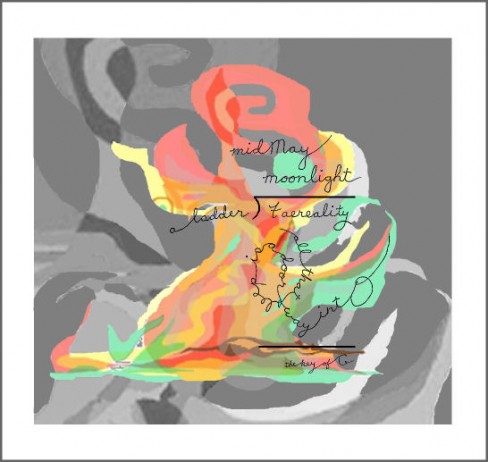
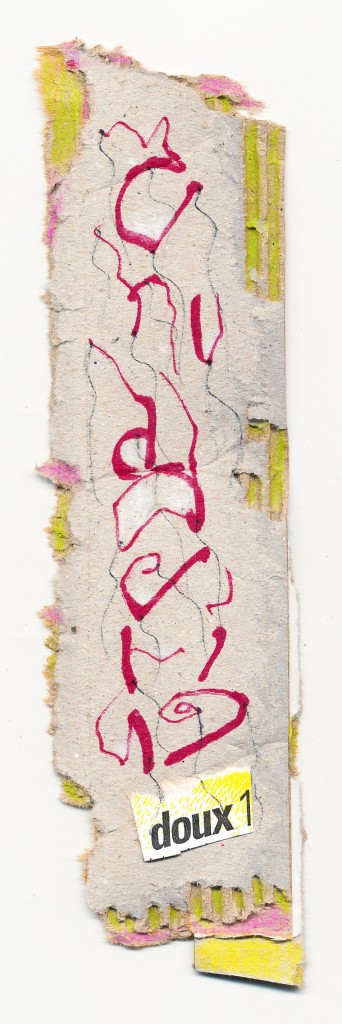
This one I call “Cursive Mathemaku No. 3.”


This is another one that, so far, I like a lot.  I even think it should be popular!  In any event, there’s a lot more work I have to do–color the writing (I’m pretty sure) and work out background.  The latter will be a combination, I think, of what I did with my preceding poem, and what I’ve done with my other two cursive mathemaku.  I’m looking forward to playing with it, but also fearing to. 

Entry 457 — Off to the Hospital

Wednesday, June 1st, 2011

I’ll be off to the hospital in another half hour or so.  I feel good.  Things should go well.  If everything works out maximally well, I’ll be able to make a blog entry from the hospital tomorrow.  Don’t bank on that, though.


Entry 448 — Another Terminological Change

Tuesday, May 24th, 2011

.

Although many of my coinages sound pretentious, I always aim for ordinariness.  It’s not that easy to achieve.  Hence, “xenological poetry” as one of my main categories of poetry.  Well, I suddenly saw yesterday that “dislocational poetry” could takes its place.  Ironically, that was the very first name I gave such poetry–surrealistic and jump-cut poetry–thirty or forty years ago.  I don’t know why I dropped it.  I see no reason not to use it now, though, so will.

Meanwhile, I also realized that “vaudevillic” as a term for all varieties of jump-cut poems is unfair since some of them cohere quite nicely.  So I’m bringing back “jump-cut” to its previous position, and demoting “vaudevillic” to a secondary position as an adjective describing one kind of jump-cut poems, the other kind being, “convergent jump-cut poems.”  Be sure to update your copies of A Preliminary Taxonomy of Poetry,” students.

I’ve made a change in what constitutes aesthetic pleasure, too: one of two things, fundaesthetic pleasure or pleasure due to fundaceptual stimuli, and anthraesthetic pleasure, or pleasure due to anthroceptual stimuli.  Then there’s a sort of new word, “osmoticism,” for the ability to learn osmotically, and its antonym, “unosmoticism,” which I use to represent one of the many intellectual dysfunctions of people who don’t believe in Shakespeare.

Last, and close to least is, “lifage,” my word for anything a person uses to trade when attempting to  increase the pleasure-to-pain ratio of his life.  An economics term.  There are two kinds of lifage, “inborn” and “acquired,” the latter of which is a person’s private property.  I came up with it because I needed some such term for what one trades to another when one rents a house to the latter in return for (the lifage) of money.  It’s not the lifage of the house (assuming for the sake of argument that it is as good after the rental period as it was before it) but the actual hours of life the landlord gives up, hours he could have used enjoying the house himself and which are permanently lost.  In other words, the term, “unearned income,” is nonsense.

Entry 419 — Philosobumblery

Monday, April 11th, 2011

“If you have to ask what jazz is, you’ll never know.”  Louise Armstrong.

“If you can’t define something, either you are lacking in analytical ability or it doesn’t exist.”  Bob Grumman.

By “define” I mean describing something not perfectly but intelligently enough for others to use your definition to find and use what you’ve defined.  For instance: to say that Bob Grumman’s residence is “the house with green walls at the southeast corner of Midway Boulevard and Hayworth Road in Port Charlotte, Florida, USA,” is to define it more than sufficiently for most purposes.  Ways can be found, in my view, for you to define it (or anything else) in any greater details required for whatever your purpose is.  Eventually.  To not yet have sufficient data to define something well does not make it undefinable.

I’m writing all this because of another stupid passage in Nordlinger’s New Criterion music review: “. . . a Carnegie Hall booklet featured an interview with James Taylor, the folk-rock-pop legend.  He said, ‘A trick that I seem to have used over and over again is to juxtapose a cheerful musical style with a grave or heavy lyrical content.  These things are so beyond description and analysis.’”  Sure, for someone not blessed with a good reducticeptual awareness (and most people in the arts are not, although Taylor seems to me to have given a helpful, partial description of his art).   I don’t fault Taylor for his off-hand remark about description and analysis, but Nordlinger for using it to support his belief in things that are beyond analysis, in this case a piece of unconventional music Nordlinger quoted a terrible attempt at an analysis of–in his mind to show, I gather, the futility of analysis, not that analysis, like anything else, can be poorly done.

Only initial premises are beyond analysis, and they are very few, one of mine being “The Universe is an eternal collection of matter and at least one urwareness occupying infinite space.”  (An “urwareness” is a person’s final eternal conscious-of-existence self; I know I have one and have no way of knowing whether anyone else does or not.)  My final definition of matter, if I had one, would be my only other unanalyzable premise, I believe.  My definition of space is simply “everywhere that matter isn’t.”  I recognize that this definition is considered obsolete by certified scientists, but hold to it, anyway.  Indeed, I recognize that I’m not saying anything certain philosophers now considered hopelessly out of it weren’t saying 200 or more years ago.

Entry 418 — How Philistines Think

Sunday, April 10th, 2011

Here’s Jay Nordlinger,  the music critic I think must be the world’s worst, in his latest column for The New Criterion: “Shortly before he left the music directorship of the New York Philharmonic, I did an interview with Lorin Maazel.  I asked him about conducting very familiar music.  Take Tchaikovsky’s Fifth: Was it still glorious and thrilling to him?  He said ‘It’s as glorious and thrilling as the day it was written.’ And ‘if you become jaded because of overexposure, the problem is yours, not the composer’s.’”

It’s a variation on one of the few stupid things Keats said, “A thing of beauty is a joy forever,” that Philistines, particularly in music, use to defend their resistance to anything unfamiliar.   But even the worst mediocrities don’t perform Tchaikovsky’s fifth three times during one concert.  Boredom with the over-familiar is what keeps a species from extinction.  Performances of Tchaikovsky’s symphonies (which I loved when I first heard them in my teens) should be banned until 2040.

Entry 408 — The Pleasure of a Poem

Saturday, March 26th, 2011

One experiences the main pleasure of a poem the moment one recognizes the truth it is a misrepresentation of.

This may be my best saying about poetry.  It came to me yesterday in response to a thread at New-Poetry.  (Without “main,” which I just now added, remembering the simpler pleasures poetry can give one.

One experiences the main pleasure of a musical composition the moment one recognizes the old music it is a misrepresentation of.   The statement’s logic holds for “a non-representational visimage,” too.  And “a work of narrative art.”

Entry 405 — Happy St. Patrick’s Day

Thursday, March 17th, 2011

.

Because I’m one-quarter Irish (due in part to the O’Meara family of County Cork), one of whom came here to fight in the Civil War.

I’m not really back.  I just thought of a summa of my thinking about art and science that I thought I should make public in case I drop dead before my vacation from my blog is over.

A verosopher’s duty is to attain as good a systematic understanding of existence as he can, and then express it as clearly as he can, which is by far the harder job.  An artist’s duty is to attain as good a systematic understanding of existence as he can, and then express it as unclearly as he can so long as he is just clear enough for his most serious engagents to connect to.

I’m not saying anything I haven’t been saying for fifty years, just saying it better, maybe.

Oh, I have an announcement, too: Jake Berry has been kind enough to use six of my poems to inaugarate the Otherstream Unlimited Blog here.   They’ve all been here before, except the last.  I happen to consider them all major, even the one at the top, which I rate that high because of its cheerful accessibility.  Really, in some ways it’s as good as anything I’ve done.

Okay, only the pair just below the top one are major.  (I really can’t understand how I was able to make such terrific poems.  They sum up just about everything I’ve managed to master of infraverbal, visual and mathematical poetry over the years.)   The others are pretty damned good, though.

Entry 251 — “Homage to Shakespeare”

Monday, October 11th, 2010

I keep directing my Shakespeare authorship friends and enemies to this poem, but none has commented on it, that I recall.   I tend to think Shakespeare fans rarely are much interested in newer forms of poetry.   I made it around twenty years ago.  It was the first of my visual poems to get accepted for Kaldron, the leading American visual poetry magazine of the time (but international in scope).  Unfortu- nately, I can’t show it large enough for the small print to be visible her.

Here’s an annotated detail of it showing what the small print says.

Entry 250 — Going in Reverse

Monday, October 11th, 2010

I now know more about pleasure and pain than I understand.   My problem, I think, is that what I know seems right, but I can’t organize it into any kind of neat, accessible package.  The thing bothering me is what beauty is.  I once pegged it as simply the right ratio of pleasure to pain a stimulus produces.  Then I remembered something obvious to almost everyone but me: that there are stimuli that are automatically perceived by healthy minds as beautiful.  Nothing wrong with two kinds of beauty, but the two seemed to me too different from one another to share a name.  Next thing you know, I’d have to accept an elegant mathematical proof as beautiful.  Okay in bull sessions, but not if one is concerned with useful serious communication since a term loses its linguistic value to the degree that it can be applied to significantly different things.

So, how about calling the stimulus with the proper familiarity to unfamiliarity ratio . . . ?  I can’t think of anything.  There’s the beauty our instincts are sensitive to, and the truth our instincts about what contradicts, what harmonizes, are sensitive to.  Empathy would be what our instincts derive pleasure from when interacting with others–that which is anthroceptually pleasurable, in terms of knowlecular psychology.  There’s good, too, or the pleasure–instinctive in many cases–we feel when we, or others, act in a manner we consider moral.

Okay, folks, I have to turn to neologization, again.  “Assimlatry.”  That is now my term for any stimulus causes that has the right r/f ratio (or “resolution/frustration” ratio, resolution being what happens when a psychevent leads to the familiar, frustration being what happens when it leads to  unfamiliarity).  “Assimlatrous” is the adjectival form.  Yes, grotesque terms, but naming is the first step toward understanding, and essential.

There’s also the need for the instinctive pleasure one feels when achieving a goal.  “Triumph” may be sufficient.  No, I think “success” better.  And “resolution” for “assimilatry.”  No, no” “comprehension” is the perfect name for it!  So, I have the following pairing on my list of kinds of pleasure and pain (with which of my theory’s awareness’s is involved in each case):

instinct-based evaluception

beauty/ ugliness: fundaceptual evaluception
empathy/ hostility: personal anthroceptual evaluception
good/ bad: moral anthroceptual evaluception
success/ failure: sagaceptual evaluception

logic-based evaluception

truth/ error: reducticeptual evaluception

experience-based evaluception

comprehension/ perplexity: combiceptual evaluception

I think I may be getting somewhere, after all. And, wow, a list of terms none of which is a coinage!  (I mean aside from the names of my awarenesses.)

Entry 247 — Still Trying to Get Terms Right

Saturday, October 9th, 2010

I now propose that the three human emotional responses are instinct-based, assimilation-based and logic-based.  And I’m back to naming the three evaluceptual (or emotion-evaluational) types dionysian, apollonian and hermesian, with the claim that dionysian and apollonian have much in common with Nietzsche’s two personality types but aren’t identical to them.  It’s true that when introducing my theory I have to spend time explaining my types, but that would be the case whatever I named them.  So why not go with interesting names?

In any case, the dionysian’s primary emotional reaction to stimuli will be on the basis of his innate instinctive evaluation of them as painful, pleasurable or neutral.  A wound will be painful, a smiling face pleasurable, a nondescript meadow neutral.  Near-universal direct emotional responses to commonplace realities.  He will thus generally be one of the crowd, and instinctively enjoy the feeling of oneness with others that fusing with a crowd can give one, as is true of Nietzsche’s dionysian.  His enjoyments will be mainly sensual, unreflective.

The apollonian’s primary emotional reaction to stimuli will be on the basis of his evaluation of them, mostly instinctive, as to whether or not they lead to contradictions.  If they harmonize with his other relevant understandings, he will find them pleasurable.  If they contradict those understandings, they will pain him to the degree that they contradict them.  If they lead to neither significant agreements or disagreements, as will most often be the case, they will cause no emotional reaction.  The apollonian’s enjoyments will tend to be abstract, austere, thoughtful.  He will feel himself above the masses, as is the case with Nietzsche’s apollonian.

The hermesian’s emotional reaction is similar to the apollonian’s inasmuch as it is determined in the cerebrum rather than coming already tagged the way the dionysian’s does.  However, whereas the apollonian is concerned with unchanging contradictions, the hermesian is concerned with how familiar a situation comes about, which is constantly in flux.  That is, if a psychevent leads to contradiction X, it will always cause pain, but if a psychevent leads to situation Y, the result may be pain on Tuesday but pleasure on Thursday, or even later on Tuesday, since what is familiar is a matter of one’s constantly growing knownledge of existence, while what is contradictory will always be contradictory.

Ergo, the hermesian’s response will tend to be the most sophisticated of the three.  It will be due to the hermesian’s long-term, cummulative experience of life, whereas the apollonian’s will be due to his innate, permanent sense of consistency, and the dionysian’s to his unchanging instinctive attraction-to/repulsion-from his immediate experience of life.

Still, the dionysian response will be the most natural, the generally most rich. the most unarguably valid of the emotional responses.  The apollonian’s the most scorned but probably the one most important for establishing the final value of an artwork, with the hermesian’s irrelevant if concerned with stimuli of not instinctual resonance or logic.

Okay, I’m still fumbling for my take.  I’m getting close to it, though.

Mathematical Poetry Specimen « POETICKS

Archive for the ‘Mathematical Poetry Specimen’ Category

Entry 143 — Taxonomical Update

Friday, June 11th, 2010

I toppled back into my null zone a couple of days ago.  Don’t feel like writin’ nuttin’ but have something too important not to make public right now.  It has to do with my recent taxonomy.  I want to add that “propaganda” is now a rank under “Sociodominance,” and “information” a rank under “Utilitry.”  I want also to put “war” and  “politics” under “Sociodominance,” and add “play” to my Phylum.

“Play,” by the way, breaks down into “games” and “pretense.”  “Games” I define as activities without connection to any other member sharing the category “games” is in whose participants follow rules and pursue some goal the attainment of which is considered victory.  I can’t remember the details of Wittgenstein’s demonstration that “games” could not be defined, but believe I have definied it.  Metaphoric use, or misuse of the term notwithstanding.   “Pretense” is unserious participation in any of the activities in my Phylum, by “unserious,” meaning that no knowledgeable person would consider the activity to be in any significant way the “real thing”–children playing house, for instance.

I also have a new long division mathemaku to bring to the world’s attention.  I won’t even draw it, it’s so lame: actual salt (glued to the page) divided into “NaCl” gives you “naming” with a subdividend product ot “salt” and a remainder of “science.”  This is lame because it’s just the statement of an opinion, to wit: “By naming the real substance, salt, you get the word, “salt,” which is equal, when “science” is added to it, to was salt esentially is, which, it is implied, is more than what it is as a substance.   The only reason I bother to post the poem at all is because it reverses the standard belief that real things are more than the words for them.  For me, words are more than their referents.

Entry 116 — Finally Back

Tuesday, March 9th, 2010

All I have today is a revision of my last mathemaku:

The title of the piece is “Mathemaku in Honor of Andrea Bianco’s 1436 Map of the World.”  I changed the previous quotient from “music” to a picture of a lute.  My reasoning was that “music” was too general; I wanted something that said “medieval.”  I’m satisfied with it now.

I’m a bit shocked to see how long it’s been since my last entry here.  I thought it’d only been four or five days.  I’m going to try to post more often now, maybe not daily but at least three or four times a week.  The past three days I’ve woken up feeling good.  I’ve been more productive though not as productive as I’d like to be.  Still, I’m out of the null zone I was in.

Part of the reason for that is that my bad leg (due apparently to sciatica) is better, although I still can’t run on it to any extent.  I’m optimistic that it will fully come around if I give it time and don’t play tennis again till I’m sure it’s okay.  Three times I played when it seemed okay but not right, and each time suffered during the next few days.

The pain pills I’m taking for the problem are probably (alas) the main reason I’m feeling so good psychologically.  Also contributing it the fact that I’m winning the game of Civilization I’m playing in!  I’ve never won it at the level I’m now playing it at.  This shouldn’t mean anything but it means a ridiculously lot!  Winning just about any kind of competition really zings me!

That’s it for now.  Hope to be back tomorrow.  Will definitely be back before the week ends.

Entry 54 — Christmas, 2009

Friday, December 25th, 2009

Entry 44 — A Mathemaku & Some Poetics Notes

Tuesday, December 15th, 2009

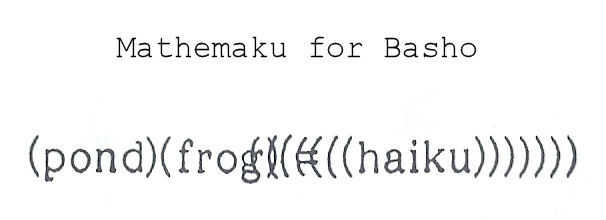
The following, which is from #691,  is one of my earlier mathemaku.  It’s simple to understand: just think ripples, and remember that in strict mathematical equations, what’s on one side of an equals sign is upposed to stay there, and what it might mean metaphorically if it did not.

Mathemaku4Basho

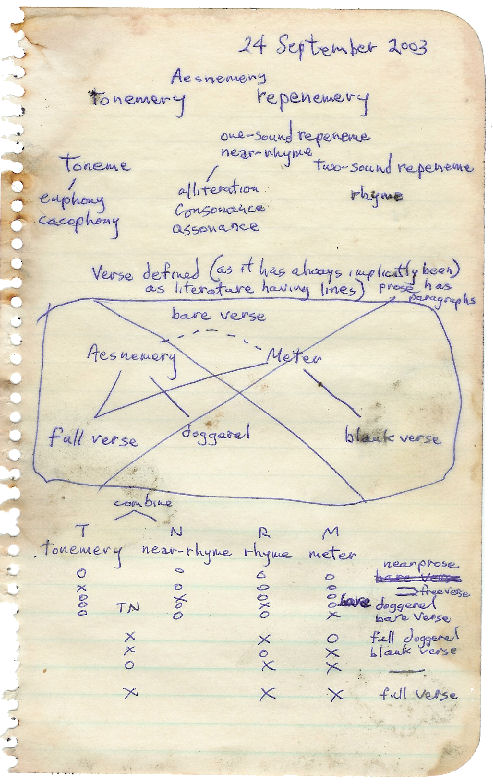
Next we have a page  I scribbled some notes on in 2003 that makes good sense to me at this time, although I never took the notes into any kind of essay, that I recall:

Sept03page

And now, after two simple uploads, I’m too worn-out to do anything else, believe it or not.

Entry 40 — #675 through #670

Saturday, December 12th, 2009

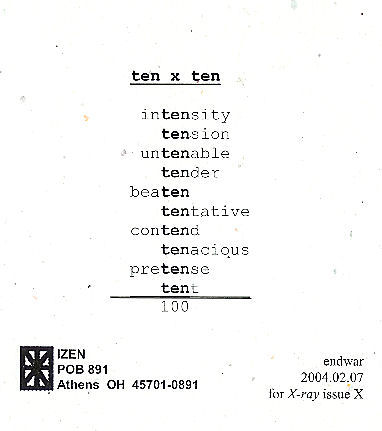
In #675, I posted Endwar’s “Ten X Ten,” having liked it so much, I assume, that I’d forgotten I’d posted it a week of so before at my blog.  Under the Endwar piece, I had three mathematical poems by Kaz Maslanka, one of which is also a visual poem but too large to reproduce here without losing most of the text.  One of the others has the same problem, but the one below should be readable:

a-mans-intelligenceOops, you may need a magnifying glass.  My choice of reproduction seems to be the size above, or four times as large.  Anyway, it’s called “A Man’s Intelligence” and may be more informrature–a specimen of informratry–than poetry.  Let me quote what it says: “A man’s Intelligence” equals “intelligence Quotient” divided by the product of “The measurable level of Dionysian blood transfused in a saffron masseuse boasting whispers through the cool crystal shot glass of the finest golden tequila” times “The amount of passion fueled by a young pink Venus–her hand wandering in slow circular patterns, a seemingly aimless whistle up the man’s inner thigh.”

#677 and #678 are about the Christmas mathemaku I’d done a draft of the previous year, and worked some more on at this time (December 2005), and have worked on since then, finishing it, I believe.   Then a reproduction and revision of a long division poem I used in the autobiographical essay in the mainstream series of such things I got it into many years ago, without its making any difference whatever in my vocational reputation.  I don’t like it well enough to reproduce it here.  I had another of my mathematical poems in #680 that I don’t like enough to reproduce here.

Entry 34 — Yesterday’s Mathemaku Again, and Another

Saturday, December 5th, 2009

Here’s the latest version of what I think I’m calling “Frame 17″ of The Long Division of Poetry:

17Aug07D-light

I didn’t like the background blue as dark as it showed here, so I lightened it.  For some reason, that made a lot of difference to me.  I also changed the quotient of the mathemaku below, another variation on the lead frame of The Long Division of Poetry that I composed in 2007 and have only touched up slightly since, mostly to increase its resolution.  I feel it’s about as good as I’m capable of getting as a mathematical poet–although I do feel I’ve done a few mathemaku that are better than it.

20Nov09E

The divisor is hard to read on-site, I don’t know why.  The image is much darker than it is on the screen of the computer where I do my Paint Shop work, even though I tried to lighten it.   Oh, it’s tiff on my computer, jpeg here, which may explain it.  Anyway, the divisor reads, “a memory of/ Harbor View, June 27, 1952″

Note: for those of you new to Grumman Studies, “manywhere-at-once,” which is usually capitalized, is where (according to my poetics) metaphors and other figures of speech send one.  Two or more places in one’s brain at the same time.  So this poem attempts to express the value of equaphoration–my term for any poetic device that in some way equates one thing with another, even irony, which equates the truth with its opposite.

Entry 33 — Yesterday’s Poem

Friday, December 4th, 2009

Here’s yesterday’s image again:

17Aug07B

It’s one of my mathemaku, of course.    I’ve actually been working industriously  on it, trying get it right enough to submit to some sort of  anthology Nico Vassilakis and Crag Hill are putting together.   The version above is a recent revision of my first draft of 2007, a variation on “Frame One” of my Long Division of Poetry series.

17Aug07D-light

“Frame One” is similar to the top image except that its divisor is “words.”  It had long bothered me because (and make sure to write this down, students, because it’s an excellent example of the way I think about my poems) its claim was that “words” squared (basically–although it’s really distorted words, or words told slant. times regular words) happened to equal an image having to do with summer rain.  Why that and not, say, a Pacific sunset?   Obviously, the quotient times the divisor could equal anything.  That, I didn’t want.  Off and on I thought about this, but could think of no way to take care of it.  Until a couple of days ago, when I finally concentrated for more than a few minutes on it.  I came up with several pretty good solutions, one of them changing everything in the poem but the sub-dividend product (the image).

My final solution (I hope) resulted in the above poem.  All I did was add “memories of a long-ago summer day” to the quotient.  That assured that the sub-dividend product would have to do with summer–that it would be, that is, a visual poem about summer.  And, as a poem, it would be poetry.

No doubt in due course I’ll think of something else I find illogical about it and want to revise it again.  For now, though, I’m happy with it.

Oh, I’ve made several changes to the main image in it, too.  One was to combat the darkness in the top version (which wasn’t in it until I put it out here).  I’m as fussy about getting my graphics looking the way I want them as I am about everything else in a poem–except the choice of font, and things I can’t do anything about with my equipment, like density of resolution.

Entry 32 — A Mathemaku from 2007

Thursday, December 3rd, 2009

I continue to be more out of it than not, so have just this for today:

17Aug07B

Guess who composed it.

Entry 31 — Old Blog Entries 663 through 670

Wednesday, December 2nd, 2009

In #663, I presented my Odysseus Suite–but the reproduction is too crude for me to re-post it here.   My nest entry featured this, by Endwar:

TenByTenAs I announced when I first posted this, I am hoping to publish an antho- logy of mathematical poems, like this one, so if you have one or know of one, send me a copy of it, or tell me about it.
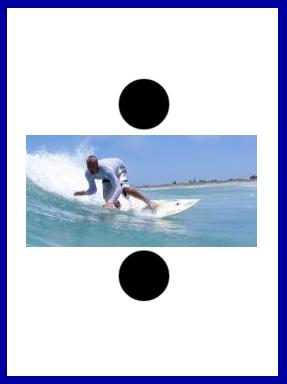
#665 had this by Marton Koppany, which I have to post here because it was dedicated to ME:

Odysseus

Hey, it’s mathematical, too.  The next entry, whose number I fear to state, concerned this:

Bielski-Haiku-BW

This is from Typewriter Poems, an anthology published by Something Else Press and Second Aeon back in 1972. It’s by Alison Bielski, An English woman born in 1925 whose work I’m unfamiliar with. I find this specimen a charmer . . . but am not sure what to make of it. Three lines, as in the classic haiku. The middle one is some sort of filter. Is “n” the “n” in so much mathematics? If so, what’s the poem saying? And where does the night and stars Hard for me not to assume come in? Pure mathematics below, a sort of practical mathematics above? That idea would work better for me if the n’s were in the lower group rather than in the other. Rather reluctantly, I have to conclude the poem is just a texteme design. I hope someone more clever sets me right, though. (I’m pretty sure I’ve seen later visio-textual works using the same filter idea–or whatever the the combination of +’s. =’s and n’s is, but can’t remember any details.)

It was back to my lifelong search for a word meaning “partaker of artwork” in #667–but I now believe “aesthimbiber,” which I thought of in a post earlier than #667, I believe, but dropped, may be the winner of my search.

Next entry topic was about what visual poets might do to capture a bigger audience.  I said nothing worth reposting on a topic going nowhere because visual poets, in general are downright inimical to doing anything as base as trying to increase their audience.   One suggestion I had was to post canonical poems along with visual poems inspired by them, which I mention because in my next entry, I did just that, posting a Wordsworth sonnet and a visual poem I did based on and quoting part of it–and don’t re-post here because of space limitations.  I wrote about the two in the final entry in this set of ten old blog entries.

Entry 25 — Old Entries 641 through 651

Thursday, November 26th, 2009

azily back to old blogs again, this time beginning this mathematical poem by Andrew Topel taken from #641:

add3-small

A very slightly revised version of one of the mathemaku in yesterday’s entry not worth posting here was the feature in my next entry.  Then some minor autobiography.  In #644 & #645 I posted 3 more of Andrew Topel’s addition poems, including:

add4-small

On September 24, 1997, I started my first blog, an actual log for my poetry website, Comprepoetica.  In entries #646 through #651 I reprinted my (few) entries.  OF great historical interest, no doubt, but too boring to post here.

Entry 381 — “a lexicOn” « POETICKS

Entry 381 — “a lexicOn”

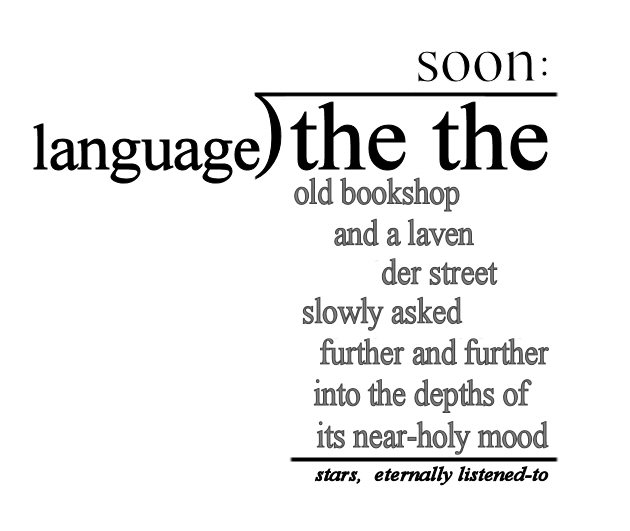
Below is my latest mathemaku, the one I’ve been working on all week.  I may try to improve it eventually, but I’m leaving it alone for now.

Leave a Reply

Entry 390 — Two Poems from three Years Ago « POETICKS

Entry 390 — Two Poems from three Years Ago

.

Just about three years ago I wrote a version of the following poem:

.             Poem has a question

.             Whose sleep is the sky?
.             For hours and
.             hours Poem
.             wondered.

I improved it just now by deleting its previous two last words, “about that.”

Note: I find that the day after I wrote the above, I “improved” it by adding ten or twelve lines to it.  I hereby disown that version.

The following is a re-done poem I sent a year or more earlier to something going on in Mexico.  I was trying to do something with the show’s theme of International friendship, or something.  Barely worth keeping, I’d say but may some will enjoy it.

Note: as should be obvious from the way I strained tofind things for this entry, I’m still blah.

5 Responses to “Entry 390 — Two Poems from three Years Ago”

  1. marton koppany says:

    Whose sleep is the sky.

  2. Bob Grumman says:

    Aah, you minimalists!

    But possibly yours is an equal but different version of the poem; I like Poem physically in his poems, though, and the emphasis on the time the question intrigues him. There’s even a juxtaphor (implicit metaphor) between the motion of the sky and the motion of Poem’s wonder–for me, at any rate.

  3. marton koppany says:

    It just came to my mind as a possible “answer” to Poem’s “question”. Perhaps, yes, because he was physically there. :-)

  4. Kevin Kelly says:

    I’m still working my way in reverse (top to bottom) on your blog, Bobby, so I may find more like these, but I think there’s something really interesting going on in “Mathemaku No. 21,” specifically in the figure after the minus sign. I like the possibilities with the reverse type creating new shapes inside those already created in the mashing up of letters.

  5. Bob Grumman says:

    Thanks for the look, Kevin.

Leave a Reply

Entry 624 — A Change of Mind « POETICKS

Entry 624 — A Change of Mind


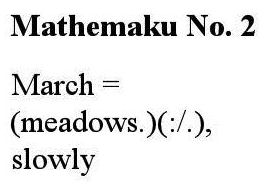
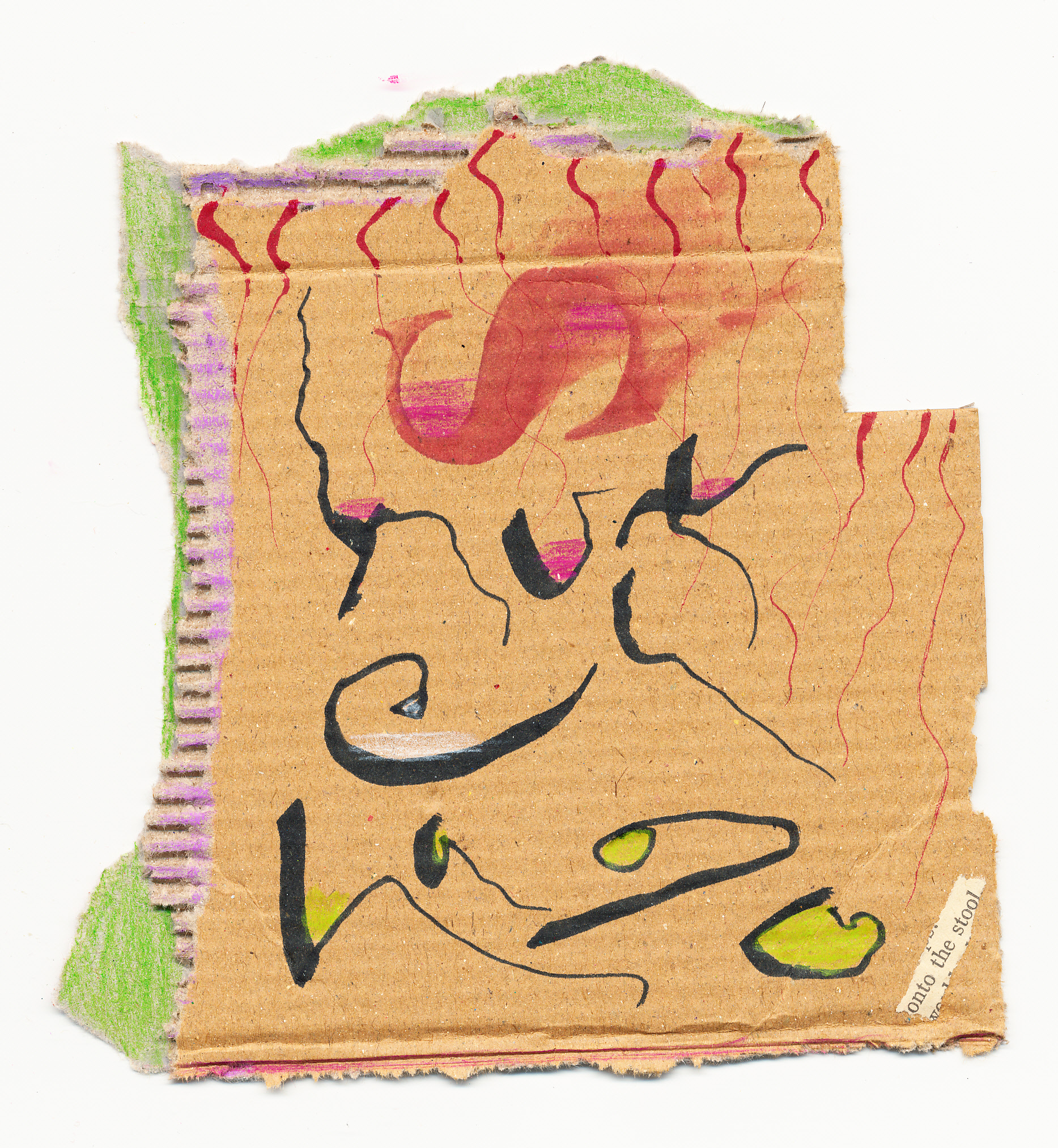
In Entry 536, I called the following a “misfire.” It made no sense to me. Coming across it again a week or so ago, I completely changed my mind: it makes perfect sense to me, now (if only meta-rationally). I now think of it as being as good as anything I’ve yet done. I also decided my “Cursive Mathemaku No. 2″ is probably better without the colored background I added to it.  Sometimes, though, I actually finish a piece permanently.

.

Leave a Reply

Entry 491 — Rough Sketch of Another Poem « POETICKS

Entry 491 — Rough Sketch of Another Poem

This one I call “Cursive Mathemaku No. 3.”


This is another one that, so far, I like a lot.  I even think it should be popular!  In any event, there’s a lot more work I have to do–color the writing (I’m pretty sure) and work out background.  The latter will be a combination, I think, of what I did with my preceding poem, and what I’ve done with my other two cursive mathemaku.  I’m looking forward to playing with it, but also fearing to. 

2 Responses to “Entry 491 — Rough Sketch of Another Poem”

  1. marton koppany says:

    It is beautiful, Bob! One question though: what is the first letter of the divident (before “aereality”?)? I can’t dechiper it.

  2. marton koppany says:

    Ok, sorry for my old English.
    (And thanks for the clue, Bob, that you sent me in a email message.)

Leave a Reply