Infraverbal Poetry Specimen « POETICKS

Archive for the ‘Infraverbal Poetry Specimen’ Category

Entry 1540 — A New Work of Mine at Truck

Saturday, August 16th, 2014

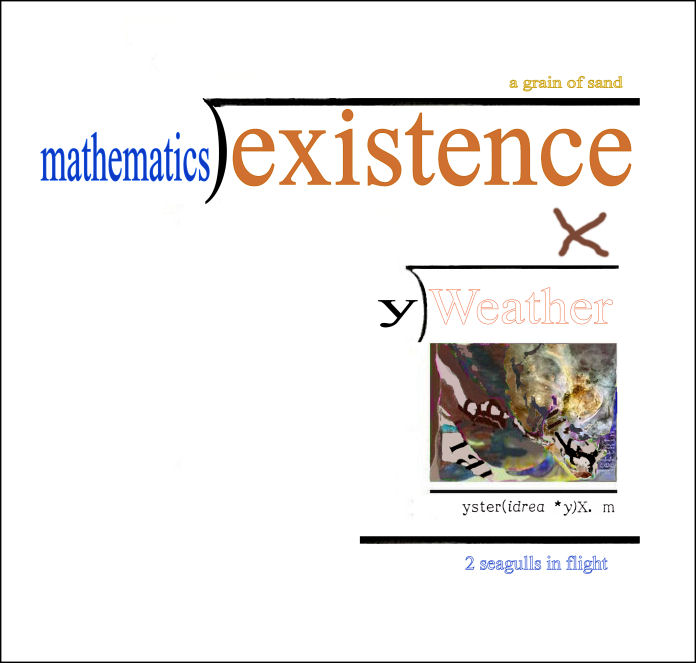
Just an announcement today as I ccontinue to try to get my current reviews out of the way (and do seem to slowly be succeeding in doing so).  Go here to see “An Evening in June, 1952,” a nostalikuical long division about (sob) my lost boyhood, mostly the part of it spent in boys’ adventure books, but also actual times camping out. Click once on my poem to see a better version of it.

The codes are simple, but I’ve put hints that help down at the far right, if you need them. Further hints available for $12 apiece at HINTS, 1708 Hayworth Road, Port Charlotte FL 33952. (Note, for those of you keeping score: yes, it is a Major Poem.) (Note, for any knownstreamer accidentally here who laughs at the presumption of my declaration, I dare you to present a cogent argument against it.  Not that my declaration isn’t intended as a joke, but only in part.  I absolutely believe it.  I don’t think all or even most, of my poems are major, but if–at my age–I didn’t feel some were it would indicate that I’ve completely wasted my life.)

(((b=a, 5=e)))

.

AmazingCounters.com

Entry 1538 — Curiosities?

Thursday, August 14th, 2014

I’m really cheating today: I’m using part of a review or column for Small Press Review that I’ve been working here.  The work I’m reviewing is Richard Kostelanetz’s Ouroboros (see Entry 1535):

An ouroboros is a mythological serpent swallowing its tale, so an excellent title for this collection of 188 words like, well, “ouroboros,” swallowing their tails, each time adding at least one interesting word to what they’re saying, “sour,” in the case of “ouroboros.” They are set in a highly appropriate, highly dramatic font called “Wide Latin”—very bold and jabbingly pointed at all extremities. It’s definitely fun to find smaller words inside Kostelanetz’s specimens of “circular writing,” as he terms it: “tea,” “pet,” and “petite,” for example, in “appetite,” as well as “appetite” itself, which one discovers rather than automatically sees, or “tin,” “descent,” and, most important,” “scent” in “incandescent” (because of the poetic jolt light as an immaterial scent, or a scent as immaterial light suggest to those sensitive to connotation). But can such objects be considered poems—rather than “curiosities” .

I told Chris Lott that I would explain why I thought certain arrangements of numbers Richard had made were more than curiosities, and that I’d soon explain why I thought that.  Here, quickly, using Richard’s circular words, I’ll give the gist of my reasoning that some  of them are, the ones that: accentuate connotative value, a virtue of poems although not necessarily a defining quality, and in the process create an image complex of aesthetic value, the way I think “appetite” turns eating into a very feminine tea party, and “incandescent” makes “scent” and “incandescence” plausible metaphors for each other; that they also sslow the reading of them, as any effective poem must (although I do not consider that a defining characteristic, either, but the result of defining characteristics, like the flow-breaks line-breaks serve as in free verse, and the extreme flow-break of a word being spelled into a circle); and, least important, but still important, they are decontextualized from prose, both by simply being called poems and by not being visually rose.

Richard’s number poems are somewhat different.  I hope to discuss them, too, before long.

One further note.  Many of Richard’s circular words combine into interesting narratives full of “heightened cross connotativeness,” by which I mean, one word’s  mundane connotation turning vividly into a related connotation due to a similiarly mundane connotation in an adjacent circular word.  For more on that, you’ll have to wait for my column, as I now see this text will become.  You will be able to do that by subscribing to Small Press Review, which I wish a few of you would do; or by waiting for me to post the column in my Pages here a few months after it is published.

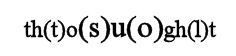
Note #2: I do not consider circular words to be visual poems; for me, they are visually-enhanced infra-verbal poems–the poetic value lies almost entirely on what goes on inside them verbally.  Although you might say their visual sspin flicks connotations into view . . .

.

AmazingCounters.com

Entry 1309 — A Little Quartet

Tuesday, December 24th, 2013

With thanks to Mark Sonnenfeld in whose whose latest Marymark Press broadside it appears:

Housekeeper

.

Entry 1279 — Cumminfluenced Itemgs from 2006

Sunday, November 24th, 2013

CummingsAndGongsCoveryou'retoooldnowunderGoingGong

.

Entry 1250 — Rejected Pwoermd

Saturday, October 26th, 2013

I was going to use the pwoermd, “mythstery,” inside the open letters of “the core of faereality,” which is the dividend of a set of long division poems I’ve been working on, but decided it was too frothily cute.  But maybe not worthless?  Anyway, here it is.  And I’m outta here.

.

Entry 1034 — A Math Poem by Ed Conti

Wednesday, March 6th, 2013

Million

This is an extremely plural specimen of plurexpressiveness: an infraverbal, visual, mathmatical poem by the best composer of infraverbal light verse I know of, and among the best light verse poets of any kind, Ed Conti. To see some other great examples of his work, go here.
.

Entry 995 — A Gem by Kevin Kelly

Saturday, January 26th, 2013

The following is a pwoermd Kevin Kelly posted to Spidertangle the other day:

hearthththrob

I like the way it makes me, at any rate, close to simultaneously strongly, sympathetically identify with the one whose heart throb is involved, and laugh at the poor jerk.  The lisp of the heartbeats is any excellent touch, too.  Not to mention the stuttering attempt to say, “the,” but not be able to.  Never has “heart throb” been so fully writ.

.

Entry 929 — a form of i

Wednesday, November 21st, 2012

I got home yesterday afternoon after a very nice, mostly relaxing time at my niece, Laura’s, wedding (getting to which was the only unrelaxing time, because of my old man’s plumbing), and visiting my brother’s and sister’s families.  I got a few things done once home, and this morning, but want to take the rest of the day off, so will only post the bit of light infraverbal poetry below–which I came up mwith last night and, believe it or not, don’t consider mathematical, unless you want to call understanding that the square root of minus one equals i in mathematics makes it so.  Calling it mathematical would be like calling “1self” mathematical.  Using math symbols does not make a text mathematical; only showing and using math operations does that.  For me.

Note: in mathematics, i stands for imaginary, because solution, being impossible to determine, is “imaginary.”  I expect to be using it in upcoming math poems, and possibly the entire piece above.

.

msn spaces tracking
AllOnlineCoupons.co.uk

Entry 855 — An Appropriately Titled “Untitled”

Saturday, September 8th, 2012

The following infraverbal masterpiece is the world’s first artwork given the title, “Untitled,” appropriately. It’s just one of the 78 pieces in Identities, a collection of work by Irving Weiss just out from Xexoxial Editions.  It’s something to wonder through many more times than once, with a fantastic skitter through the arts, from low to high, 100% verbal to 100% visual, the comic to the largest ultimates (as well as a combination of both). I hope to say more about it here and elsewhere.

  .

Entry 846 — A Pwoermd by Stephen Nelson

Thursday, August 30th, 2012

Stephen composed this in a dream!  I think that happened to me once.

I consider it primarily an infraverbal poem, because dependent on what happens inside it.  But it is also a visual poem.  What makes it terrific is that, as spelled, it is a double metaphor: for (1) shape-changing flexibility, and (2) a flood surging forward too quickly for its spelling to bother with correctness–but brilliantly describing it as well as denoting it.  I got it from the Otherstream Unlimited site, where I called it “an instant classic.”

.

Entry 372 — Mathemaku Still in Progress « POETICKS

Entry 372 — Mathemaku Still in Progress

If I ever come to be seen worth wide critical attention as a poet, I should be easy to write about, locked into so few flourishes as I am, such as “the the” and–now in this piece, Basho’s “old pond.”  I was wondering whether I should go with “the bookshop’s mood or “a bookshop’s mood” when Basho struck.  I love it!

Just one word and a trivial re-arrangement of words, but I consider it major.  (At times like this I truly truly don’t care that how much less the world’s opinion of my work is than mine.)

We must add another allusion to my technalysis of this poem, describing it as solidifying the poem’s unifying principal (and archetypality), Basho’s “old pond” being, for one thing, a juxtaphor for eternity.  Strengthening its haiku-tone, as well.  But mainly (I hope) making the mood presented (and the mood built) a pond.  Water, quietude, sounds of nature . . .

Oh, “old” gives the poem another euphony/assonance, too.

It also now has a bit of ornamental pond-color.  Although the letters of the sub-dividend product are a much lighter gray on my other computer than they are on this one, the one I use to view my blog.

2 Responses to “Entry 372 — Mathemaku Still in Progress”

  1. Kevin Kelly says:

    I really like this one; it strikes me as very E.E. Cummings-inspired, and I love that guy. I think the use of gray is a good idea because it gives the “remainder” more punch at the end. I’m a bit confused on reading your description in which you keep talking about Basho’s pond, which I don’t see in evidence here … I’m thinking if I had seen an earlier version of this, or I was better versed in the Grummanverse, I would understand that. And finally, you won’t have to struggle between “the” or “a” bookshop’s mood soon, where there’s just one bookshop left. Just had to end that with a little (sad) humor!

  2. Bob Grumman says:

    Oh, boy, I get to explain! Nothing I love more. Basho comes in because of his famousest poem, which I’ve made versions of and written about a lot, the one that has the “old pond” a frog splashes into. My poem has an “old bookshop” that has a mood with depths a street enters like (I think) the pond’s water with depths the frog enters. But now that you bring it up, I guess the allusion is pretty hermetic.

    Glad you like it. I still do now that I’m looking at it again–although it strikes me as pretty weird.

Leave a Reply

Entry 379 — “for bob grumman” « POETICKS

Entry 379 — “for bob grumman”

Yesterday, Andrew Topol posted a mathematical poem by Anna Korintz at Spidertangle called, “for bob grumman,” so I had to post it here:

.

Thanks, Anna and Andrew!

Oh, and I have another alphabet to present, a very lame one:

abcdefghijklmnopqrstuvxyzw

.

Leave a Reply

Entry 31 — Old Blog Entries 663 through 670 « POETICKS

Entry 31 — Old Blog Entries 663 through 670

In #663, I presented my Odysseus Suite–but the reproduction is too crude for me to re-post it here.   My next entry featured this, by Endwar:

TenByTenAs I announced when I first posted this, I am hoping to publish an anthology of mathematical poems, like this one, so if you have one or know of one, send me a copy of it, or tell me about it.

#665 had this by Marton Koppany, which I have to post here because it was dedicated to ME:

Odysseus

Hey, it’s mathematical, too.  The next entry, whose number I fear to state, concerned this:

Bielski-Haiku-BW

This is from Typewriter Poems, an anthology published by Something Else Press and Second Aeon back in 1972. It’s by Alison Bielski, An English woman born in 1925 whose work I’m unfamiliar with. I find this specimen a charmer . . . but am not sure what to make of it. Three lines, as in the classic haiku. The middle one is some sort of filter. Is “n” the “n” in so much mathematics? If so, what’s the poem saying? And where does the night and stars Hard for me not to assume come in? Pure mathematics below, a sort of practical mathematics above? That idea would work better for me if the n’s were in the lower group rather than in the other. Rather reluctantly, I have to conclude the poem is just a texteme design. I hope someone more clever sets me right, though. (I’m pretty sure I’ve seen later visio-textual works using the same filter idea–or whatever the the combination of +’s. =’s and n’s is, but can’t remember any details.)

It was back to my lifelong search for a word meaning “partaker of artwork” in #667–but I now believe “aesthimbiber,” which I thought of in a post earlier than #667, I believe, but dropped, may be the winner of my search.

Next entry topic was about what visual poets might do to capture a bigger audience.  I said nothing worth reposting on a topic going nowhere because visual poets, in general, are downright inimical to doing anything as base as trying to increase their audience.   One suggestion I had was to post canonical poems along with visual poems inspired by them, which I mention because in my next entry, I did just that, posting a Wordsworth sonnet and a visual poem I did based on and quoting part of it–and don’t re-post here because of space limitations.  I wrote about the two in the final entry in this set of ten old blog entries.


Tags:

Leave a Reply

Emmett Williams « POETICKS

Archive for the ‘Emmett Williams’ Category

Entry 831 — Counting to Five

Wednesday, August 15th, 2012

I’ve probably posted this before but it’s worth a second post.  I came across it while hunting for stuff to use in my mathematical poetry guest blog.  It’s more of a joke than a poem, but a good joke is as valuable as a good poem:

.

Entry 373 — “Cursive Mathemaku No. 1″ « POETICKS

Entry 373 — “Cursive Mathemaku No. 1″

.

The past few days, I’ve been trying to get my mathemaku numbered and filed in order.  I’m up to Number 49.  Don’t know what Number 50 is.  It will take time to arrange the rest of my mathemaku.  I’ll have to go through a lot of diary and blog entries.  I rarely date finished print-outs, but often date rough drafts, especially the first ones.

For the heck of it, I rated my first 49: 16 of them I consider first-rate, 25 okay, and 8 not too hot.  I’ll probably keep them since sometimes others get something out of works one doesn’t think of oneself.

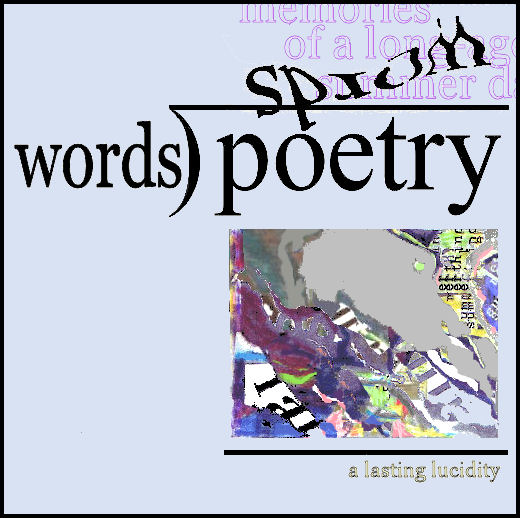
Anyway, the above turned up at position 34.  I’d forgotten about it and don’t think I ever posted it, so here it is.  It’s one of the ones I rate “okay.”  At the time I made it, I thought cursive mathemaku would be a fine vein for me to follow up on, but I did only this one–and my “Long Division of Haiku,” which is one of my 8 disappointing children.

Further notes about my first 49 mathemaku: they actually consist of probably something like 80 mathemaku since they include six or seven sequences, one of them quite long, The Long Division of Poetry.  I’m sure I’ve done over a hundred mathemaku by now, but I doubt that I’m up to “Mathemaku No. 100″ yet.

5 Responses to “Entry 373 — “Cursive Mathemaku No. 1″”

  1. nico says:

    this i like. keep it. do no touch ups.

  2. marton koppany says:

    A very beautiful piece!

  3. Bob Grumman says:

    Thanks:

    Nico–but I’m itching to make one very small change! I probably won’t. IF I do, I promise not to mess with it otherwise.

    Marton. Yours and Nico’s encouragement is much appreciated. Your eyes are as good as they come. I hope you get me to do a few more cursive poems. I’ve let some ideas wander in but they so far have all kept going.

    –Bob

  4. Kevin Kelly says:

    I like this. I think the cursive really flows well with the illustration. Would like to see more of these.

  5. Bob Grumman says:

    Thanks, Kevin. This one has now gotten three compliments. I did try to do another cursive but it turned off into something else. I do want to try more, though.

Leave a Reply

Visual Poetry Specimen « POETICKS

Archive for the ‘Visual Poetry Specimen’ Category

Entry 621 — Evolution of Style

Wednesday, January 11th, 2012

One of my works that I was particularly pleased with when I came across it while backing up blog entries was the following:
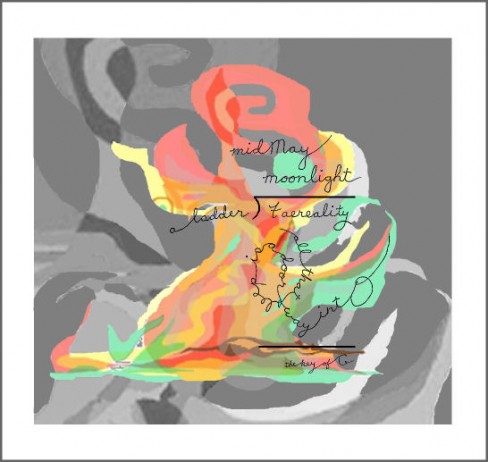


I have one problem with this: my only version of  it is a low-resolution jpg, which I don’t know how to convert to high-resolution tif, except by simply redoing it.  Any suggestions from anybody out there who knows more than I do about this kind of thing?

I didn’t re-post it only to ask for help, or because of how much I like it, but as an example of how my work as a poet has evolved.  Actually, I want to show that it has evolved.  That’s because Paul Crowley, the nut I most argue with on the Internet about who wrote the works of Shakespeare, seems not to believe that a poet’s style, or way of making art, evolved once he’s past his apprenticeship.  Of course, he will claim I’m not a poet, and that the evidence I’m about to produce to show my evolution indicates only trivial changes, not anything like genuine evolution.  I enjoy talking about my work, and analyzing any poem, so will go ahead with my demonstration, anyway.

First of all, I should state my claim: it is that over the past couple of years, my style as a poet has evolved appreciably, and that this poem illustrates it.

(1) I only began using cursive ten or fewer years ago, and never for more than a word or two.  This poem and two others have all or most of their texts in cursive.  Because the difference in expressiveness between print and cursive is visiopoetically meaningful to those who appreciate visual poetry, this wholesale use of cursive script counts as a significant evolution of style.

(2) My use of cursive is more elegant here than it is in mt other two recent poems making extensive use of cursive.  Note, for instance, the large O, and the increased gracefulness of all the letters compared with the letters in my other two cursive poems.

(3) Twenty years ago, I didn’t bother giving my poems backgrounds.  Since then I have, and have slowly been improving (but have plenty of room for further improvement).  Note the harmony of the background’s shape and colors with the text, especially the O. 

(4) The background has another important value–the connotations it picks up as a result of its being a variation (mostly through color changes) of the background in another poem of mine.  Connecting poems of mine with others’ poems and others of my own poems is another way I’ve evolved as an artist, not doing it until perhaps twenty years ago, then only very slowly doing it to a greater and greater extent.  This poem may be the first to re-use an entire background from another poem.  This is not trivial, for it allows this poem to suggest “dictionary-as-temple,” the main part of the foreburden of the poem its background is from.  It also should make this poem easier to enjoy, the same way the repetition in a new musical work of an old theme is usually pleasant to hear.  I believe the happiness of the colors of this version of the background gains from the reminder of the different, lower-key mood evoked by the other version.

(5) The use of color in tension with greyscale is another trick new to me twenty years ago that I exploit more and more in my present works, as here (though I’ve done more with it elsewhere).

(6) I think my language has evolved over the years, too–from fairly literal to metaphorical and/or surreal.  The “logic” of this piece and most of my recent pieces is not so easy to guess, which may be an unfortunate evolution, but an evolution nonetheless.

(7) You can’t tell from this image, which has been reduced in size to fit the normal computer screen, but the hard copy is larger than anything I did ten or more years ago, which is another result of evolution. 

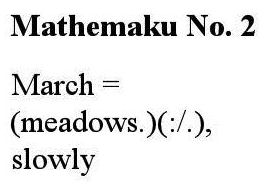
Here’s my first or second mathemaku, done thirty or more years ago, to make the profound evolution of my style more inescapable. Yet I maintain this piece is at the level of later pieces; it is simply more condensed. For one thing, it is only linguistic and mathematical. Nothing visioaesthetic happens in it. The eye is used only to recognize the symbols it contains, not to enjoy colors or shapes the way my faereality poem compels it to–i.e., not a visual poem (except inthe mindlessnesses of those for whom just about everything is a visual poem). It is short, and printed. Its words are simple to an extreme.
.

Entry 620 — Getting Enough Sleep

Tuesday, January 10th, 2012

A little while ago (it is now around 9 P.M., 9 January)  I was feeling good.  I attributed this to my having gotten two naps today, one of an hour, the other of one or two hours.  And I had gotten six hours of sleep last night, which is about as much as I generally get.  I had just about finished backing up my blog entries and was very pleased at how good many of my poems seemed to me when I noticed them during the process.  Unfortunately, I got the dates up my upcoming entries wrong, and in correcting them, lost what I had written for this entry.  That pretty much wiped out my mood.  I can’t stand screwing up like that, but I do it all the time!
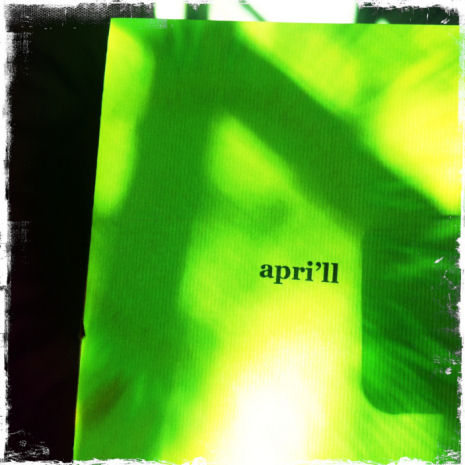


This is a pwoermd I stole from Geof Huth’s blog–because it has become too sophisticated to accept comments from dial-ups like my computer, and I wanted to comment on it.  It’s by Jonathan Jones, lately of Brussels, but a citizen himself of the United Kingdom.  What I like most about it is that it’s lyrical–as too many pwoermds are not.  It wouldn’t be a visual poem for me, but an illustrated poem, except that I subjectively feel “apri’ll” is producing the wonderful colors of spring it is slanted into a portion of (through sheer will-power).  Hence, in my taxonomy it is an infra-verbal visual poem.

.

Entry 618 — “Hungarian Vispo No. 2″

Sunday, January 8th, 2012

Marton Koppany’s latest visual poem may be the gentlest satire on a country’s government ever, if I’m interpreting it correctly. Note the boot on the head of one of the country’s citizens, for instance–and the complete insanity of the country the cloud with an umbrella suggests. Much more is going on that I’ll let you discover without help.
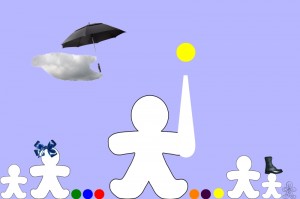
Hungarian Vispo No. 2

.

Entry 613 — Vispo SpamAd

Tuesday, January 3rd, 2012

The following is a detail from a Spam ad that I got yesterday.   It’s a good example of a commercialized visual poem.  Effective as an eye-catcher, but not very good as a visual poem.

 

 Below is my improved version.  Certainly not yet a great work but better than the original.  If you can’t see why, I’m afraid you aren’t too perceptive about the art.  If you can’t see how the basic idea could be used in a far better piece, you probably aren’t an effective visual poet, or are tired.

 

Diary Entry

Monday, 2 January 2012, Noon.  I got up late because I stayed up late last night watching my Giants fall apart, but win anyway because Dallas fell apart just in time to keep from winning.  I don’t think the Giants have much hope of going far in the play-offs, but I’ll be rooting for them.  And the other teams are pretty inconsistent, too, except for San Francisco and Green Bay.

I began the day by forcing myself to run.  Actually, I slowly ran, then ran fast albeit not really fast, then walked.  Rrrrrruuuuunnnnnn, rruunn, walk over and over until I’d gone around the middle school field four times (two miles).  My stamina is still amazingly poor, but I actually genuinely sprinted when I went all out.  Which is to say, I was able to pump my legs all the way up and stretch out, the way one does when sprinting.  I didn’t do it fast enough to really sprint, but I did it.  I was worried that I no longer could.  Now it’s just a matter, I think, of getting enough stamina to push myself harder, and for longer periods.  My “sprints” were only for around twenty yards or so–but maybe a whole forty once or twice.  Since getting back, I posted my blog entry for today, which was easy because already done.  I corrected my latest Page, “How to Appreciate a Mathemaku,” after getting a list or errors I very much appreciated from John Jeffrey.  I have a lot more chores to do, but I’m already worn out.  Maybe after lunch and a nap I’ll be able to get more done.

5 P.M.  One more chore out of the way: filling in the size and price of my works on the exhibition contract and tags.  I’m asking $200 for most of them.  Highest price is $600.  Two I’ll accept $100 for.  I don’t expect to sell anything.

.

Entry 598 — “Fifty”

Monday, December 19th, 2011

This is from Geof Huth’s blog:
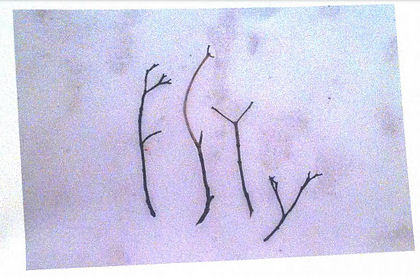
 I liked this when I first saw it although I didn’t find it saying anything verbally.  When I finally realized it said, “fifty,” I thought it accidental because I couldn’t see why it would say that.  My slow mind eventually remember that Geof is now fifty-years-old, which makes this image a particularly effective representation of his present strange combination of freedom and awkward incompleteness . . . straining, yearning for something.  With his ego (“I,” as Karl Kempton would be sure to notice) lost or transcended.

Diary Entry

Sunday 18 December 2011, 6 P.M.  Another unproductive day.  Tennis in the morning, a fine meal at Linda’s in the afternoon.  A blog entry for today just taken care of a little while ago.  A little work done on my “Mathemaku for Scott Helmes” to count as “work on preparation for the A&H exhibition.”  And now I’d like to go to bed, but will probably read instead.

 .

Entry 597 — Chumpy Leg

Sunday, December 18th, 2011

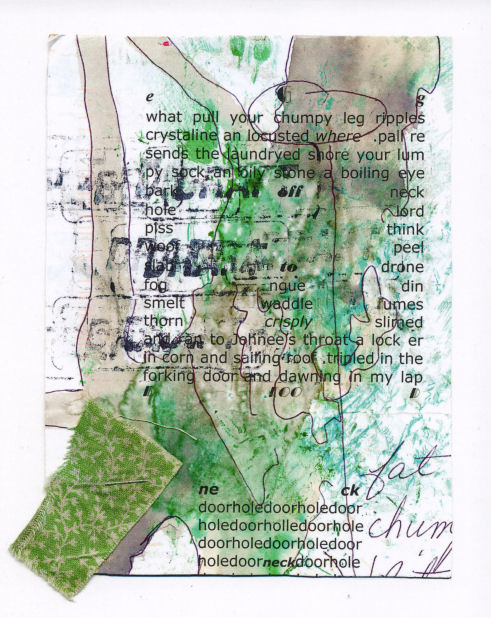
John M. Bennett has another major collection of poetry out.  This one is called The Gnat’s Window.  78 poems.  Bilingual.  Closely inter-associating sequence.  Amazing.  I told John I’d try to do a critique of it, and I still hope to once my year-end chaos of chores is behind me, but–gah–John is one of the few poets I feel may be beyond my abilities as a critic, and he’s at his best–and therefore beyondest–in this book.  Part of one of the poems, which Diane Keys has found a way to, uh, fatten, in all the best senses, with color, a piece of cloth and some cursive annotations–and the circling of “crumpy leg, is below.  It’s from the back cover of John’s book.
 

Diary Entry

Saturday, 17 December 2011, Noon.  Wow, since getting back at eleven from tennis and a McDonald’s snack, I’ve already gotten the day’s blog entry posted, which was easy because it was already done, and made a finished copy of  the new version of “Mathemaku for Scott Helmes” at Paint Shop.  It’s not the official copy: it’s too small, and the official version will include the original cut-out fragments of magazine ads.  There will also be the A&H framed version which will be in between the one I just made and the official version in size. 

8 P.M.  Since noon I haven’t done much.  I printed out two copies of “Mathemaku for Scott Helmes” and scribbled annotations explaining the terms I will put on one that will be on display atthe exhibition.  Otherwise, I continued reading started yesterday of the magazines and books I will be reviewing for Small Press Review

.

Entry 587 — “The Bells”

Thursday, December 8th, 2011

My friend, Richard Kostelanetz is writing (actually, revising) an essay dealing with, among other things, appropriated art.  When he asked something about Tom Phillips’s A Humument, I remembered other superior examples of appropriation art such as the work on a dictionary of Doris Cross, and the following appropriation of Edgar Allen Poe’s “The Bells” by Michael Basinski, which I thought worth posting here:
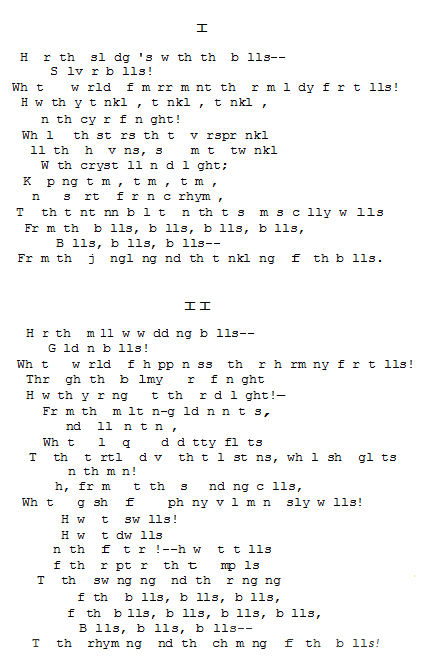
   

Here’s the original:

Hear the sledges with the bells–
Silver bells–
What a world of merriment their melody foretells!
How they tinkle, tinkle, tinkle,
In the icy air of night!
While the stars that oversprinkle
All the heavens, seem to twinkle
With a crystalline delight;
Keeping time, time, time,
In a sort of Runic rhyme,
To the tintinnabulation that so musically wells
From the bells, bells, bells, bells,
Bells, bells, bells,–
From the jingling and the tinkling of the bells.

Hear the mellow wedding-bells,
Golden bells!
What a world of happiness their harmony foretells!
Through the balmy air of night
How they ring out their delight
From the molten-golden notes!
And all in tune,
What a liquid ditty floats
To the turtle-dove that listens, while she gloats
On the moon!
Oh, from out the sounding cells,
What a gust of euphony voluminously wells!
How it swells!
How it dwells
On the Future! how it tells
Of rapture that impels
To the swinging and the ringing
Of the bells, bells, bells–
Of the bells, bells, bells, bells,
Bells, bells, bells–
To the rhyming and the chiming of the bells!

In the essay I quoted Mike’s poem in, I called it “an amazingly loud-though-silent jangle of . . . Poe’s famous poem.”  I’d add here that Basinski’s version gave me the thrill that Poe’s version, I’m sure, gave many of its first readers.

* * *

Wednesday, 7 December 2011, Noon.  I’ve partly recovered from having accidentally deleted my blog entry for Monday.  A semblance of it is back up.  I also posted an entry for today.  I’ve done nothing else yet, but hope soon to go out to buy some frames and a pad of good-quality large paper.

Later note: I succeeded in finding two reasonably-priced frames of the kind I wanted (able to be stood up on a counter) that I bought.  That took care of my pledge to do something of value for my exhibition every day, barely.  Meanwhile, I sketched a new mathemaku.  Then took care of this entry.

.

Entry 584 — An & & My Full Triptych

Monday, December 5th, 2011

It seems that almost every time I seem to be getting productive, something knocks me down.  This time it’s only a lost entry–this one, that I was trying to correct some detail of and lost in the process–without realizing it, so was not able to try to find the lost material by backing up until it was too late.  So now I have to spend an hour or so, restoring what I can recall of what was here two days ago. 
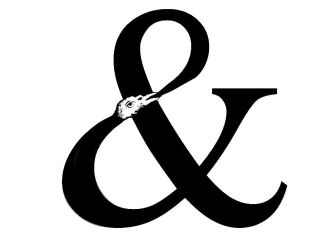
 One item was this by Moribund Face:


And all three of my frames of “Triptych for Tom Phillips”:
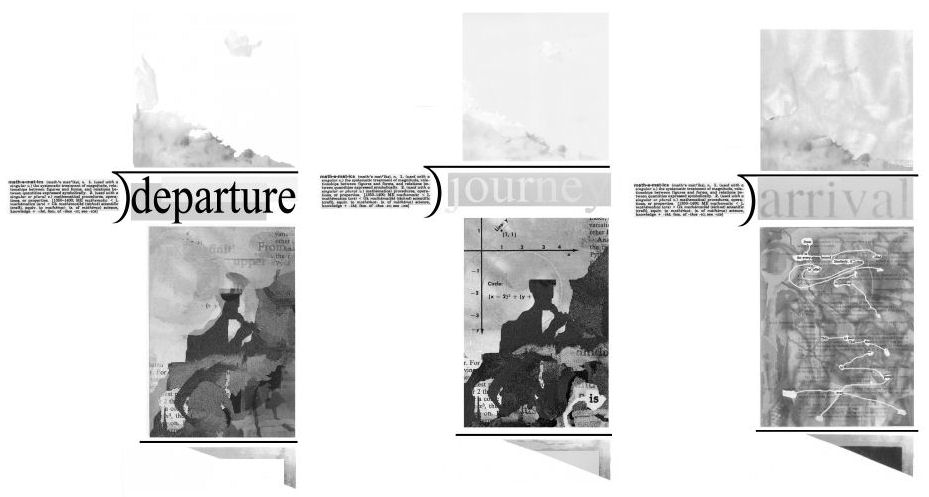
About the ampersand, I commented something about how it expressed the essence of “andness.”  I loved the way its bird regurgitated what looked like all of itself, while looking to continue “anding” forever.  I said little about my full triptych except that if you click on them, you’ll see a larger image of them which may be helpful although still very small–and in black&white.  The original frames are each eleven by seventeen.  Oh, one thing I did point out was that the frames are about, “departure,” “journey” and “arrival,” and are intended to be about them in the largest sense, but particularly about them with regard to arriving–for either an engagent of it or its author.

* * *

Sunday, 4 October 2011.  Sunday is hazy to me now, three days in the past as it is.  I played tennis early in the morning–badly.  I didn’t return to my Shakespeare book, but evidentally got a blog entry posted, and probably wrote an exhibition hand-out or two.

.

Entry 551 — John M. Bennett’s “Cardboard”

Wednesday, November 2nd, 2011

There’s a Penguin anthology of twentieth-century out. It’s edited by Rita Dove.  Here’s a list of the poets represented in it, with thanks to John Jeffrey for having alphabetized it:

Ai
Elizabeth Alexander
Sherman Alexie
Paula Gunn Allen
A.R. Ammons
John Ashbery
W. H. Auden
Amiri Baraka (LeRoi Jones)
Ted Berrigan
John Berryman
Frank Bidart
Elizabeth Bishop
Robert Bly
Louise Bogan
Gwendolyn Brooks
Olga Broumas
Hayden Carruth
Lorna Dee Cervantes
Marilyn Chin
Sandra Cisneros
Lucille Clifton
Judith Ortiz Cofer
Billy Collins
Gregory Corso
Hart Crane
Robert Creeley
Victor Hernandez Cruz
Countee Cullen
E. E. Cummings
Carl Dennis
Toi Derricotte
James Dickey
Stephen Dobyns
Hilda Doolittle (H.D.)
Mark Doty
Rita Dove
Norman Dubie
Alan Dugan
Paul Lawrence Dunbar
Alice Moore Dunbar-Nelson
Robert Duncan
Stephen Dunn
Cornelius Eady
Russell Edson
T. S. Eliot
Louis Erdrich
B.H. Fairchild
Lawrence Ferlinghetti
Annie Finch
Nick Flynn
Carolyn Forche
Robert Francis
Robert Frost
Alice Fulton
Tess Gallagher
Albert Goldbarth
Jorie Graham
Angelina Weld Grimke
Donald Hall
Barbara Hamby
Joy Harjo
Michael S. Harper
Robert Hass
Robert Hayden
Terrance Hayes
Anthony Hecht
Lyn Hejinian
Garrett Hongo
Marie Howe
Andrew Hudgins
Langston Hughes
Richard Hugo
Mark Jarman
Randall Jarrell
Robinson Jeffers
James Weldon Johnson
June Jordan
Weldon Kees
Brigit Pegeen Kelly
Galway Kinnell
Carolyn Kizer
Joanna Klink
Etheridge Knight
Kenneth Koch
Yusef Komunyakaa
Maxine Kumin
Stanley Kunitz
Li-Young Lee
Denise Levertove
Philip Levine
Larry Levis
Audre Lorde
Adrian C. Louis
Amy Lowell
Robert Lowell
Thomas Lux
Nathaniel Mackey
Archibald MacLeish
Haki R. Madhubuti (Don L. Lee)
David Mason
Edgar Lee Masters
William Matthews
Heather McHugh
Claude McKay
William Meredith
James Merrill
W. S. Merwin
Jane Miller
Marianne Moore
Paul Muldoon
Harryette Mullen
Carol Muske-Dukes
Marilyn Nelson
Howard Nemerov
Naomi Shihab Nye
Frank O’Hara
Sharon Olds
Mary Oliver
Charles Olson
Gregory Orr
Michael Palmer
Carl Phillips
Robert Pinsky
Ezra Pound
Dudley Randell
Adrienne Rich
Alberto Rios
Edwin Arlington Robinson
Theodore Roethke
Muriel Rukeyser
Kay Ryan
Sonia Sanchez
Carl Sandburg
Delmore Schwartz
Frederick Seidel
Anne Sexton
Brenda Shaughnessy
Laurie Sheck
Leslie Marmon Silko
Charles Simic
Louis Simpson
Gary Snyder
Cathy Song
Gary Soto
David St. John
William Stafford
A.E. Stallings
Gertrude Stein
Gerald Stern
Wallace Stevens
Susan Stewart
Ron Stilliman
Ruth Stone
Mark Strand
James Tate
Henry Taylor
Sara Teasdale
Melvin B. Tolson
Jean Toomer
Natasha Trethewey
Reetika Vazirani
Diane Wakoski
Derek Walcott
Margaret Walker
James Welch
Roberta HIll Whiteman
Richard Wilbur
C. K. Williams
Miller Williams
William Carlos Williams
C. D. Wright
Charles Wright
Franz Wright
James Wright
Kevin Young

After seeing this list, I said what I knew I’d be saying before seeing it in a comment at a blog where it had been given an “A”: “Close to worthless. The good poets in it are already amply anthologized. Whole schools of the best American poets of the last forty years of American Poetry are entirely ignored. The one with Robert Lax in it (minimalism) for just one example. The editors of POETRY will find little in it, or not in it, to complain about-–which is proof of how bad it is.” 

Another ignored school, needless to say, is visual poetry, as represented by much of the work of John M. Bennett, such as this duo, “Cardboard,” that he posted just today (and he’s done scores as good):
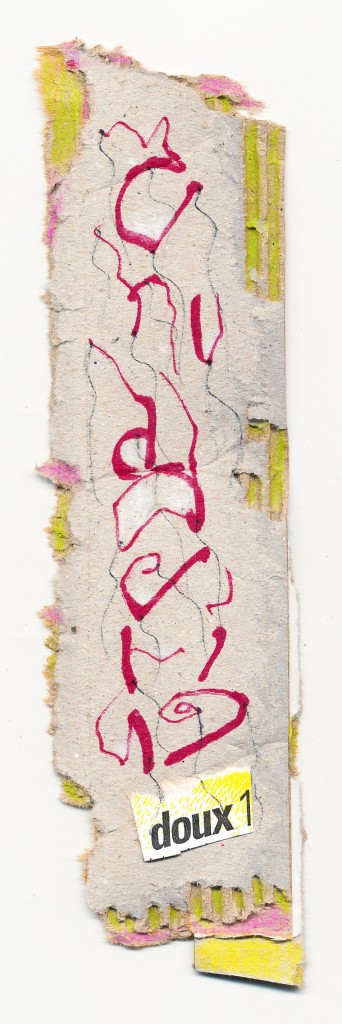
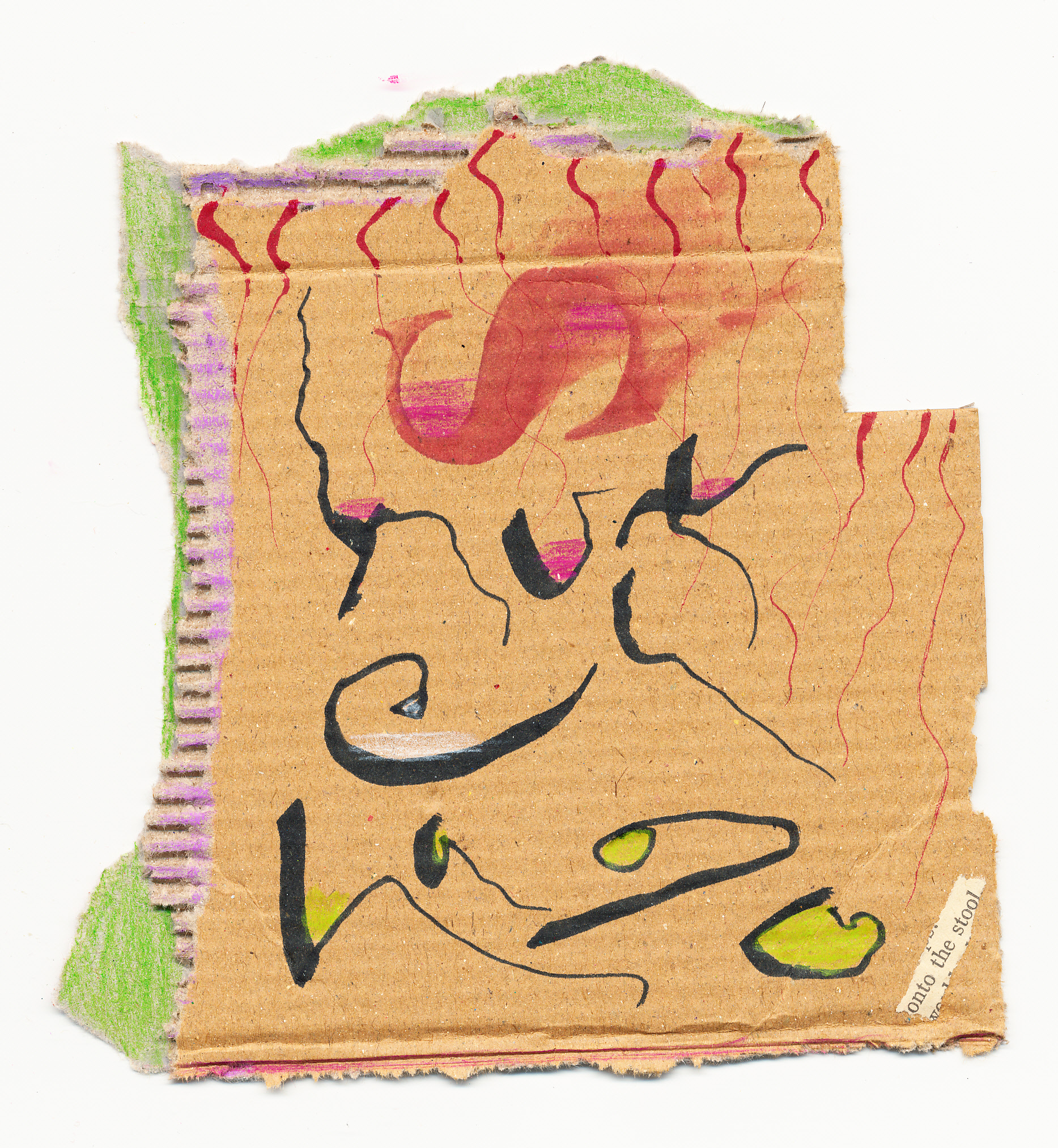


I doubt anyone has more completely captured the essence of carboardedness–or the shuddery feel of decaying tenement rooms–than John has with these.  But with strangely joyful coloring in sharp contradiction of shuddering and tenements, but somehow absolutely right.  As with the poem by Gregory I seem to have abandoned, I find I need time before I’ll be able fully to appreciate these.

The Penguin anthology annoyed me, but after reflecting only briefly, it cheered me up: a comparison of its poets coming into their prime after 1950 to the poets in my crowd such as John M. Bennett could not more perfectly exemplify  academic art (including, I was amused to see, the least innovative portion of what’s being called “language poetry”) versus living art.  I may be deceived about the value of my work, but I know I’m not about that of my fellow visual poets.  We’re the Monets, Renoirs, van Goghs, Cezannes, they the French academics.

.


Enter 550 — Marton’s “Cursive” Again

Tuesday, November 1st, 2011

Marton  got back to me about his “cursive” yesterday, giving me enough material for a full entry.

 
He pointed out the direction of the leaves is not consistent.  I had not noticed it.  Which is a good lead-in to one of my much-repeated dogmas: there’s more to every good poem, however seemingly simple, than even a good critic will find on his own.  Marton believes that “the first and the second leaf are connected in a way which is not possible in nature.”  Hence, for him, the poem is displaying “the surmounting (or appeasing) of that impossibility.”  This is a reading in addition tomine, not a counter-reading since it is does not contradict my reading.  (Dogma #2: there is more than one good reading of any good poem-but there is only one main reading–to which all the other readings must conform.  That said, I read the change of the direction of the ellipsis to suggest oneleaf’s rebelliousness.  It doesn’t want to be part of an ellipsis.  Or, in my main reading, it it is eager for winter, and the other two leaves are not?  as for the linkage of the leaves being impossible in Nature, I’m confused: I view their stems as touching.  But is the image of a vine?  These leaves don’t look like a vine’s leaves to me. 
 
They don’t look like autumn leaves, as my main reading of the poem has it, either.  But they are detached leaves, so can’t be summer or spring leaves.
 
Marton also reminded me that he had dedicated the poem to me.  That, he added, “is an important piece of information. :-) ”  I was being modest, but I see that the dedication actually is important, for it connects the poem to my series, “Cursive Mathemaku.”  Thinking about that connection, I thought of something else to mention about the poem–the fact that cursive writing is personal.  The Nature in the poem is not a machine typing out falling leaves but an individual writing a poem with her leaves.
.
 

Artists Mentioned in Entries « POETICKS

Archive for the ‘Artists Mentioned in Entries’ Category

Entry 659 — A Tribute to the Piano

Saturday, February 18th, 2012

I had high hopes for this one, which I composed yesterday.  I even thought I might work a sequence out of it, using the Klee ship “musical theme” as the first step of a visual symphony.  But I wasn’t satisfied with what I did with the ships.  As I worked with them, though, I came up with a lot of minor ideas I liked.  The main one was a suddenly conscious attempt to provide a metaphor for the coming of spring.  But I also liked breaking up what was originally as single framed image, and changing the sizes of each unit.  Grey-scaling the first two tiny ones seemed a nice touch, too.  And the escape of the final ship!  I didn’t like my dividend too well, either–after my initial enthusiasm for it (being a sucker for anything having to do with spring).  For some reason it doesn’t seem quite there, for me.  Maybe I’ll simplify it to, “a brook’s revived consideration of an April countryside.”  Yes, I think I was trying for too much. . . .

.

Entry 657 — My Motto as a Poetry Critic

Thursday, February 16th, 2012

 Thinking about what Tony Robinson had at his blog spurred me to this motto of my own (obnoxious) practice as a poetry critic: Try for maximal understanding of the nature and value of what I’m critiquing, fully committed to the advance of poetry, as I understand it, and expressed with the best balance of clarity and fresh language I can manage.  I originally continued with “–with no significant suppression of emotion, regardless of the tender feelings of the hyper-offendable,” but upon reflection found that nice to say but too secondary for this motto. 

Better: Using the the best balance of clarity and fresh language I can manage, try to express maximal understanding of the nature and value of what I’m critiquing, fully committed to the advance of poetry, as I see it.  Ah, but I now see that “the value of what I’m critiquing” would include what the latter does to advance poetry.  Ergo:  Try, using the the best balance of clarity and fresh language I can manage, to express maximal understanding of the nature and value of what I’m critiquing. 

And here’s a copy (an imperfect one) of my motto as a poet:

.

Entry 656 — A Clone of Shakespeare

Wednesday, February 15th, 2012

To continue my argument that the arts progress just like verosophy does (and take care of this entry with minimal effort), here’s a question: if a clone of Shakespeare had been created in 1980 and he was now a professional actor writing plays for the stage and screen, would they not be better than the ones he wrote four hundred years ago?  Would he not be able to improve on what he composed then?

.

Entry 655 — A Response to a Blog Entry

Tuesday, February 14th, 2012


It’s at Anthony Robinson’s blog here.

Here’s what I said:

“Inaccessible writing” as writing not like I do, yes–and the related “incomprehensible poetry” without a hint that others may find it comprehensible–even the critic himself if he really tried. I try never to label any poem inaccessible although I will confess I can’t figure out a poem when that’s the case.

Good words on the so-called “principal aim”–but I would add that I would like to know why a poetry for the few should be denigrated. Should no one compose operas because, in Crews’s words, “most audiences will have trouble wrestling (them) into meaning?” Or cook really far-out gourmet dishes? Crews should have said he couldn’t say anything intelligent about Miller’s book, and ended his “review.”

Can’t say I think much of Crews’s example of Miller, when he’s good. Wind does have a sound, it seems to me, since–as I understand it–sound is what happens when something causes the air to vibrate which in turn causes mechanisms in the ear to vibrate. The wind, being air, would do this directly. Or, in the poem, indirectly, by causing trees to vibrate which causes the air to vibrate which causes the auditory mechanisms to vibrate. But maybe I’m wrong. In any case, all the poet seems to me to be saying is that the room is silent except for the sound of the wind in the trees.

Good question, whose ear does it appeal to. Seems to me a competent critic would say what the lines do auditorily that will tend to seem musical to most people, such as repeat words and syllables, which this passage does; but it doesn’t seem to me to do much else. The critic need not point out what I call a poem’s “melodations” as good, just point them out, since some readers may miss them–or hear them but not fully appreciate them.

I do agree with Crews that a poem needs some kind of point of stability–what I call a unifying principle–to deviate interestingly from. I’m big on titles, too, but certainly don’t think lack of one can spoil a poem. I’m not confident that Crews can recognize the most interesting unifying principles, some of them quite delayed.

Like all critics with readerships (as I believe Crews may have, for I think I’ve heard of him), he seems not to say much about poetic technique–subject matter and points of view seem to be for him all that matters in a poem.

I think you captured him quite well, young Anthony. Thanks for a report that got me involved enough for all this.

.

Entry 653 — A Response to Hal Johnson’s Poem

Sunday, February 12th, 2012


Here’s Hal Johnson’s visio-infraverbal poem again:

 ”Lost in thought” is the simplest explication of this, but a better reading focuses on thought that is opposed, disrupted, damaged and finally sent in the wrong direction back to its futile beginning.  With “ugh” and “tough” being disconcealed in the process further to suggest the losing struggle for meaning expressed.   In short, a deft pwoermd.  A visuaol one as well as infraverbal because you can see the word’s letters metaphorically enacting the struggle.

.

Entry 652 — An Infraverbal Poem by Hal Johnson

Saturday, February 11th, 2012


Here’s an infraverbal poem–actually a visio-infraverbal poem–Hal Johnson posted at New-Poetry:

    
 I’ll leave it for now as a puzzle.  Tomorrow I’ll reveal why it’s a first-rate poem.

 .

Entry 650 — Some Anti-Philogushy

Thursday, February 9th, 2012

Me Versus B. H. Fairchild and Others He quotes

Language can be a way of rescuing the hidden life, and that way is poetry.  You can’t rescue any hidden life, whatever that is, with prose?  Or some other art?  Or science?  Why wouldn’t using language to drown certain aspects of unhidden life be equally or more valuable? 

Glenn Gould: “The purpose of art is the gradual, lifelong construction of a state of wonder and serenity.” And wonder is everything to a poet.   It sure isn’t everything to me.  It and serenity are only two of many pleasures it is the function of art to provide.   Its manner of providing them is what sets it apart from verosophy and other endeavors which can, and try, to lead to wonder and serenity, and other pleasures.

Mandelstam: “We will remember in Lethe’s cold waters / That earth for us has been worth a thousand heavens.”  Nice thought–but unattainable heavens to dream toward are a high good, too.

Seven propositions:

1. By way of Wittgenstein and Heidegger: A poem is a verbal construction which, through an array of rhetorical and prosodic devices of embodiment, achieves an order of being, an ontological status, radically different from that of other forms of discourse (with the exception of certain kinds of descriptive and fictional prose).  I agree: a poem is a verbal construction different from almost all other verbal constructions.

2. Poetry occurs at a considerable distance from the ego.  As does almost anything else I can think of, when it isn’t nothing but ego.

3. There exists an infinity of nonverbal meaning.  Which the infinity of possible verbal meaning can express.

4. Science is progressive, but Art is not. It doesn’t get better; it just gets different. (The relevance and utility of all poetic forms.) See Mandestam.  All the arts, like all the sciences, have become vastly superior to what they were hundreds or thousands of years ago, but anti-progressives mistake the sentimentality that becomes more and more attached to the old because of their age for aesthetic rather than nostalgiacal value.  Compare the clumsy “novel” in the Bible about David with almost any competent commercial novel of today, for instance.  Consider how much more of existence the best art of today is about compared with earlier art.  For just one thing, today’s art has a vastly larger tradition to make allusions to than previous art had.  There have been artists in the past as great as our best, but what our best have produced is significantly better than what they did in part because of the what the artists of the past did.  (Note, this is a subject requiring a book.)

5. Rules are made to be broken; techniques are made to be used. (They were never rules anyway; they were techniques. The freedom of the artist, like that of the lathe machinist, is the freedom to choose those techniques, those tools, that he deems necessary for the task at hand. The refusal to use technique–and, obviously, to learn it–is the refusal to be an artist, or at least a free one.)  I more or less agree with all this, but I wonder how one can avoid using some technique.

6. Form is an extension of subject matter rather than of ideology or religious belief.  Every work of art requires a container; I call that container form; one calling it “an extension of subject matter,” if I understand him, needs to tell me what, then, is containing it and the subject matter it is an extension of.  I don’t know what ideology and religious belief have to do with it; how would they be not subject matter?

7. Meter is not the reins to keep the horse of the poem in check; it’s the heartbeat of the horse. Drop the reins. (Clearly this is an argument for meter rather than against it.) It is almost impossible to convince poets who never bothered to learn prosody that meter is something that emerges from within the language rather than something that is imposed externally upon the language. Even conversational English is very loosely iambic.  I think meter is both natural and imposed–necessarily imposed to add predictability to balance the difficult-to-accept unpredictability of horses going beyond prose that poetry at its best is. 

A poet is always limited by the fact that he has to write for other human beings.  Just to be argumentative, I would say that a poet’s having to write for others (and he needn’t) greatly increases his field of play.  (Note that our Wilshberian’s poet writes rather than composes.  It never occurs to any Wilshberian that a poem might be more than words.)

.

Entry 649 — Some Philogushy from B.H. Fairchild

Wednesday, February 8th, 2012

“Philogushy” is my term for “love of gush.”  It’s practiced a good deal by poets.  Once again I could think of nothing to post here, so I stole the excerpt below from 25 pages of journal entries by poet B.H. Fairchild that are in the latest issue of New Letters, a magazine I’m reviewing for Small Press Review.  I knew nothing about Fairchild but apparently he’s very well-known, and a grant-winner.   

Language can be a way of rescuing the hidden life, and that way is poetry.

Glenn Gould: “The purpose of art is the gradual, lifelong construction of a state of wonder and serenity.” And wonder is everything to a poet.

Mandelstam: “We will remember in Lethe’s cold waters / That earth for us has been worth a thousand heavens.”

Seven propositions:

1. By way of Wittgenstein and Heidegger: A poem is a verbal construction which, through an array of rhetorical and prosodic devices of embodiment, achieves an order of being, an ontological status, radically different from that of other forms of discourse (with the exception of certain kinds of descriptive and fictional prose).

2. Poetry occurs at a considerable distance from the ego.

3. There exists an infinity of nonverbal meaning.

4. Science is progressive, but Art is not. It doesn’t get better; it just gets different. (The relevance and utility of all poetic forms.) See Mandestam.

5. Rules are made to be broken; techniques are made to be used. (They were never rules anyway; they were techniques. The freedom of the artist, like that of the lathe machinist, is the freedom to choose those techniques, those tools, that he deems necessary for the task at hand. The refusal to use technique-and, obviously, to learn it-is the refusal to be an artist, or at least a free one.)

6. Form is an extension of subject matter rather than of ideology or religious belief.

7. Meter is not the reins to keep the horse of the poem in check; it’s the heartbeat of the horse. Drop the reins. (Clearly this is an argument for meter rather than against it.) It is almost impossible to convince poets who never bothered to learn prosody that meter is something that emerges from within the language rather than something that is imposed externally upon the language. Even conversational English is very loosely iambic.

A poet is always limited by the fact that he has to write for other human beings.

* * * * *

Most of the other entries are at this level. some stupid, some interesting, none what I’d call a serious attempt to understand what poetry is, rather than what the effect of poetry the definer admires is.  Subjective philogushy rather than objective verosophy.  I’m not going to discuss any individual entries now so as to leave myself something to write about tomorrow.

.

Entry 647 — “The Four Seasons”

Monday, February 6th, 2012

Here’s another of my earlier visual poems:

The clever bit was the upside-down m

.

Entry 646 — “Homage to Wordsworth”

Sunday, February 5th, 2012

Today a not-very-good copy of one of the visual poems I plan to have in my next show:

Not much to say about it except that it is inspired by one of the more famous of Wordsworth’s sonnets, which describes how the ocean, “with his eternal motion make(s)/ a sound like thunder–everlastingly.”

.

Entry 32 — A Mathemaku from 2007 « POETICKS

Entry 32 — A Mathemaku from 2007

I continue to be more out of it than not, so have just this for today:

17Aug07B

Guess who composed it.

Leave a Reply

Moribund Facekvetch « POETICKS

Archive for the ‘Moribund Facekvetch’ Category

Entry 584 — An & & My Full Triptych

Monday, December 5th, 2011

It seems that almost every time I seem to be getting productive, something knocks me down.  This time it’s only a lost entry–this one, that I was trying to correct some detail of and lost in the process–without realizing it, so was not able to try to find the lost material by backing up until it was too late.  So now I have to spend an hour or so, restoring what I can recall of what was here two days ago. 

 One item was this by Moribund Face:


And all three of my frames of “Triptych for Tom Phillips”:

About the ampersand, I commented something about how it expressed the essence of “andness.”  I loved the way its bird regurgitated what looked like all of itself, while looking to continue “anding” forever.  I said little about my full triptych except that if you click on them, you’ll see a larger image of them which may be helpful although still very small–and in black&white.  The original frames are each eleven by seventeen.  Oh, one thing I did point out was that the frames are about, “departure,” “journey” and “arrival,” and are intended to be about them in the largest sense, but particularly about them with regard to arriving–for either an engagent of it or its author.

* * *

Sunday, 4 October 2011.  Sunday is hazy to me now, three days in the past as it is.  I played tennis early in the morning–badly.  I didn’t return to my Shakespeare book, but evidentally got a blog entry posted, and probably wrote an exhibition hand-out or two.

.