Entry 78 — Of Manywhere-at-Once, Volume Two « POETICKS

Entry 78 — Of Manywhere-at-Once, Volume Two

For three months or so I have been critiquing a book by an imbecile who doesn’t know who wrote the works of Shakespeare, only that Shakespeare did not.   Diana Price’s Shakespeare’s Unorthodox Biography. Each day (but one) I’ve attacked a section of it at HLAS, where the authorship debate can be carried on without restrictions.  I started the critique for many reasons, the main one being that the book is too full of crap to ignore.  Nor did I ignore it when it was first published.  I read it through, making copious annoyed and sarcastic annotations in it.  I wrote up an overview of its main thesis for use in my own authorship book.  And I fully intended to write a thorough critique of it–which I never got around to.  Until now.

2009 was a terrible year for me, especially the second half of it.  I did almost no writing during that second half.  So my second reason for my critique was simply to force myself into a writing routine.  I have to admit I also wanted something to express anger about, being pretty unhappy at the time with just about everything in my life.  In other words, take out my misery on poor Diana Price.  Not a worthy victim but published hardbound by a more respectable company than I ever was, and asked to lecture on her book at universities, as I never have been asked to lecture on my Shakespeare book.  Oh, what I’d really call my main purpose is to present a full-scale portrait of a propagandist–that is, reveal what the main propagandistic devices are and how they work.  A handbook on propaganda for the uninitiated, or–more exactly–the incompletely initiated–which would include me, out to learn in the process.

My venture  has so far been successful.  My critique is now almost 40,000 words long, and I’m almost halfway through Price’s books, which I’m covering page by page.   For some reason today I thought of a similar project I could start here: constructing day by day another book I have notes for and long ago seriously hoped to write but didn’t, my Of Manywhere-at-Once, Volume Two. (I’ve had a third volume in mind to do, as well.)

So: tomorrow I’ll begin it.  I figure I’ve pretty much taken care of this entry already–and want to add something to it that has nothing to do with my manywhere book, but want to record in case I forget about it.  It has to do with my knowlecualr psychology, specifically with my theory of temperaments.  Until an hour or so ago, I posited four temperaments (or personality-types): the rigidnik, the milyoop, the ord, and the freewender for, respectively, high-charactration/low accommodance persons, high-accommodance/low charactration persons, medium charactration/medium accommodance (ordinary) persons, and high charactration/high accommodance persons.   My types were based on two of my three mechanisms of intelligence, charactration and accommodance.  I suddenly saw earlier today that a fifth temperament based on the third mechanisms of intelligence, accelerance, might be in order.  A person high in accelerance bu not high in either of the other two mechanisms.   An eruptor?  Not sure how good a name that is, but it will do for now.

Tags:

Leave a Reply

Entry 34 — Yesterday’s Mathemaku Again, and Another « POETICKS

Entry 34 — Yesterday’s Mathemaku Again, and Another

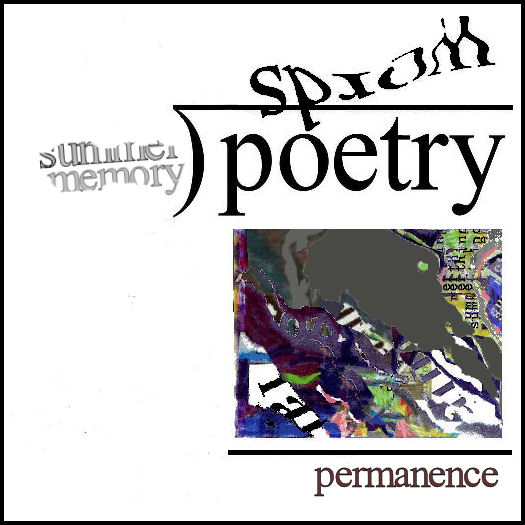
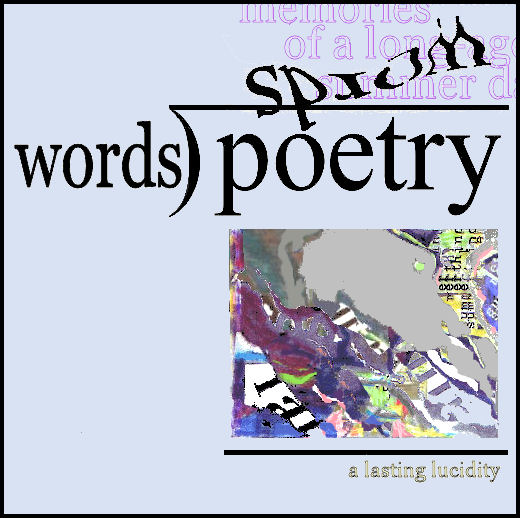
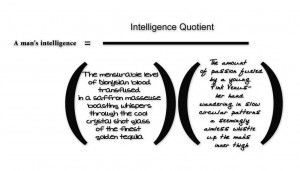
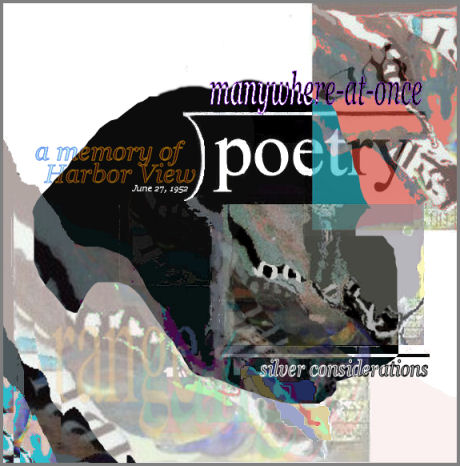
Here’s the latest version of what I think I’m calling “Frame 17″ of The Long Division of Poetry:

17Aug07D-light

I didn’t like the background blue as dark as it showed here, so I lightened it.  For some reason, that made a lot of difference to me.  I also changed the quotient of the mathemaku below, another variation on the lead frame of The Long Division of Poetry that I composed in 2007 and have only touched up slightly since, mostly to increase its resolution.  I feel it’s about as good as I’m capable of getting as a mathematical poet–although I do feel I’ve done a few mathemaku that are better than it.

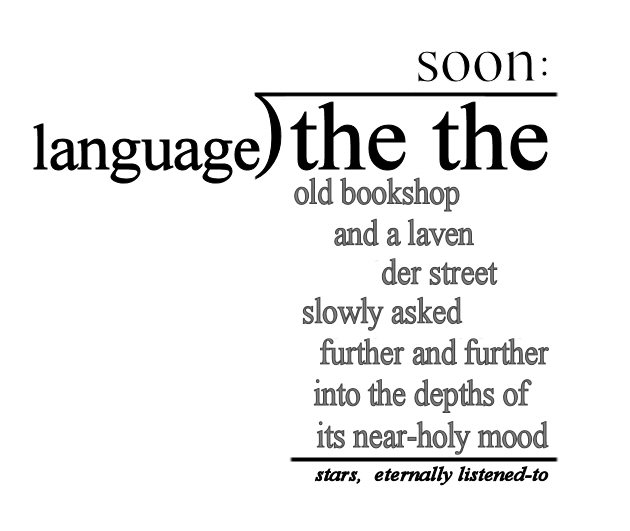
20Nov09E

The divisor is hard to read on-site, I don’t know why.  The image is much darker than it is on the screen of the computer where I do my Paint Shop work, even though I tried to lighten it.   Oh, it’s tiff on my computer, jpeg here, which may explain it.  Anyway, the divisor reads, “a memory of/ Harbor View, June 27, 1952″

Note: for those of you new to Grumman Studies, “manywhere-at-once,” which is usually capitalized, is where (according to my poetics) metaphors and other figures of speech send one.  Two or more places in one’s brain at the same time.  So this poem attempts to express the value of equaphoration–my term for any poetic device that in some way equates one thing with another, even irony, which equates the truth with its opposite.

Leave a Reply

B. H. Fairchild « POETICKS

Archive for the ‘B. H. Fairchild’ Category

Entry 650 — Some Anti-Philogushy

Thursday, February 9th, 2012

Me Versus B. H. Fairchild and Others He quotes

Language can be a way of rescuing the hidden life, and that way is poetry.  You can’t rescue any hidden life, whatever that is, with prose?  Or some other art?  Or science?  Why wouldn’t using language to drown certain aspects of unhidden life be equally or more valuable? 

Glenn Gould: “The purpose of art is the gradual, lifelong construction of a state of wonder and serenity.” And wonder is everything to a poet.   It sure isn’t everything to me.  It and serenity are only two of many pleasures it is the function of art to provide.   Its manner of providing them is what sets it apart from verosophy and other endeavors which can, and try, to lead to wonder and serenity, and other pleasures.

Mandelstam: “We will remember in Lethe’s cold waters / That earth for us has been worth a thousand heavens.”  Nice thought–but unattainable heavens to dream toward are a high good, too.

Seven propositions:

1. By way of Wittgenstein and Heidegger: A poem is a verbal construction which, through an array of rhetorical and prosodic devices of embodiment, achieves an order of being, an ontological status, radically different from that of other forms of discourse (with the exception of certain kinds of descriptive and fictional prose).  I agree: a poem is a verbal construction different from almost all other verbal constructions.

2. Poetry occurs at a considerable distance from the ego.  As does almost anything else I can think of, when it isn’t nothing but ego.

3. There exists an infinity of nonverbal meaning.  Which the infinity of possible verbal meaning can express.

4. Science is progressive, but Art is not. It doesn’t get better; it just gets different. (The relevance and utility of all poetic forms.) See Mandestam.  All the arts, like all the sciences, have become vastly superior to what they were hundreds or thousands of years ago, but anti-progressives mistake the sentimentality that becomes more and more attached to the old because of their age for aesthetic rather than nostalgiacal value.  Compare the clumsy “novel” in the Bible about David with almost any competent commercial novel of today, for instance.  Consider how much more of existence the best art of today is about compared with earlier art.  For just one thing, today’s art has a vastly larger tradition to make allusions to than previous art had.  There have been artists in the past as great as our best, but what our best have produced is significantly better than what they did in part because of the what the artists of the past did.  (Note, this is a subject requiring a book.)

5. Rules are made to be broken; techniques are made to be used. (They were never rules anyway; they were techniques. The freedom of the artist, like that of the lathe machinist, is the freedom to choose those techniques, those tools, that he deems necessary for the task at hand. The refusal to use technique–and, obviously, to learn it–is the refusal to be an artist, or at least a free one.)  I more or less agree with all this, but I wonder how one can avoid using some technique.

6. Form is an extension of subject matter rather than of ideology or religious belief.  Every work of art requires a container; I call that container form; one calling it “an extension of subject matter,” if I understand him, needs to tell me what, then, is containing it and the subject matter it is an extension of.  I don’t know what ideology and religious belief have to do with it; how would they be not subject matter?

7. Meter is not the reins to keep the horse of the poem in check; it’s the heartbeat of the horse. Drop the reins. (Clearly this is an argument for meter rather than against it.) It is almost impossible to convince poets who never bothered to learn prosody that meter is something that emerges from within the language rather than something that is imposed externally upon the language. Even conversational English is very loosely iambic.  I think meter is both natural and imposed–necessarily imposed to add predictability to balance the difficult-to-accept unpredictability of horses going beyond prose that poetry at its best is. 

A poet is always limited by the fact that he has to write for other human beings.  Just to be argumentative, I would say that a poet’s having to write for others (and he needn’t) greatly increases his field of play.  (Note that our Wilshberian’s poet writes rather than composes.  It never occurs to any Wilshberian that a poem might be more than words.)

.

Entry 649 — Some Philogushy from B.H. Fairchild

Wednesday, February 8th, 2012

“Philogushy” is my term for “love of gush.”  It’s practiced a good deal by poets.  Once again I could think of nothing to post here, so I stole the excerpt below from 25 pages of journal entries by poet B.H. Fairchild that are in the latest issue of New Letters, a magazine I’m reviewing for Small Press Review.  I knew nothing about Fairchild but apparently he’s very well-known, and a grant-winner.   

Language can be a way of rescuing the hidden life, and that way is poetry.

Glenn Gould: “The purpose of art is the gradual, lifelong construction of a state of wonder and serenity.” And wonder is everything to a poet.

Mandelstam: “We will remember in Lethe’s cold waters / That earth for us has been worth a thousand heavens.”

Seven propositions:

1. By way of Wittgenstein and Heidegger: A poem is a verbal construction which, through an array of rhetorical and prosodic devices of embodiment, achieves an order of being, an ontological status, radically different from that of other forms of discourse (with the exception of certain kinds of descriptive and fictional prose).

2. Poetry occurs at a considerable distance from the ego.

3. There exists an infinity of nonverbal meaning.

4. Science is progressive, but Art is not. It doesn’t get better; it just gets different. (The relevance and utility of all poetic forms.) See Mandestam.

5. Rules are made to be broken; techniques are made to be used. (They were never rules anyway; they were techniques. The freedom of the artist, like that of the lathe machinist, is the freedom to choose those techniques, those tools, that he deems necessary for the task at hand. The refusal to use technique-and, obviously, to learn it-is the refusal to be an artist, or at least a free one.)

6. Form is an extension of subject matter rather than of ideology or religious belief.

7. Meter is not the reins to keep the horse of the poem in check; it’s the heartbeat of the horse. Drop the reins. (Clearly this is an argument for meter rather than against it.) It is almost impossible to convince poets who never bothered to learn prosody that meter is something that emerges from within the language rather than something that is imposed externally upon the language. Even conversational English is very loosely iambic.

A poet is always limited by the fact that he has to write for other human beings.

* * * * *

Most of the other entries are at this level. some stupid, some interesting, none what I’d call a serious attempt to understand what poetry is, rather than what the effect of poetry the definer admires is.  Subjective philogushy rather than objective verosophy.  I’m not going to discuss any individual entries now so as to leave myself something to write about tomorrow.

.

Entry 386 — 4 Mathemaku from c. 2005 « POETICKS

Entry 386 — 4 Mathemaku from c. 2005

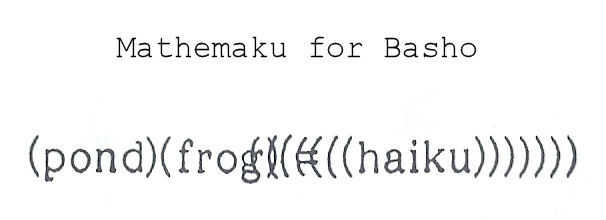
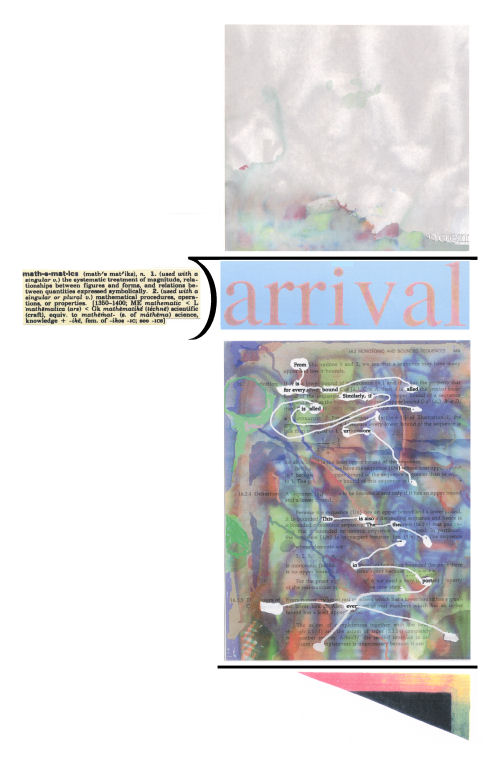
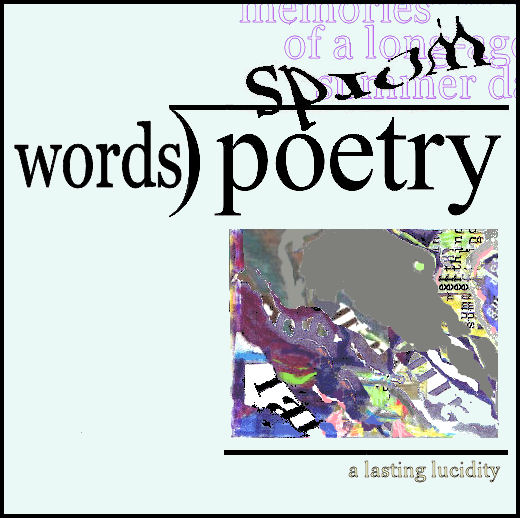
As of part of my continuing neurotic habit of adding small projects to my over-extendedness, I began going through my old blog entries to find out when I made various mathemaku of mine, for I posted all of them at my blog, I think, as I finished them (and even when sketching some of them, as well as when revising them).  I’m now up to my 600th entry.   I was happily reminded of the many frames I’ve done for my Long Division of Poetry sequence: around thirty, I’m pretty sure.  I found one sub-sequence that I quite like and don’t think I’ve ever posted as a sequence:

.

.

.

I’m not sure whether or not the following frame should be considered at extension of this little sequence.  Originally, I added it simply because I thought it nice, but not worth an entry to itself.  Now I begin to see how it may connect to the other two. . . .

.

Not that any woman ever drove me to drink.  Wait, women were the reason I drank: I only went to bars for the strippers, except the few times I wanted to watch Lakers’ games before I had a television.  I drank more beers (always beers though I never liked the taste of beer) than needed to cover the cost of being there mainly to make the strippers look good.

3 Responses to “Entry 386 — 4 Mathemaku from c. 2005”

  1. Kevin Kelly says:

    You’re going to upset the feminists with that last comment, mister. By the way, the copy editor in me tells me there is some grammatical hell going on in your opening graph for this entry — i.e. “now” disguised as “not,” and read the first sentence out loud to yourself. Regarding the mathemaku, I think the first one is perfect already, and the others are unnecessary.

  2. Bob Grumman says:

    Well, thanks for the copy editing, Kevin. As for your literary criticism, I’m afraid I have over 30 other divisions of “poetry” logic would require you to say were unnecessary. But no problem: now that you’re a Californian, your literary opinions don’t count no more.

    Note, despite your comment, I have approved you as a commenter here. Just shows what kind of person I am, right?

    –Robbit

  3. Kevin Kelly says:

    You seem to be implying that you can outperfect perfection. That’s so Grummanly of you.

Leave a Reply

Entry 580 — “Poem Becomes Another Person” « POETICKS

Entry 580 — “Poem Becomes Another Person”


                                 Poem Becomes Another Person                 

                                 One day Poem spontaneously
                                 became another person, Problem.
                                 He shrugged it off.  His author no doubt
                                 no longer had any more chores for
                                 him as a combination poem/alter ego.
                                 He assumed he was still an alter ego–
                                 his author had never shown any ability to create
                                 a human being of any complexity at all
                                 that wasn’t 97% himself.

                                 Problem wandered around for several lines
                                 without being or encountering anything
                                 problematic. 

                                 Was that a problem?  He quickly
                                 spiffled a gumshoe, rhinestones
                                 being out of fashion. 


* * *


Wednesday, 30 November 2011, 4 P.M.  A pleasant-enough day.  I ran around seven this morning, planning to cover a mile but only was able to run half that.  I blame it on going too fast to begin with–after not having run for two or more weeks.  Not that I start all that fast.  After walking a little, I ran a little, and felt good.  I ran a hundred yards or so after that, feeling almost like I was really running.  After breakfast, I got another exhibition hand-out done, and worked some on my Hardy Boys mathemaku.  It’s not framed, so I’m replacing a framed one with it–mainly because I want to get the framed one unframed so I can scan it into my computer.  I have to have a computer copy of it somewhere but haven’t been able to find it.  Its framing was professionally done, so I don’t want to mess with it.  I’ll take it to the frame shop I’ve done business with and have the guy there switch poems.  Along the way, I had two short naps.  I feel pretty okay now.  I’ve done all my chores, getting a short blog entry out of the way a little while ago, and not having work on the book to do for a few more days.  Reading–another Clancy (mainly)–and A new game of Civilization, with my Civilization winning streak up to 3.

Later note: I wrote a second exhibition hand-out for the day, a little commentary on my Hardy Boys mathemaku.

.

Leave a Reply

Entry 1759 — A Possibly Finished Poem « POETICKS

Entry 1759 — A Possibly Finished Poem

HomageToGomringer21March2015FinalOoops, the above is not my final version, this is:

HomageToGomringer21March2015

.

AmazingCounters.com

Leave a Reply

Jody Offer « POETICKS

Archive for the ‘Jody Offer’ Category

Entry 83 — MATO2, Chapter 1.05

Saturday, January 23rd, 2010

About a week later I heard from one of my California writer friends, Moya Sinclair, who called me a little after eight in the evening sounding very cheerful and energetic.  She, Annie Stanton, quite a good linguexpressive poet, Diane Walker, well-known as a television actress under her maiden name, Brewster, who had literary ambitions and was quite bright but never to my knowledge broke beyond the talented dabbler stage, and I had been a few years earlier the main members of a little writers’ group at Valley Junior College in the San Fernando Valley presided over by Les Boston, a professor there.   Technically, we were doing independent studies with Dr. Boston, but in reality we friends who met weekly to discuss one another’s writing, mine at the time plays.  Annie and Diane were about ten years older than I, Moya close to eighty by the time of her phone call, and she was in a convalescent home.  Her circulatory system had slowly been wearing out.  I fear she died there, for I never heard from her again.  Both Annie and Diane died around then in their early sixties, huge unexpected losses for me.

Moya reported that Annie had been over for a visit and had left my book with her.  Moya said she’d been reading parts of it and found it beautifully written, etc.  She had a few adverse comments on it, too–on Geof’s word for one-word poem (“pwoermd”), for instance, but that was to be expected.  Moya, for years working on an autobiographical novel, was pretty wedded to the old standards.  We had a fine chat that boosted my spirits a good deal.  She represented one of the main kinds of readers I hoped would like my book.

A day later I got a very positive letter from Jack Moskovitz about my book, and a lukewarm one about it from Geof.  Geof, as I remember, felt I should have lightened up on the Grummaniacal coinages.  I think he was right.  I believe one of the things I tried to do in my two revisions of the book was to cut down on them.

The next day, according to my diary, I got lots of letters, mostly from people I sent my book to, and for the most part complimentary though Jody Offer, a California poet/playwright friend of mine, felt I got too advanced in parts–I’m sure in part because of my terminology.  I was finding out, though, that my book was not as geared for non-experts as I’d hoped.

Cor van den Heuvel « POETICKS

Archive for the ‘Cor van den Heuvel’ Category

Entry 48 — Full Effectiveness in Poetry

Saturday, December 19th, 2009

I’m skipping ahead to old blog entry #796 today to make a point about my recent cryptographiku. #796 has Cor van den Heuvel’s poem:

.                                               tundra

I go on in the entry to say I believe Eugen Gomringer’s “Silencio,” of 1954, was the first poem to make consequential  visiophorically expressive use of blank space:

.                      silencio silencio silencio  .                      silencio silencio silencio  .                      silencio          silencio  .                      silencio silencio silencio  .                      silencio silencio silencio

I finish my brief commentary but then opining that van den Heuvel’s poem was the first to make an entire page expressive, the first to make full-scale negative space its most important element. Rather than surround a meaningful parcel of negative space like Gomringer’s masterpiece, it is surrounded by meaningful negative space. I’m certainly not saying it thus surpasses Gomringer’s poem; what it does is equal it in a new way.

I consider it historically important also for being, so far as I know, the first single word to succeed entirely by itself in being a poem of the first level.

Then there’s my poem from 1966:

.                 at his desk
.                         the boy,

.                                writing his way into b wjwje tfdsfu xpsme

This claim to be the first poem in the world to use coding to significant metaphorical effect. Anyone who has followed what I’ve said about “The Four Seasons” should have no trouble deciphering this. I consider it successful as a poem because I believe anyone reasonably skillful at cyrptographical games will be able (at some point if not on a first reading) to emotionally (and sensually) understand/appreciate the main things it’s doing and saying during one reading of it–i.e., read it normally to the coded part, then translate that while at the same time being aware of it as coded material and understanding and appreciating the metaphor its being coded allows.

I’ve decided “The Four Seasons” can’t work like that. It is a clever gadget but not an effective poem because I can’t see anyone being able to make a flowing reading through it and emotionally (and sensually) understanding/appreciating everything that’s going on in it and what all its meanings add up to, even after study and several readings. Being able to understand it the way I do in my explanation of it not enough. This is a lesson from the traditional haiku, which must be felt as experience, known reducticeptually (intellectually), too, but only unconsciously–at the time of reading it as a poem rather than as an object of critical scrutiny, which is just as valid a way to read it but different.

Conrad Didiodato « POETICKS

Archive for the ‘Conrad Didiodato’ Category

Entry 862 — What’s A Literary Critic?

Saturday, September 15th, 2012

There’s a discussion at leafepress.com the title of which is, “What is Literary Criticism? What is a Literary Critic?” It’s mainly between Conrad DiDiodato and John Bloomberg-Rissman, but Ed Baker takes a few potshots at the others, basically reiterating the standard belief of the romantic poet that criticism is irrelevant to poets.

The discussion annoyed me because it made no references to my criticism. Of course, I didn’t really expect it to, although Conrad knows a little of my work, but I have trouble listening to people taking tenth-rate critics seriously when my work is available. Yes, I am that arrogantly convinced of the value of my criticism. Not that I’m all that sure it’s any good, but that I am positive that it’s many orders of magnitude better than Derrida’s, say, or DeMan’s, or that moron Foucault, which these guys seem to admire (although they do seem to be familiar with a wide range of critics, some of whom I don’t take as tenth-rate, like Cleanth Brooks.

The discussion annoyed me more because, like so many such discussions, it starts nowhere, really, and splathers inconclusively severalwhere. Its central defect is absence of defined axiom-setting terms—due to the standard belief of its participants that “artworks . . . can NEVER be fully unpacked.” The truth is that any artwork can be unpacked sufficiently to satisfy any sane person. Just as the distance from my house to yours can be measured sufficiently to satisfy any sane person although it can never be measure perfectly.

This absence of defined terms allows them to say sometimes interesting things, and not worry about contradiction. And it satisfies the political need of the naïve to feel certain all beliefs are equally true/false, just as all persons are equally good/bad. The only problem with it is that it’s nonsense. This is a problem, because false beliefs are much more likely to lead to grief than true beliefs—as every knows intuitively but intellectuals keep out of their verbal awarenesses. For example, an intellectual won’t make a fifty-foot swan dive into a pool whose water he knows is frozen because his reptile brain will give him nausea at the thought of doing so. But the nausea will never work its way up into his verbal awareness and bother him with the possibility that a belief that a fifty-foot dive into a pool of solid ice is harmful is true whereas a belief that it is not harmful is false.

I know. Simplistic. But in the final analysis, true.

I began this expecting simply to answer the questions in the title of the leafepress.com discussion. No, not answer them, just scatter a few thoughts concerning them. I’ve elsewhere answered the questions pretty well, I believe, although I’m not sure when or where. Right now, however, I have one new thought (for me) about the subject: that there is an important difference between a literary critic and a literary appreciator. A literary critic tells you—make that, “tries to tell you”—everything important to know about a particular literary work based on its expressive elements alone. Which will include what is denoted, what connoted and what is explicitly alluded to. It will, I believe, also include what is implicitly alluded strongly enough for most knowledgeable engagents of the work under analysis to connect to. “Fourscore and ten years ago,” for instance, with “Lincoln’s “fourscore and ten years ago” being an explicit reference.

Hmm, I see that I’ve defined a literary critic, except that I left “literary work” undefined. So be it, for now, although it’s easy to define; it’d take too many words for me to bother doing that here (and I’ve done it elsewhere). Oh, one other minor omission: I didn’t say what it is important to know about a literary work. I’ve defined that, too. It wouldn’t take all that many words, but too many for me to bother with here.

Let me turn to what a literary appreciator is. I decided I needed the term because it seems to me my definition of the literary critic is almost identical to any new critic’s. But new critics opposed going beyond the artifact on the page or pages in analyzing it. I believe them correct to dos, but only strictly speaking. I want someone telling me about a poem, say, to tell me things about its maker, including things having little or nothing to do with the poem. Like, Wow, a guy like Ezra Pound could believe in a totally loony economics theory yet write “In a Station of the Metro!” A literary appreciator is a literary critic who also is willing to discuss all kinds of things about a poem beyond what it is as literature. He is not someone who slights literary analysis to do this. He must also avoid finding implicit allusions that aren’t there for any normal person and building wacky psychiatric interpretations out of them the way Freud did and has followers have. As basically all the French critics and their allies have in diverse ways.

Not that there isn’t a place for, say, someone who focuses on what forces in society may have influenced the final form of a poem. Such a person is neither a literary critic nor a literary appreciator; he is a sociological critic of literature.

Before I end I want to mention that I would divide literary critics into two kinds: the practical literary critic and the theoretical literary critic (unless I think of a better name). The first deals with works of literature, each mostly by itself, although he may (and usually should) connect a work to other works of its author, and to like works by others; the second does this also, but presents some kind of theory for the nature and value of a literary work—not just that rhyme is pleasurable, for instance, but why it is. Along the way he will provide a taxonomy of the kinds of literary works he deals with, and a continuing list of the techniques used in them with detailed descriptions of them, and why they are effective.

Above the two kinds of literary critics is the literary philosopher. Such a person is a serious seeker of significant final truths about literature. He will probably also be a philosopher of aesthetics, one seriously seeking significant final truths about all the arts, not just literature. My taxonomy continues upward, finally arriving at the neurophysiological theorist—who is one step below the Total Verospher, who seriously seeks significant final truths about everything!

Urp.

.

Entry 153 — A Second Announcement

Tuesday, June 22nd, 2010

An interesting discussion of “vispo” and visual poetry that includes careful discussions of my poetic practice by Conrad Didiodato is now among this blog’s “Pages” under the category of “Discussions Of Bob Grumman’s Poetry.