Charles Alexander
Poet, Book Artist, Critic, Publisher
Alexander was born in Honolulu, grew up mostly in Norman, Oklahoma, was educated at Stanford University and the University of Wisconsin-Madison, and has lived in Tucson for most of the last 14 years, including at present, with his wife Cynthia Miller, one of the premier visual artists of the American Southwest. His e.mail address is [email protected].
Charles Alexander’s books of poetry include Hopeful Buildings (Chax Press, Tucson, 1990) and arc of light / dark matter (Segue Books, New York, 1992).
Two chapbooks are forthcoming in winter 1998: Four Ninety Eight to Seven from Meow Press (Buffalo, New York) and Pushing Water from Standing Stones Press (Morris, Minnesota).
Alexander has also published reviews and critical essays on contemporary literature and culture. He is the founder and director of Chax Press, which was begun in Tucson, Arizona in 1984; Chax moved to Minneapolis from 1993 through 1996, and returned to Tucson in the summer of 1996. Chax is a publisher of handmade letterpress books and trade literary editions, both of which explore innovative writing and its conjunction with book forms. Through Chax Press, from 1986 to the present Alexander has organized literary readings, talks, workshops and presentations by artists. From 1993 through 1995 Alexander was executive director of Minnesota Center for Book Arts, the nation’s most comprehensive center for the arts of the book, both in terms of programs and artists’ studio facilities. As its director, Alexander completed the production of the visual/literary artists’ book, Winter Book in 1995 with visual artist Tom Rose.
In addition he has directed educational programs and a variety of
artists’ residencies, creative productions, and other works. He was the
organizer and director of the 1994 symposium, Art and Language: Re-Reading the Boundless Book, one of the foundational symposiums in the recent history of the book arts. From this symposium, he edited the formative collection of essays, Talking The Boundless Book: Art, Language, and the Book Arts (Minnesota Center for Book Arts, Minneapolis, 1996).
Alexander has given poetry readings, lectures, and workshops throughout the country at colleges, universities, art centers, and other locations, including at the University of Alabama, the University of Arizona, theState University of New York at Buffalo, Painted Bride Arts Center in Philadelphia, Small Press Traffic in San Francisco, Canessa Gallery in San Francisco, the University of Washington, Pacific Lutheran University in Tacoma, Scottsdale Center for the Arts, and many more. Alexander has also performed poetry in galleries and art centers, has collaborated with musicians and dancers, and in general brings to poetry a broad sense of artistic and collaborative possibility.
Poet Robert Creeley writes that Alexander’s work “hears a complex literacy of literalizing words. By means of a fencing of statements, sense is found rather than determined. The real is as thought.” And, concerning his 1992book, arc of light/dark matter, the poet and critic Ron Silliman writes, “Now Charles Alexander pushes the envelope of what is possible in writing
ven further, to the ends of the universe. And beyond. . . This is the most
sensuous, intelligent, rewarding writing I’ve read in ages.”
Christopher W. Alexander
Poet/Critic/Publisher
Alexander’s regular address is PO Box 522402, Salt Lake City, UT 84102; e.mail will reach him at [email protected].
Born 25 March 1970, in Akron, OH, he is espoused (unofficially) to Linda V. Russo and is the father of one child.
He works as a computer tech teacher. He has a B.A. from the University of North Carolina at Greensboro, and a master’s from Boston University. Besides composing poetry, he writes cultural criticism and acts as a press collective co-ordinatoror editor. He likes both classical and hardcore music (composers: Bach, Beethoven, Schoenberg, Shostakovich, Ives, Cage; bands/musicians: The Minutemen, Sonny Rollins, Charles Mingus), film (Derek Jarman’s TheGarden; The Last of England), politics (Intifada, IRA, American domestic; foreign affairs), hiking, bicycling, painting; sculpture (Picasso, Diego Rivera, F. Kahlo, Duchamp).
Among the books closest to him are The Brothers Karamazov and Berger’s A Painter of OurTime; he is also high on the play, Woyzeck. He describes his religious outlook as buddhist/none, marxist. He enjoys following pro basketball, but only Chicago games & only occasionally. He practiced Tae Kwon Do for 10 yrs., now lifts weights, jogs, goes on extended hikes, bicycles, cross-country skis, and occasionally goes snowshoeing.
About his background in science and philosophy he says, spent 2 yrs. of my undergrad studying genetics, got bored; moved over to american lit. “I do read a good deal of philosophy,” he says, “particularly Nietzsche, Hegel, Marx, Wittgenstein, Derrida, the polit. philosophy of the Frankfurt School critics (esp. Adorno), Foucault, M. Bakhtin; V. Volosinov, Pierre Bourdieu, Raymond Williams, etc.— focus on political & language phi.
About his life-in-general, Alexander says, “complicated, but good overall. L.& I are relatively poor, but happy together, nominative press collective is taking off a bit, my poetic work is good if difficult.”
He had work in n/formation 1: spring 1997 and is currently viewable on the web at http://choengmon.lib.utah.edu/~calexand/nonce. His book, Dusky Winders (nominative press collective, 1996) has been reviewed in Taproot Reviews. The contemporary poets important to him are Robert Creeley, Donald Revell, Charles Bernstein, Barrett Watten, Tina Darraugh, Peter Inman, Ron Silliman, Alan Halsey, Susan Howe, Peter Gizzi, David Bromige, Bruce Andrews and Susan Gevirtz. His favorites from the past are Zukofsky, Oppen, Williams, Stein, Spicer, Duncan and Apollinaire.
Critis he deems important are Max Horkheimer, Theodor Adorno, M. Perloff,
David James, Walter Benjamin, Michael Davidson, Barrett Watten, Charles Bernstein, Ron Silliman, Bruce Andrews, Steve Evans. In describing his tastes in poetry, Alexander says, “I respond most favorably to innovative form, but not as pure utterance.” He is “interested in a poetics that reflects a commitment to leftist politics of some variety — not necessarily overtly (expository) but that raises questions of the epistemological variety.
not interested in a liberatory politics of the signifier; or pure music any more than in naively content-driven verse.”
As a critic, he aims for a reading of particular works in the context of their material conditions, poetry as a reflection /or criticism of its culture of origin. He tends to think of poetry in terms of “a Bourdieulian field of poetic production, in which participants take positions that have meaning in relation to the field as a whole. we seem to suffer from a polarization @ this point — or rather not so much a polarization, which violates the spatial metaphor, but an antagonism —wherein some sectors of the field dominate in
terms of monetary capital, recognition (by mass-market media organs) by virtue of the accessibility of their work (in terms of a middle-class view of art — largely affirmative or comprehensible in terms of that class; pretensions to universality, e.g., conforming to common sense, etc.). This is light verse, even @ its most critical, because the criticism it lodges is always given in terms of the dominant, so partially serves a recuperative function; positioned elsewhere in the field, variably antagonistic but united by their lack of /or distain for monetary capital are various innovative poetries.”
He goes on to say that “if one is concerned with the politicization of poetry, it’s important to realize the value of other kinds of work, even if one still priviledges one mode. My chief interest is less in the antagonism between poetry communities than in possible critical-rhetorical strategies characterized by the whole of poetry as a genre, both innovative;
dominant — despite the fact that, clearly, my tastes run to the former. He recommends the following for entries in the Comprepoetica Dictionary: Electronic Poetry Center (http://wings.buffalo.edu/epc), n/formation
(http://choengmon.lib.utah.edu/~calexand/nonce/), UbuWeb, Fluxus Online, Poet’s House (NYC), Misc. Proj. (Atlanta zine), Talisman (N.J. journal), Situation (D.C. zine), Impercipient Lecture Series (Providence, R.I. journal), Mirage/Period(ical) (S.F. zine), Mass. Ave. (Boston zine), lyric (S.F. zine) and Antenym (S.F. zine).
Click <a href=”http://www.reocities.com/SoHo/Cafe/1493/poem2.html”>here</a> to read naldecon series, a sample of his work.
Click <a ref=”http://www.reocities.com/comprepoetica/compoems/poem3.html”>here</a> to read Joel Kuszai’s Globigerina Ooze, Alexander’s choice of another contemporary poet’s work he likes.
Kit Austin
Poet
Austin’s street address is 814 N. Dodge Street, Iowa City IA 52245; her e.mail address is caroline-austin@uiowa; and her phone number (319) 337-6124.
She has had work published in 100 Words and River King Poetry
Supplement.
Among the contemporary poets important to Austin are James Merrill, Frank Bidart, Gary Soto and Cynthia Macdonald; among those of the past she considers important are Whitman, Dickinson, Keats, Stevens, Shakespeare, Eliot, Rilke, Cendrars, Yeats, Hardy. Edmund Wilson is the one critic she names as important to her.
She welcomes any feedback about her poetry. For a sample of it, click <a href=”http://www.reocities.com/SoHo/Cafe/1493/poem36.html”>here</a>.
For Matthea F. Harvey’s Frederick Courteney Selous’s “Letters To His Love,” a favorite poem of Austin’s by someone else, click <a
href=”http://www.reocities.com/SoHo/Cafe1493/poem37.html”>here</a>.
Maura Alia Bramkamp (BRAM camp)
Poet
(street address) 266 Elmwood Ave #307
(city&state) Buffalo, NY 14222
(e.mail address) [email protected]</p>
(affiliations/organizations)
National Writers Union, member
Italian American Writers Union, member
The Haight Ashbury Literary Journal, Lifetime Subscriber
(publication credits)
<i>The Buffalo News</i> (essays)
Amazon.com Editorial Review: <i>Welcome To My Planet: Where English is Sometimes
Spoken</i>, by Shannon Olson
<i>ARTVOICE</i> (Buffalo, NY)
Buffalo Spree (Buffalo, NY)
<i>The Haight Ashbury Literary Journal</i> (San Francisco)
<i>Switched-On-Gutenberg</i> (Internet Seattle-based)
<i>Exhibition</i> (Bainbridge Island, WA)
<i>The Woodstock Times</i> (Woodstock,NY)
<i>synapse</i> (Seattle, WA)
<i>convolvulus</i>
<i>Half Tones to Jubilee</i> (Pensacola, FL)
Signals (Olympia, WA)
tight (Guerneville, CA)
Spillway (WA)
The Healing Woman (CA)
The Wise Woman (CA)
105 Magazine (New Paltz, NY)
POETALK (CA)
<i>cups: a cafe journal</i> (San Francisco, CA)
<i>Arts Journal</i>poems & interview (Poulsbo, WA)
<i>Coffee House Quarterly</i> (CO)
<i>Higher Source</i> (Bainbridge Island, WA)
And others………
(list of works)
CHAPBOOK
<i>Resculpting</i> (Paper Boat Press,1995)
ANTHOLOGIES
<i>This Far Together</i> (Haight Ashbury Literary Journal, 1995)
<i>Go Gently</i> (The Healing Woman, 1995)
<i>Bay Area Poets Coalition 1995 Anthology</i>
<i>Husky Voices</i> (Univ of WA, MFA Anthology, 1998)
(where written up)</p>
<i>Women’s Work</i> (Seattle,WA, 1995)
<i>Arts Journal</i> (Poulsbo, WA, 1996)
<i>The Healing Woman</i> (1996)
<i>Small Press Review</i> (Pick of the Month & Review, 1996)
<i>synapse</i> (review, 1996)
<i>The Kitsap Herald</i> (1995)
(contemporary poets important to Bramkamp)
Charles Simic, Jana Harris, Billy Collins, Lynda Hull (deceased),
Seamus Heaney, Lynn Emmanuel, Carolyn Kizer,
Mark Doty, Raymond Carver, Nikki Finney,
Jane Kenyon, Ai, Gillian Conoley, Patti Smith
Larry Levis (deceased), Adrienne Rich, Carolyn Forche,
Yusef Komunyakaa, Nuala Ni Dhomhnaill, Nancy Willard,
Richard Hugo, Theodore Roethke, Carol Ann Duffy,
Marlene Nourbese Philip & many others
(poets of yesteryear important to respondent)
Colette, Muriel Rukeyser, Paul Celan,
Rilke, Rimbaud, Edward Lear, Sylvia Plath,
Anne Sexton, Elizabeth Bishop,
Samuel Beckett, Eugene O’Neil, W.H. Auden, Frank O’Hara
And many more……….
(critics important to respondent)
Eavan Boland, bell hooks, Adrienne Rich…
otherwise, not particularly interested in criticism. I think going through an MFA program
ruined it for me.
(tastes in poetry) I’m most drawn to narrative, lyrical, and prose poetry. Yet, I
read widely and try to sample styles outside my usual references.
(impression of contemporary poetry) Ever-changing. Expanding, shouting, fighting
amongst our many selves, loud, soft, chilling,consoling, alienating & inviting.
(zines, etc., that ought to be listed in the dictionary)
<i>Switched-On-Gutenberg</i> (Internet)
<i>The Cortland Review</i> (Internet)
<i>SketchRadio.com</i> (Internet)
<i>Small Press Review & Small Magazine Review</i> (Dust Books)
<i>The Directory of Poetry Publishers</i> (Dust Books)
<i>Directory of Literary Magazines</i> (CLMP)
.
<b>Michael Basinski, Poet</b>
Basinski lives at 30 Colonial Avenue, Lancaster NY 14086; his
e.mail address is [email protected]; his phone number 716 645-2917
He was born 19 November 1979 in Lisbon. He is 6 feet tall and weighs 165 pounds. His
eyes and hair are brown, his ethnic background Polish. He got his Ph.D. at SUNY,
Buffalo. His occupation, says he, is working, his vocations, etc. His characterizes himself
a pagan in both religion and politics. He claims not to enjoy anything in the arts besides
poetry, or have any interest in sports. He enjoys nothing in science or philosophy, either.
In answer to the <i>Comprepoetica</i> survey question that asks a respondent to name
the first poem that comes to his mind right then, he said, None.
Basinski has published in many periodicals including <i>First Offense, First Intensity,
Angle, Torque(Toronto), Kiosk, Essex Street, Washington Review, Chain, Boxkite,
Leopold Bloom, Taproot, Generator, Arras, Explosive Magazine, RIF/T, Yellow Silk,
Benzine, Sure, Another Chicago Magazine, Lyric&, Mirage no.4(Period)ical, Lower
Limit Speech, Juxta, Wooden Head Review, Synaesthetic, Small Press Review</i>, and
other WEB and Email magazines.
His books include: <i>[Un-Nome]</i>, The Runaway Spoon Press; <i>Idyll</i>, Juxta
Press; <i>Heebee-jeebies</i>, Meow Press; and many others. He has been written up in
<i>Texture, Small Press Review, Taproot Reviews, Exile, Poetic Briefs</i>, etc.
He says that the poets of yesteryear important to him are Those before the coming of
circles. His tastes in poetry? Glitches and witches. His impression of contemporary
poetry? Angels and beasts.
<b>David Beaudouin, Poet</b>
Beaudouin resides with his wife, family and Dawgs at 2840 St. Paul St., Baltimore, MD
21218. His e.mail address is [email protected], his phone number is 410-467-0600. He
was born 3 February 1951 in Baltimore.
Beaudouin got his degree in 1975 from Johns Hopkins. His religion is Quakerism, his
main political belief, Keep right except to pass.
His credits include the following chapbooks:
<i>Catenae,
American Night,
Human Nature</i> and <i>
Gig</i>. He was last published on the Net in <i>Enterzone</i>.
Contemporary poets of importance to him are
Bernard Welt,
Terry Winch,
Kendra Kopelke,
Kim Carlin,
Jenmny Keith,
Ron Padgett and
Anselm Hollo. Earlier poets of importance to him are
Frank O’Hara,
Charles Olson,
Joe Cardarelli, and
Elliott Coleman.
About contemporary poetry, he says, Well, it’s a mess, but I’m not
cleaning it up this time.
He enjoys going to the movies<i>any</i> movies. He sums up his background in
philosophy and science with the following single sentence: When I was 10, I invented the
Buddha in my bedroom.
About his life, he says, Well, it seems to be moving along.
.
.
.
<b>Thomas Bell, Poet</b>
Bell lives at 2518 Wellington Pl., Murfreesboro, TN 37128. His telephone number is
(615)
904-2374; his e.mail addresses are [email protected] and [email protected].
Born 18 February 1943 in Milwaukee, he is married and has two children. He is right-
handed; about this he says, I write right and draw left. poetry depends on where
i’m coming from. i right write and draw to an inside straight.
He describes his religious denomination as democrat. His occupation is
psychologist, for which he got the necessary degrees from the University of Wisconsin –
Milwaukee, Marquette, and the Wisconsin School of Professional Psychology. He is also
an
editor and librarian. He’s had work published on
paper and on the Internet.
One contemporary poet who is especially important to him is Allen Davies, and he
considers William Carlos
Williams the most important poet of the past for him. He names no critics he favors
but throws his support to those who are experimental experiential.
Click<a href=”http://www.reocities.com/SoHo/Cafe/1493/poem24.html”> here</a> to
read The Flowers, one of Bell’s poems.
Visit <A HREF=”http://www.public.usit.net/trbell”>Bell’s HomeSite</a> for
more of his poems.
<b>Ken Brandon, Poet</b>
Ken Brandona painter as well as a poet (actually, both combined, much of the time)was
born 10 February 1934 in Seattle, Washington. He now lives with his wife, Maru Bruno
Flores, in Mexico. His mailing address is La Danza 6, San Miguel de Allende, GTO.
37700 Mexico; his phone number is (Mexico)(415)-2-7098. A graduate of the University
of Washington in Seattle, he has three children: Ansel, Mateo and Dylan.
According to the <i>Comprepoetica</i> survey form he filled out,
Brandon makes his living under dim eyes passes the trail market. His religion is Zenjoko,
his political affiliation good. As for the poets who have influenced him,</p>
<pre>
the other poets
I throw in the fire
to get hot
</pre>
His hobbies are confidential. In answer to the survey question about what techniques and
subject matter are of value to him in poetry, he says, Technique is self without trying for
any subject matter. Regarding contemporary poetry, he says, As I think of it, it defines
itself automatically.
Brandon is a publisher who has put out 19 issues of the zine, <i>Iz Knot</i>, as of 1997.
His work has not been much written up. My own stuff grips my interest, he says in
response to the query on the survey about what books he reads, or movies he goes to, and
so forth. He describes his background in philosophy and science as normal. As for the
sports he watches or participates in, information about that, he says, is confidential.
On life-in-general, Brandon says:</p>
<pre>
finding his path less taken
misled the dead gardner
for a while
</pre>
To view an untitled sample poem by Brandon, click <a
href=”http://www.reocities.com/SoHo/Cafe/1493/poem31.html”>here</a>. </p>
<b>Janet Buck</b>
Buck teaches writing and literature at the college level. Her poetry, humor, and
essays have appeared in <i>The Pittsburgh Quarterly, The Melic Review, Sapphire
Magazine, The Recursive Angel, Southern Ocean Review, Lynx: Poetry from Bath,
Apples & Oranges, Oranges & Apples, The Rose & Thorn, San
Francisco Salvo,
Poetry Super Highway, Poetik License, Mind Fire, Astrophysicist’s Tango
Partner
Speaks, Perihelion, Oracle, Poetry Motel, Feminista!, Calliope, The Beaded
Strand,
New Thought Journal, Medicinal Purposes, 2River View, Kimera, Free Cuisinart,
In
Motion, Athens City Times, Conspire, Idling, remark, BeeHive, Gravity,
AfterNoon, A
Writer’s Choice, Niederngasse, Shades of December, Maelstrom, The Oracular
Tree,
Red Booth Review, Poetry Heaven, Tintern Abbey, Arkham, hoursbecomedays, The
Artful Mind, Oatmeal & Poetry, Black Rose Blooming, Apollo Online, Masquerade,
Pigs ‘n Poets, Savoy, The Poet’s Edge, Allegory, GreenCross, Online
Writer,
Poetry
Cafe, Oblique, Locust Magazine, The Poetry Kit, Pyrowords, Vortex, Ceteris
Paribus,
The Suisun Valley Review, Illya’s Honey, Fires of Autumn, Orbital Revolution,
A
Little Poetry, Dead Letters, King Log, Peshekee Review, The Green Tricycle,
Pogonip,
Chimeric, Poetry Repair Shop, 3:00 AM Magazine, Wired Art from Wired Hearts</i>,
and
hundreds of print journals and e-zines world-wide. A print collection of
Janet’s poetry
entitled <i>Calamity’s Quilt</i> is soon to be published by Newton’s Baby Press.
For a sample of her poetry, A Writer’s Prayer, click <a
href=”http://www.reocities.com/SoHo/Cafe/1493/poem49.html”>here</a>.
<b>Bill Burmeister (BER my stir), Poet</b>
Burmeister resides with his wife, Diana, at 8018 Lakepointe Drive, Plantation, Fla 33322.
His
e.mail address is [email protected]. A Florida native of Armenian
(mother) and German (dad) descent, he was born 22 March 1961, in St. Petersburg. He
works as an Electronics Engineer, having gotten his bachelor’s and
master’s in that field at the University of Central Florida. His hobbies include
reading folklore, following baseball, listening to jazz/blues music, raising plants, amateur
astronomy, good wine and cigars, and collecting stamps.
He has several works in progress (as of late October 1997): poem/play (1 yr); first
chapbook of poems; translations of a play by the (deceased) Ecuadorian poet Gonzalo
Escudero and poems from Jorge Guillen’s <i>Cantico</i>.
Among the contemporary poets important to Burmeister are
John Ashbery, Charles Bernstein, A. Child, Clark Coolidge, Henry Gould, Lyn Hejinian,
Simic, J. Tate, Revell, Paz, Yau, L.Scalapino, B.Hillman, S.Howe, D.Ignatow, M.Strand,
M.McClure, B.Guest, R.Bly . . .
Earlier poets important to him include Homer, Dante A., Milton, Shakespeare, Blake,
Wordsworth, Dickinson, Rimbaud, Apollinaire, Loy, Williams (WCW), Pound, Breton,
Char, Zukofsky, Oppenheim.Celan, Loy, Joyce, T.Roethke, Carroll, Jorge Guillen, Lorca,
Neruda, Gonzalo Escudero, Spicer, Duncan, Patchen, Antonio Machado, Dickinson,
Wallace Stevens, Unamuno, Gustavo Adolpho Bequer, Beckett, D.Thomas, Muriel
Rukuyser, Rilke, J.Taggart . . .
Among critics, he particularly values the work of Blanchot, Bernstein, Perloff, Sartre,
Bachelard and Paz.
About his tastes in poetry he says, I have a fairly open, generous approach to poetry,
especially in what comes to me from the past. For poetry in the present, I look for the
writing as thinking, metaphysical, meditative, stream of consciousness, chance, new
surrealism, playfulness with language, nonsense, energetic lively language, reinvented
language, and so on. I look for innovation, but not necessarily formal innovation. What I
like most, I get from the avante-garde, but contentment with the avante-garde is an
impossibility by definition. The avante-garde is not the beginning and the end of a
particular kind of poetry, but rather only the beginning, and maybe not the best possible at
that since a new dialogue has been begun with all of literature and history, the past as well
as a future.
As for criticism, he says, I don’t consider myself a critic as such, although
naturally, I recognize the importance of maintaining a critical ability since this has been
and will continue to be an essential part of literature. For me, taste, appeal, enjoyment,
and enthusiasm must be considered at the personal level as much as any aesthetic, but can
never be
forced upon another as aesthetic. I tend to believe that poetry
is a lot like religion in that a kind of faith is necessary to
hold the poem together. It seems to me that the poem is a delicate, but patient entity that
outlives time-sensitive criticism (such as identity politics and other socio-political agendas
in the guise of criticism). Good critical writing is that which goes before or after good
writing: it informs, enlightens, and expands readership rather than merely decodes and
justifies.
Outside his field, Burmeister enjoys reading novels by James (<i>The Wings of a
Dove</i>), Faulkner (<i>The Sound and the Fury</i>) Kafka (<i>The Trial</i>) Gunter
Grass (<i>Cat and Mouse, Tin Drum</i>), Thomas Mann (<i>The Magic Mountain</i>),
the science fiction of G.Bear, Simak, Asimov, and D.Brin (before he choked), and Plays
by Beckett (<i>Waiting for Godot, Krapp’s last tape</i>), Gonzalo Escudero
(<i>Parallelogram</i>), the short word plays of Gertrude Stein, and the plays of
Sheakespeare. He collects books of black & white photography (Weston, Man Ray,
Irina Ionesco) and films (Wells, The Marx Brothers, D.Lynch and more). He is also
building a collection of original paintings by Latin American painters such as the
contemporary Ecuadorian Arauz. He listens to John Cage, experimental jazz (A.Braxton
and others) and acid jazz, and classical music.
About his interests in science and philosophy, he says, i tend (right now anyway) to be
partial toward the Spanish philo. Jose Ortega y Gassett, J.P.Sartre, Kierkegaard, Derrida,
& Kant.
For philosophy of science, I have tended toward Einstein, Newton, Asimov, and Faraday.
Burmeister was educated in hard sciences up through elementary modern physics (theory
of quantuum electrodynamics, statistical mechanics, etc.), in mathematics
up through essential calculus, linear operator theory, diffential equations and boundary
value problems (applied).
In answer to the <i>Comprepoetica</i> survey question about the present world situation,
he says, I’m wondering for how long we can survive this ludicrous zero-sum game
known as the ‘Global economy.’
For a sample of Bill Burmeister’s poetry (with a brief commentary on it by
Burmeister), click <a
href=”http://www.reocities.com/soho/cafe/1493/poem11.html”>here</a>.
<b>Harry Burrus, Poet/Publisher</b>
Burrus lives with his wife, Megan, at 1266 Fountain View, Houston, Texas 77057-2204.
His telephone number is (713) 784-2802; his e.mail address, [email protected]
He was born in Denver, reared in St. Louis. Moved to Houston in June 1977. He is six
feet one and weighs 175 pounds. His parents
were university professors. His father was the first Pro Football player with a PHD. He
himself holds advanced degrees in Film, Dramatic Arts, and Poetryand is active as a
collagist, photographer, screenwriter and filmmaker as well as a poet and the publisher of
<i>O!!Zone</i>, which he describes as a
modest literary-art zine.
His poetry books include: <i>I Do Not Sleep With Strangers, Confessions of a Tennis
Pro;
Bouquet; A Game of Rules; Without Feathers; For Deposit Only; the Jaguar
Porfolio</i>; and <i>Cartouche</i>. He has also co-edited with Peter Gravis of Black Tie
Press,
<i>American Poetry Confronts the 1990’s</i>.
Burrus’s poetry, photographs, and collages have appeared in various publications
and
exhibitions in the US and abroad.
Says Burrus about making a living, I gain dinero via photography, scripts, workshops, and
various other artistic
pursuits (and years ago as a tennis pro).
About religion and politics/nationalism (and money), he finds that most people
cannot discuss without harboring ill-feeling and/or distrust for those who
possess views different from their own. Hence, I tend not to engage in these
areas unless it is with those capable of out of body experiences.
He has difficulty specifically determining what poets and critics and other influences have
been important to him. The aggregation is subtle and ongoing. Travel, for sure, is a
primary player. On the goat path and with the
aroma of donkey dung filling the surrounding air, I witness and pick up
juxtaposition, impact, resonance, and cultural unravelings. On these
excursions I shoot a lot of film, make journal entries, and ambient sound
recordings and always use the material. I never know how or when or in what
form the work will appear, but it eventually does pop up somewhere, either in
poems, art of some kind like a collage, or, perhaps, a story emerges.
I am drawn to openness, curiosity, and a willingness to take chances. I like
strong personalities. I favor high energy and experimentation. The seduction
has been more from artists and filmmakers, rather than poets, although a few
poets have landed a stroke or two. A few personalities that quickly come to
mind are: Ernst, Magritte, Man Ray, Buñuel, Resnais, Cartier-Bresson,
Schwitters, Godard, Bergman, Newton, Rausenberg, Matta, Isidore Ducasse,
Pessoa, Prevert, Bowles, Wenders, and Gysin.
I tend to appreciate those engaged in multiple activities and skilled in
different pursuits. Peter Beard and Bruce Chatwin come to mind. Journeymen.
I enjoy Henry Miller’s writing about watercolors more than his novels. I
enjoy the independence of his watercolors.
I make extractions from movements (Dada, Surrealism, The Beats, etc.), pulling
on the dynamism or a particular tack something I notice that I might employ
in my work. I may utilize or value aspects of the thinking that goes into a
work more than the work itself. Burroughs’ and Kerouac’s and Lawrence’s
ideas, for example. I also value their dedication.
Previously I read a lot of poetry and poetry publications, but I became
disenchanted with the likes of APR and Poetry too much sameness. Even
newcomers and alternative journals, which broke away from the writing school
content and were, at first, exciting and fresh, even they slowly lost their
zest and started wearing that familiar uniform. There is, however, still
energy in various zines and micro-presses, so, choice is out there. One must
forage for the interesting which is the same with people.
My engagement with international visual poets, mail artists, and photographers
provides visual stimulation, plus insights into other cultures. Myriad
personalities have opened to me and my exchange with them I eagerly maintain.
I find correspondence or working on a collage or making a photograph more
intriguing than being a spectator of some sporting event.
Burrus cites three critics who write well about their topics: Walter Pater, John Simon, and
Marvin Bell.
The last full collection of poetry Burrus has read (as of 15 November 1997 was
Bukowski’s <i>Betting on the Muse</i>; last
non-poetry book: <i>Breaking the Maya Code</i>, by Michael Coe.
Click <a href=”http://www.reocities.com/SoHo/Cafe/1493/poem18.html”>here</a> to see
Blue Mirror, a poem from Burrus’s <i>A Game of Rules</i>
(name of respondent) Brandon
(pronunciation of respondent’s name) Carpenter
(street address) 4616 S. Rusk
(city&state) Amarillo, Tx 79110
(e.mail address) [email protected]
(phone number) N/A
(po-type) Poet/Critic
(affiliations/organizations)
Denver Word Affiliate
Vocal Velocity Records
(publication credits)
Poetry Cafe
Anvil
Poetry Shelter
Pauper.com
Sharptongue
(list of works)
A flame of the heart in the hands of Dread
Discombobulate the Dissemated
Muddy’s Cafe: Out of the Mud
Sharptongue
(contemporary poets important to respondent) Ben Ohmart
(poets of yesteryear important to respondent)
Baudlelaire
Rimbaud
Ginsberg
Kerouac
(tastes in poetry)
Avant-Garde
Beat
(description of criticism) Pick out the truth of the piece, show the path to find these truths
and uplift the reader, author, editor and other critics.
(zines, etc., that ought to be listed in the dictionary)
Realpoetic
(sample of respondent’s poetry) members.tripod.com/Carpenter_B</p>
<hr />
</body>
</html>
.
<b>Joel Chace, Poet</b>
(pronunciation of respondent’s name) Chase
(street address) 300 E. Seminary St.
(city&state) Mercersburg, PA 17236
(e.mail address) [email protected]
(phone number) 717-328-3824
(affiliations/organizations)
Poetry EditorAntietam Review and 5_Trope electronic
magazine.
(publication credits)
My poems have appeared or are forthcoming in print journals and
magazines such as the following: <i>The Seneca Review, The Connecticut
Poetry Review, Spinning Jenny, Poetry Motel, No Exit, Pembroke
Magazine, Crazy Horse, Kudos</i> (England), and <i>Porto-Franco</i> (Romania). I
have also published work in Electronic Magazines such as the following:
<i>Ninth St. Labs, Recursive Angel, Highbeams, Switched-on-Gutenberg,
Kudzu, Pif, The Morpo Review, Snakeskin, Slumgullion, PotePoetZine,</i>
and <i>The Experioddicist</i>.
(list of works)
Northwoods Press, in 1984, published my collection of poems entitled
<i>The Harp Beyond the Wall</i>. Persephone Press, in 1992, published my
second book, <i>Red Ghost</i>, which won the first Persephone Press Book Award
and was nominated for a Pushcart Prize in that same year. Big Easy
Press, in 1995, brought out a collection entitled <i>Court of Ass-Sizes</i>.
In June, 1997, came a full-length collection, <i>Twentieth Century
Deaths</i>, from Singular Speech Press. <i>The Melancholy of Yorick</i>
(Birch Brook Press) and <i>maggnummappuss</i> (nominated for a 1998 Pushcart Prize)
appeared in 1998, and a bi-lingual edition of my poems is being prepared in Romania.
(where written up)
<i>Slumgullion, Pif, Mind Fire, A Writer’s Choice, Next,
No Exit, Grab-a-Nickel, Small Press Review</i>.
(contemporary poets important to respondent)
Jake Berry, W.D. Snodgrass, Adrienne Rich,
Jack Foley, Robert Creeley.
(poets of yesteryear important to respondent)
Jack Spicer, Thomas McGrath, Muriel Rukeyser,
Wallace Stevens, Walt Whitman.
(critics important to respondent)
Jack Foley, Muriel Rukeyser,
Marjorie Perloff.
For two samples of Chace’s poetry, click <a
href=”http://www.reocities.com/SoHo/Cafe/1493/poem48.html”>here</a>. He’d
appreciate any feedback on it that you’d care to e.mail him.
<b>Blaise Cirelli, Poet</b>
Cirelli was born 1 January 1952 in Philadelphia. He describes himself as having a
Buddhist leaning and being Leftist Apolitical. His publication credits include
<i>Agniezewska’s Diary, VIA, Zaum, Blind Donkey </i>and<i> Talus and
Scree</i>, and his
etry’s been written up in the San Louis Obispo Local newspaper. Contemporary
poets he admires include Michael Palmer,
Lyn Hejinian, Mei Mei Bruseenbugge (spelling?), Robert Hass, Ron Padgett and Robert
Pinsky. He also admires the work of Ezra Pound,
Homer,
William Carlos Williams,
Loraine Niedecker,
Frank O’Hara,
Shelley,
Browning and
Tennyson.
Critics important to him are
Charles Altieri,
Helen Vendler,
Marjorie Perloff and
Forest Gander.
As a reader of poetry, he enjoys Experimental, Meditative Lyric poetryand <i>not</i>
Nature (Because how can you not like nature? I’d rather be in nature than read
about it). His impression of the current scene is that There seem to be a lot of
diocre poets getting published.
Among his favorite books are: <i>The Brothers Karamazov, Crime and Punishment
<i>and</i> The
Sorrows of Young Werther</i>. He lists two favorite movies: <i>Black Robe</i> and
<i>Il Postino</i>. The sculpture of Henry Moore is important to him. About philosophy
he says, I wish I could understand Wittgenstein. On life-in-general: Some peop
are born with failure, others have it thrust upon them. His
Favorite name for a cat: Spot (if it has spots); Favorite food: organic turnips.
For a sample of Cirelli’s poetry click <a
href=”http://www.reocities.com/SoHo/Cafe/1493/poem4.html”>here</a>.
<b>Dark Poet, Poet</b>
Dark Poet’s address is 555 this isn’t real, Punta Gorda FL 33982. His
e.mail address is [email protected], his phone
number,(941) 555-9992.
(affiliations/organizations) NA
(publication credits) NA
(list of works) NA
(where written up) Conspiracy boards all over
(contemporary poets important to respondent) na
(poets of yesteryear important to respondent) Poe
(critics important to respondent) na
(tastes in poetry) na</p>
You can find a sample of Dark Poet’s work by clicking <a
href=”http://www.reocities.com/SoHo/Cafe/1493/poem45.html”>here</a>. His attitude
toward getting feedback on it: Sure. It’s a rough draft.
<b>Catherine Daly (DAY lee), Poet</b>
Daly lives at 533 South Alandele Avenue, Los Angeles CA 90036.
Her e.mail address is [email protected], and is affiliated with
UCLA Extension and various listservs.
So far (late 1998), Daly has gotten about 80 poems into print but has not yet had a book
published. She has the following
manuscripts sitting around her house, however: <i>Engine No. 9, Locket, Manners in the
Colony, Dark Night</i>, and <i>The Green Hotel</i>.
The work of Barbara Guest and some of that of Barbara Hillman
has been important to her, and she likes the work of Todd Baron, Spencer Selby, Karen
Volkman, Ann Lauterbach (her favorite poetry teacher), Janet Holmes, Jeanne Marie
Beaumontthe last three of
whom have been especially supportive of her efforts.
She considers the usual suspects among the poets of yesteryear
important to her, and she admires the criticism of Susan Howe.
About poetry she says, I expect a great deal of thought and feeling to be behind a poem,
and I tend to like poems which reflect ideas. Because I studied religion and philosophy
and math, I am particularly sensitive to the misuse of many ideas commonly placed into
these categories.
She likes her poetic narration true, not fictional.
A critic as well as a poet, Daly prefers to express critically what (she feels) the poet
attempts vs. succeeds at doing. For example, she says, Wallace Stevens mentioned that it
was really what he attempted that pleased him about his work, but that he never achieved
anything near that in his poetry. For a sample
of her criticism, her first book review, an impression of contemporary poetry, can be
found in <i>American Letters & Commentary</i>, 10th Anniversary issue.
She thinks the American Contemporary Poetry ’scene’ is very much like
the alternative music scene of the 80s, and perhaps what the truly alternative music scene
still is: an incredibly generous but fragmented variety of subgenres waiting for someone
like Kurt Cobain to come along and steal all of the riffs and jam them together on a
national stage.
See Daly’s web site for links to poems of hers that have been published online:
http://members.aol.com/cadaly.</p>
<b>Michel Delville (del VIL), Critic</b>
(pronunciation of respondent’s name) [delvil]
Delville lives at Alllée du Beau Vivier 38, 4102 Seraing, Belgium. His e.mail address is
[email protected]; his phone number is ++ 32 4 3374386.
He has two books coming out in 1998: <i>The American Prose Poem: Poetic Form and
the Law of Genre</i> (Gainesville FL: UP of Florida), and <i>J. G. Ballard</i>
(Plymouth: Northcote House).
He considers the following contemporary poets of importance:
Henri Michaux, Ron Silliman, Vasko Popa,
Miroslav Holub, Francis Ponge, Madeline Gins,
Paul Nougé, Pierre Reverdy, Max Jacob, Pierre Alferi,
John Cage, Peter Redgrove and Rosmarie Waldrop.
As for poets of the past, he lists Arthur Rimbaud, Stéphane Mallarmé, Charles Baudelaire,
Walt Whitman, Emily Dickinson, Sappho, Oscar Wilde, Shakespeare, Milton and Dante as
the heavyweights for him.
He notes four critics as being important to him: Marjorie Perloff, Roland Barthes, Frank
Lentricchia and Gérard Genette.
<b>Debra Di Blasi, Poet</b>
(pronunciation of Di Blasi’s name) dee BLAH-see
Di Blasi’s mailing address is 5932 Charlotte St., Kansas City, MO 64110, her
e.mail address is [email protected].
(affiliations/organizations)</p>
Missouri Arts Council Literature Panelist
PEN Center USA West Member
The Authors Guild, Inc. Member
The Academy of American Poets Associate Member
The Writers Place Member
National League of American Pen Women, Westport, MO Branch
Member Chair, Short Story Committee</p>
publication credits
BOOKS:
* <i>Drought & Say What You Like</i>, novella, New Directions Books: New
York, NY. March 1997 winner Thorpe Menn Book Award
* <i>Prayers of an Accidental Nature</i>, short story collection, Coffee House Press:
Minneapolis, MN. May 1999.
* Gass Pain, hypertext essay (Dalkey Archive Press/The Center for Book Culture,
www.centerforthebook.org)
*many published short fiction, articles, essays, reviews
list of works
FICTION
* <i>What the Body Requires</i> (formerly titled <i>Reprise: Reprisal</i>), novel (See
AWARDS)
* <i>The Fourth Book</i>, short story collection, in progress</p>
SHORT STORIES
*Czechoslovakian Rhapsody Sung To The Accompaniment Of Piano. <i>The Iowa
Review</i>. December 2000 (See RADIO / AUDIO and PERFORMANCE /
INSTALLATION / THEATRE)
* Blue, Recollection, and Exiles. <i>The Prague Review</i>. Winter 2000
*Snapshots: A Geneology. Show + Tell anthology of Kansas City writers and artists,
Potpourri Publications: Kansas City, MO. June 2000
*The Buck. Potpourri literary journal. Fall 1996
*Blind. New Letters literary journal. Spring 1996
*Drowning Hard. Cottonwood literary journal. 1995 anthologized in Moondance e-zine.
1997
*I Am Telling You Lies. Sou’wester literary journal. 1995
*Chairman of the Board. TIWA (Themes Interpreted by Writers and Artists) literary and
visual arts magazine. 1993 (See RADIO / AUDIO)
*An Interview With My Husband. New Delta Review. 1991 anthologized in Lovers:
Writings By Women, The Crossing Press. 1992. (See AWARDS)
*Delbert. <i>AENE literary journal</i>. 1991
*The Season’s Condition. Colorado-North Review literary journal. 1990 (See
FILM and RADIO / AUDIO)
*Where All Things Converge. Transfer literary journal. 1989</p>
NONFICTION
*<i>The Way Men Kiss</i>, memoir, in progress
<i>Gass Pain</i>, hypertext, The Center for Book Culture casebook on William H.
Gass’s The Tunnel, H.L. Hix, editor. November 2000
(www.centerforbookculture.org)</p>
Essays
Millennium Garden: Paintings by Jim Sajovic. Published in art catalog. September 1999.
Out of the Garden, Into the Cave. 1997 (See AWARDS)
What Three Cheers Everywhere Provide. Anthologized in Exposures: Essays By Missouri
Women, Woods Colt Press: Kansas City, MO, March 1997 (See AWARDS)</p>
Articles (for SOMA arts magazine: San Francisco, CA)
We’ve Got Joe Montana. 1994
I Am Writing To You From the Middle Of Nowhere. 1990
James Rosenquist: Seeing/Not Seeing. 1990
Diamanda Galas: Honesty Inside A Clenched Fist. 1989
Rising From the Ash Heap of Performance Art, Rinde Eckert Takes Off. 1988
Otto Hitzberger: Cutting Away. 1987
Miró. 1987
Jonathan Barbieri: Missiles Across the Border. 1987</p>
Art Reviews (for <i>The New Art Examiner</i>: Chicago, IL)
Jane Ashbury. 1985.
Marilyn Propp. 1984,</p>
SCREENPLAYS / FILM
Screenplays Produced</p>
<i>Drought</i>, 16mm, 28 min. 1998 (premiere) 1993 (written)
Based on the novella of the same title by Debra Di Blasi.
Produced by Breathing Furniture Films/Lisa Moncure & Michael Leen,
Screenplay by Debra Di Blasi, Lisa Moncure, Michael Leen, Directed by Lisa Moncure,
Photography by Michael Leen, Sound Design by Jim McKee/Earwax Productions,
Starring Jessika Cardinahl & Jack Conley, Production esign by Megan Ricks
& John Matheson, Editing by Jennifer Jean Cacavas, Radio Program Music by
Allen Davis.</p>
SCREENINGS:
o National Museum of Women in the Arts, Washington, DC, November 2000
o Ragtag Cinema: Columbia, MO. June 2000
o Universe Elle, as part of the 53rd Cannes International Film Festival: Cannes,
France. May 2000
* Broadcast rights purchased by Independent Film Channel. Premiere broadcast
November 23, 1999
* Kansas City Filmmakers Jubilee: Kansas City, MO. April 1999 (see AWARDS)
o Göteborg Sweden Film Festival: Göteborg, Sweden. Feb. 1999
o Festival Internacional de Cine de Bilbao Spain: Bilbao, Spain. November 1998
o Sao Paulo Mostra Internacional de Cinama: Sao Paulo, Brazil. October 1998
o Figueira da Foz International Festival of Cinema: Lisbon Portugal. September 1998
(See AWARDS)
o Webster University Film Series: St. Louis, MO. September 1999.
o Sarajevo International Film Festival: Sarajevo, Bosnia. August 1998
o Recontres Cinemágraphiques Franco-American D’Avignon, France:
Avignon, France. June 1998 (See AWARDS)
o Charlotte Film Festival: Charlotte, NC. June 1998
o Toronto Worldwide Short Film Festival: Toronto, Canada. June 1998 (See
AWARDS)
o New York/Avignon Film Festival: New York, NY. April-May 1998
o New York Women’s Film Festival: New York, NY. April 1998
o Taos Talking Pictures Film Festival: Taos, NM. April 1998 (See AWARDS)
o American Film Institute Film Festival: Los Angeles, CA. World premiere: October
1997 </p>
<i>The Season’s Condition</i> — Super 8, 10 min.
Based on the short story of the same title by Debra Di Blasi.
Produced and directed by Lisa Moncure, photography by Michael Leen. </p>
SCREENINGS:
o Toronto Film Festival: Toronto, Canada. 1998
o American Film Institute Film Festival: Los Angeles, CA. 1995
o Bay Area Film & Video Poetry Festival: San Francisco, CA. 1994
o Culture Under Fire Film Festival: Kansas City, MO. 1994</p>
Screenplays in Pre-Production
<i>My Father’s Farm</i>, original short documentary in pre-production, based on the
essay Out of the Garden, Into the Cave by Debra Di Blasi. Produced/written/directed by
Debra Di Blasi.
<i>Intruder</i>, short screenplay in pre-production screenplay by Debra Di Blasi.
Producer/director Edward Stencel.</p>
Screenplays Unproduced
The Hunger Winter, original feature in progress co-written with historian Hal Wert
The Shortest Route Home, original short screenplay
The Walking Wounded, original feature-length screenplay (See AWARDS)
The Significance of Dreams, original short screenplay
Taming Wild Geese — unproduced original feature-length screenplay
Staring Into The Sun — unproduced original feature-length screenplay </p>
RADIO / AUDIO</p>
<i>Czechoslovakian Rhapsody</i>, radio adaptation from the short story of the same
title. Produced by Finnish Broadcasting Corporation (YLE): Helsinki, Finland.
Broadcast premiere October 1998
Kansas City Fiction Writers: Vol. 1 — short stories (The Season’s Condition and
Chairman of the Board) recorded for double CD set, limited edition featuring Kansas City
fiction writers. Art Radio: Kansas City, MO. Release date December 1998
Dreamless Dream, radio adaptation from the short stories Blind, Stones, and Our
Perversions. Produced by Finnish Broadcasting Corporation: Helsinki, Finland.
Broadcast premiere October 1998
An Interview With My Husband — chamber theatre adaptation from the short story of
the same title by Debra Di Blasi. Produced and adapted by Stephen Booser, directed by
Art Suskin, stage management by Nancy Madsen, premiere at The Writers Place, Kansas
City, MO, October 1997
Drought — radio adaptation of the novella of the same title by Debra Di Blasi, produced
and adapted by YLE (Finnish Broadcasting Corporation), Helsinki, Finland o broadcast
premiere May 1998</p>
PERFORMANCE / EXHIBITIONS / THEATRE</p>
Unbroken View, multimedia installation collaboration with visual artist Sharyn O’Mara
assisted by sound designer Chris Willits. Premiere exhibition: Edwin A. Ulrich Museum:
Wichita, KS. November 2000-January 2001. Traveling to Juniata Landscape Museum:
Juniata, Pennsylvania. September 2001.
Czechoslovakian Rhapsody, multimedia performance based on the short story of the same
title by Debra Di Blasi. Written/directed/produced/performed by Debra Di Blasi.
Premiere Ragtag Cinema, June 2000
An Interview With My Husband — chamber theatre adaptation from the short story of
the same title by Debra Di Blasi. Produced and adapted by Stephen Booser, directed by
Art Suskin, stage management by Nancy Madsen, premiere at The Writers Place, Kansas
City, MO, October 1997</p>
(where written up)</p>
<i>The New York Times Book Review
*Publishers Weekly
*Book Forum
*ForeWord
*In Print
*The Kansas City Star</i>
many, many others</p>
contemporary poets important to Di Blasi</p>
Louise Gluck
Larry Levis (deceased)
Billy Collins
H.L. Hix
Galway Kinnell
Mark Strand
Marilyn Hacker
many, many others
poets of yesteryear important to Di Blasi
Sylvia Plath
T.S. Eliot
W.B. Yeats
many, many others
critics important to Di Blasi: Not particularly interested in criticism
tastes in poetry: As a fiction writer, I am most fond of narrative poetry, although I enjoy
anything brilliant that contains aural lyricism. Content is important only in that it helps
illuminate a ‘truth’ I already know or confronts me with one I have not yet
discovered.
impression of contemporary poetry: Wonderful. The range of styles and voices is a
pleasure.
zines, etc., that ought to be listed in the dictionary: Virtually every serious literary journal
that publishes poetry deserves to be on this list.
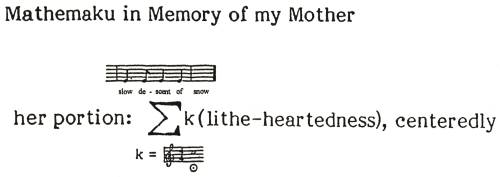
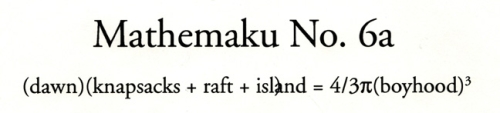
 , sigma, which of course stands for sum, or,the summation of, and has a sense similar to that of the symbol
  (the mark that looks like the letter s, an s which stands for summation), which stands for integral, and indicating that the expression following it is to be integrated, and then the symbol k, which as we noted stands for constant, and then of course the symbol +, which is the plus sign, the sign of in-addition-to, and also the sign for positive, we can see that his “mathematical expression” is the transliteration of a thought, an idea-about. This idea–and, ideas are, properly speaking, or so I would contend, always about something –is the poetic intuition–and, a poetic intuition is always an epitome.
Forget Oxford as Shakespeare and consider William Stanley, 6th. Earl of Derby, as Shaksepeare and Davies’ epigram begins to make sense. The dedication “To our English Terence Mr. Will: Shake-speare” is suspicious quite apart from the allusion to Terence.
“Will:” is abbreviated using a double dot in exactly the same way as Stanley abbreviated his forename in his signature , ” Will: Derby” (see plate VIII in Titherley’s “Shakespeare’s Identity” or the website “The URL of Derby”). Other names are not abbreviated in this way by Davies in The Scourge of Folly (e.g Epigram 155, To my worthily-disposed friend Mr. Sam. Daniell.) The hyphenated “Shake-speare” raises suspicion of a pseudonym. It has been suggested that contemporary printers used a hyphen between “e” and “s” to prevent the font from collapsing and this is why the author’s name appears in this form on the title page of many printed editions of the plays. However, in “The Scourge of Folly” other dedications (using the same font) that contain the two letters in conjunction are set without the hyphen (e.g. Epigram 184 “Against Women that weares locks like womanish men.”) suggesting that Davies’ orthography for the Shakespeare epigram was quite intentional.
The first line of the epigram suggests that it was written with tongue firmly in cheek (“Some say good Will (which I, in sport, do sing)) while the mention of the dedicatee playing Kingly parts in sport (i.e. for amusement) seems to rule out the Stratford Shakespeare who was a professional actor. William Stanley would have been a possible consort for Queen Elizabeth (the term “King” was sometimes used to describe a female monarch) due to his own entitlement to the throne through the female side of his family (the “meaner sort”)
(CF. The death of Mortimer from Henry VI part I
MORTIMER
“For by my mother I derived am
From Lionel Duke of Clarence, the third son
To King Edward the Third;”
and later
PLANTAGENET
Here dies the dusky torch of Mortimer,
Choked with ambition of the meaner sort:)
had he not compromised himself by getting involved with the theatre.
The second half of the epigram seems to be based around puns. “Raile” could be derived from the old French word “reille” and might be punning on one of its meanings “rule” which ties in with the idea of Kingship in the first half of the poem. The last two lines contain probable puns on the names of two plants “honesty” and “stock” (both given without italics) the first of which was known as “The money plant” and the second of which has a number of connotations including monetary and theatrical ones. There is a strong suggestion here of others prospering from the upright efforts of another. Considering what we know about the character of Shakespeare of Stratford it seems highly unlikely that he would have accepted such a situation with equanimity.
John Davies was an intimate of the Stanley family and, although he dedicated epigrams to other members of the clan (as well as scores of other “worthies” of his acquaintance) there is, very oddly, nothing intended for William Stanley, the sixth Earl of Derby….unless, of course, Davies regarded Stanley as “Our English Terence.”
Thanks for visiting, Jeffrey–and for commenting on my essay at length. You’re the first one to do so here. I’m too busy with other matters to wage an all-out campaign against your postition right now. I do have time for a few comments, though. One is that punctuation was, by our standards, crazy in Shakespeare’s day, so I can’t see that the colon in “Will:” means anything. Many printers used a colon similarly–perhaps mainly for nicknames, for I’m sure I’ve seen Jonson referred to in print as “Ben: Jonson.” The main explanation for the hyphen in “Shake-speare” is that it separated two words, as hyphens still do. Its use raises suspicion of a pseudonym only for cranks, I’m afraid. The great probability is that a single printer decided he liked it that way, and some other printers followed his course of action. Here we don’t know, by the way, who used the hyphen, Davies or the printer of his poem. I believe that in my essay I mention that Davies used “sport” to refer to acting. Another poem of his seems to specify that he considered Shakespeare an actor who was also a poet. I find your reading of puns strained–as strained as other readings of puns by anti-Stratfordians that posit a different True Author than you do. Aside from all that, massive direct documentary establishes Will: Shake-speare, the poet, as Will Shakespeare of Stratford-upon-Avon.
Feel free to fire a response to this at me, but don’t be surprised if I fail to answer it. I fear I feel I’ve fully answered the authorship question in my book, Shakespeare and the Rigidniks.
–Bob
Perhaps punctuation in Davies’ time was “crazy” but in Davies’ work it seems pretty consistent; the only abbreviation using a colon which I have been able to find is the case in question. Epigram 156 ” To my well-accomplish’d friend Mr. Ben. Johnson” uses a single dot so that can’t be where you thought you’d seen it abbreviated as Ben: Jonson.
Crank though I might be I still haven’t seen a satisfactory explanation for why the hyphen should be used to divide a proper name in two. If Davies’ printer had a notion to do this sort of thing, why didn’t he adopt the same practise for a name like Edmund Ashfield, (with its Sylvan overtones) the dedicatee of epigram 169? Oh, I forgot, writers and printers were all crazy back in those days.
I’m intrigued by what means you managed to divine that John Davies used the word “Sport” to refer to acting as, on searching the “LEME” (Lexicons of Early Modern English) site, I was unable to discover a single definition of the word which links it with the activity; the nearest I came to it was in one of the definitions by Thomas Thomas (1587) “Play in actes” (which if it connects to the theatre at all, must refer to the play itself rather than those who act in it). Definitions of the word overwhelmingly favour the idea of “mirth” or “jest.” If anyone is straining after a reading it appears that you are in this case.
By contrast, my reading of the puns on the words “Honesty” and “Stocke” (both emphasised by use of a different font style) are not at all strained when viewed in context: ” And honesty thou sow’st, which they do reape.” What could be more obvious than the horticultural allusion?
Finally, if you have time, please direct me to the “massive direct documentary” (sic) which establishes the Stratford Shakespeare as the poet Shakespeare as, in thirty or more years of studying the subject, I’ve failed to come across it. And, no….I won’t be at all surprised if you fail to answer this response.
My book, Shakespeare and the Rigidniks, lists most of the documentary evidence for Shakespeare. I’m hoping to have a third edition out before long. It is presently out of print. But there’s little in it that you wouldn’t already be familiar with. Things like Shakespeare’s monument, the First Folio, all the times his name was on title-pages–as well as the complete absence of direct documentary evidence against him, or for anyone else–e.g., a letter mentioning that Derby wrote Hamlet, for instance.
There are all kinds of explanations for the hyphen’s use besides the obvious one, that it separated two words. One is that Shakespeare was an actor, so perhaps liked an eye-catching name. Artists are strange, you know. One of my poet friends, born Michael Anderson, is now known as “mIEKAL aND.”
Oh, and writers and printers were not crazy back then, but spelling was was erratic enough to be called a bit crazy. Reread my essay–I’m sure I explain “in sport” in it. I think Davies used it in a poem to Robert Armine.
I skimmed through my essay and didn’t find anything about “in sport.” So I went to HLAS and found this in an entry by Terry Ross:
“Terence was an ancient Roman playwright who came from humble origins, just like Shakespeare. Davies’s references to ‘playing’ parts ‘in sport’ refer to acting, and his repeated references to ‘kings’ is a play on the name of the King’s Men; the only other poems in the volume that similarly play on ‘king’ are those to Robert Armin and William Ostler, also members of the King’s Men, and the poem to Armin also refers to playing ‘in sport.’”
I tried to find a copy of Davies’s Armin poem but failed.
Thanks for the replies, but what I really want as documentary evidence is something like a letter that mentions that Will Shakspere of Stratford-on-Avon wrote Hamlet, or anything else at all for that matter. There is actually more real documentary proof that Derby was a playwright in the form of a Jesuit spy’s letter of 30.06.1599 that reports that Derby was “busyed only in penning commodyes for the commoun players.”
Without seeing the Armin poem I can’t assess Davies’ use of the “in sport” term; what I would require to convince me is a definition dating from Davies’ time that “sport” referred to acting, and not the opinion of a commentator who fails to supply such evidence in support of such an interpretation. But, even if such was forthcoming, it would not rule out Derby as the real dedicatee of the epigram as it could be construed that by appearing as an actor he had compromised any chance he might have had to become Elizabeth’s consort. Furthermore a name on a title-page can be, and often is, a pseudonym. Other things like the monument, might have been part of a deception or evidence that others had been fooled by the various (supposed) subterfuges.
As for the hyphen, I’d like to have other instances of a proper name being separated in this way by printers of the time. As for your suggestion that it was more “eye-catching” do we have any contemporary play-bills etc., that even mention Shakespeare as an actor and, if so, is the name hyphenated. Strange that you posit all sorts of explanations for the use of the hyphen, but deem the one that says it’s a pseudonym to be the idea solely of cranks!
You mention as part of your documentary evidence for the Stratford man’s authorship lack of documentary evidence against him. This seems to constitute no proof at all in my opinion. In fact there seems to be plenty of indirect contemporary evidence against him. The “Poet Ape” sonnet of Jonson and the “Sogliardo” character in “Every man out of his humour” are generally thought to be allusions to him and hardly accord with the rapturous praise he bestows on the author Shakespeare in the first folio dedication. And I’m sure you are familiar with the “John Benson” parody which is included in the second edition of the sonnets with an engraving based on the Droeshout portrait and begins,
This shadowe is renowned Shakespear’s? Soule of the age
The applause? delight? the wonder of the Stage.
The Ostler poem describes the dedicatee as “The Roscius of these times.”
The Wiki article on Roscius states “By the Renaissance, Roscius formed the paradigm for dramatic excellence.” so I take it that when Davies’ addresses Ostler as “Sole king of actors” he meant just that and the term has nothing whatsoever to do with the King’s Men. I cannot comment on the Armin verse because I can’t find it either.
I still await
Sorry, sent the first part of the reply by mistake?
I was going to say that I’m waiting for someone to explain the “meaner sort” line in the Davies epigram with reference to Stratford Will. The “Arden Shakespeare” editor of Henry VI/1 explains the use of the term in the play as “Those whose claim to the crown, and whose rank, were inferior to his own.” How can this possibly apply to the Stratford actor who had no claim whatsoever to the crown of England? The term would certainly apply to an earl though.
Finally, I was intrigued by the line from the Microcosmos poem that you include in your article,
“And though the stage doth staine pure gentle bloode”
Why would Davies be mentioning “pure gentle bloode” when writing about actors unless he knew of instances when those who possessed it associated themselves with the stage? Shakespeare of Stratford doesn’t appear to have been a member of the blue-blooded set. Is this conjunction of the initials W.S. with a reference to the aristocracy another example of Davies being ” in the know” I wonder?
Jeffrey, I think the main difference between us is that I need less airtight an explanation for things than you do. It just doesn’t and can’t bother me that a few details in the Shakespeare story are odd, and that there’s a lot about him that we don’t know. The reverse is true for you. So, I’m sure we’ll never agree about the authorship. In any case, I really do have too many projects to take care of (or try to take care of) to get into another debate about something I’ve already argued dozens of times, often for years, with skeptics. So this really will be my last post to our discussion. Good luck with your investigation.
–Bob
Thank you, Bob. My investigations won’t lead me any further than the 6th. Earl of Derby as long as the supporters of the orthodox position continue to promise to provide all sorts of hard evidence to prove that their man was the author of the Shakespeare canon only to retire with apologies about lack of time, etc., etc., when pressed to do so.
As far as I’m concerned those who organised the deception about the authorship of the works fooled an awful lot of people at the time (as was the intention!) and still continue to do so, including all those who part with good money when they visit “Shakespeare’s Birthplace” and “Anne Hathaway’s cottage” under the mistaken impression that those places are actually what the Stratford tourist board claims them to be!
Still, congratulations on actually tackling the subject of the Davies epigram. His meanings are often obscure today (and might well have been intentionally so way back then, written only for the “in-crowd” to fully understand) but I personally regard the Will: Shakespeare epigram (along with Donne’s sonnet to “The E. of D.” and Spenser’s “Tears of the Muses” and “Colin Clouts come home againe”) as among the most significantly suggestive pieces of evidence that Derby wrote the Shakespeare works….or at least that those writers believed him to have been the real author.
Thank you, an excellent read. I feel the essay is too defensive about Davies’ motives(though an excellent analysis). Assume for a second Davies knows Terence was a front man: he then hints in these poems that Shakespeare is a front man too. This widens the conspiracy hugely. Davies was a minor figure in the Elizabeth world. If Davies was in the “know” then half of London must have been too. Not a very tight knit conspiracy, is it? Yet no-one let slip this secret openly.
When confronting anti-Stratfordians its best to keep it simple.
And imagine a poem expounding the merits of E.D.V. as a writer of “poesie”. We would never hear the end of it.
Good thinking, Jason–thanks. I’m hoping to get one final edition of my anti-Stratfordian tome, Shakespeare and the Rigidniks, published before too long. If so, I’ll slip your thought about Davies as conspirator into what I say about his Shakespeare-related poems.
all best, Bob
“I was going to say that I’m waiting for someone to explain the “meaner sort” line in the Davies epigram with reference to Stratford Will”
It didn’t mean what it would mean today – “unpleasant”, “nasty”, “miserly”. In the Elizabethan age it simply defined a social rank (or lack of it). In the context of this poem “the meaner sort” are those disqualified from being “companions for a king” – i.e. the general mass of humanity. Amongst them WS would seem like a king because of his huge accomplishments, nobility of bearing, etc.
“I’m intrigued by what means you managed to divine that John Davies used the word “Sport” to refer to acting as, on searching the “LEME” (Lexicons of Early Modern English) site, I was unable to discover a single definition of the word which links it with the activity; the nearest I came to it was in one of the definitions by Thomas Thomas (1587) “Play in actes” (which if it connects to the theatre at all, must refer to the play itself rather than those who act in it.”
Looks like you’ve answered your own question. “Sport” also refers to the play itself rather than to those who act in it (“players”). These days “sport” invariably means competitive sport, but in Shakespeare’s time it meant any kind of entertainment. But you must have seen that for yourself on LEME. As translations of Ludus you have “play in actes, mirth in words, sport, test, dalliance: a pleasant thing and not hard to be done: game, pastime, a pranke, feate, or pageant…” And you might add “revel” (“Our revels now are ended”). Davies is using the word “sport” in two senses: first as jest, second as theatrical entertainment. He is saying “in sport” (jest) that if WS hadn’t damned himself socially by becoming an actor “in sport” (plays) he might have sat at the king’s table. An obvious exaggeration.
I haven’t thought about this essay or the poem involved in a while, and am away from it right now, but I’m sure the “meaner sort” are just the sort of riff-raff Davies would not like to be around as much as he’d like to be around Shakespeare.
Mr. Grumman:
Following is the text of Davies’ poem to Armin:
To honest-gamesome Robin Armin
That tickles the spleen like an harmeless vermin.
ARMINE, what shall I say of thee but this,
Thou art a foole and knave? Both? Fie, I misse;
And wrong thee much, sith thou in deed art neither,
Although in show, thou playest both together.
Wee all (that’s kings and all) but players are
Upon this earthly stage; and should haue care
To play our parts so properly, that wee
May at the end gaine an applauditee.
But most men ouer-act, or misse-act, or misse
The action which to them peculier is;
And the more high the part is which they play,
The more they misse in what they do or say.
So that when off the stage, by death, they wend,
Men rather hisse at them then them commend.
But (honest Robin) thou with harmelesse mirth
Dost please the world; and (so) amongst the earth
That others but possesse with care, that stings;
So makest thy life more happy farre then kings.
And so much more our love should thee imbrace,
Sith still thou liu’st with some that dye to grace.
And yet art honest in despight of lets,
Which earnes more praise than forced-goodnesse gets.
So, play thy part, be honest still with mirth;
Then when th’art in the tyring-house of earth,
Thou being his seruant whom all kings do serue,
Maist for thy part well playd like praise deserue;
For in that tyring-house when either bee,
Y’are one mans men and equall in degree.
So thou, in sport, the happiest men dost schoole –
To do as thou dost – wisely play the foole.
I would like to buy your book. I have the address but would like to know the cost. Please let me know.
Hi, Mark. Thanks for the interesting Davies poem. Ten dollars
to my address will get you a copy of my book. Thanks much for
the interest.
all best, Bob
Just as an FYI, John Davies was an intimate of the de Vere family and his Orchestra (1596), like Davies’ 1595 epithalamium, was composed for the marriage of Elizabeth Vere and William Stanley, 6th Earl of Derby.
Please see the excellent article by Warren Hope, PhD, “The Singing Swallow: Sir John Davies and Shakespeare,” Elizabethan Review 21-39.
He is saying “in sport” (jest) that if WS hadn’t damned himself socially by becoming an actor “in sport” (plays) he might have sat at the king’s table. An obvious exaggeration.
Indeed, hyperbole.
And as a footnote, here is the conclusion of Davies poem, in which he praises the “singing swallow,” whom he has already described as one who “under a shadow sings.”
O that I might that singing swallow hear
To whom I owe my service and my love,
His sugr’d tunes would so enchant mine ear,
And in my mind such sacred fury move,
As I should knock at heav’n’s great gate above
With my proud rhymes, while of this heav’nly state
I so aspire the shadow to relate.
I will leave it to the local defenders of the Shakespearean status quo ante to explain why Davies is praising the Earl of Oxford in lines reminiscent of the (unpublished) Shake-Speare Sonnet 29. http://shakespeare-online.com/sonnets/29.html
please correct “swinging Swallow.” Perhaps he was swinging, but Davies does print “singing.” Apologies for the error.
Is there direct evidence that Davies was praising Oxford? I would agree that the passage quoted was influenced by Shakespeare’s sonnet, but why should that require it to be to Oxford? And I’m confused as to what your point here is, Psi.
Will now correct your typo, “>,” which I assume should be “s.”
Hi Bob. Yes. Please see the cited sources. Davies was very close to the Oxford clan in the mid to late 1590s, with many documented connections. Davies personifies Oxford as the swallow perhaps because the name de Vere was punned on the latin Ver, Veris (spring) — see, for example, Thomas Nashe’s 1592 *Summer’s Last Will and Testament,* in which the prodigal Ver, a gentle parody of the then nearly bankrupt de Vere, is a prominent character. I’m sure you’ve heard of the proverb “one swallow does not a summer make.” In this case, Davies is referring to de Vere as the swallow of spring that is announcing the coming summer. Please note how hyperbolic is praise is when applied to de Vere until you factor in “Shakespeare.”
Sorry, Psi, no time to read Warren Hope (whom I’ve read before and found to be just one more crank). What I’d be interested in seeing is some kind of direct evidence that Oxford is the singing swallow, like a title, “To My Pal Ed DeVere.”
I’d tend, by the way, to attribute the hyperbole to DeVere’s being a bigshot who once gave away a lot of money and might do so again, particularly inasmuch as we know he was not Shakespeare.
–Bob
“I find no concealed meanings in it.”
This was your first mistake.
Not a useful remark, Roger–unless you quote where I say this (no doubt I did, but can’t easily find it, probably due to my computer incompetence)–and then indicate why I’m wrong. I think I was speaking of concealed message rather than concealed meanings. Most poems can be said to have concealed meanings, although I would differentiate “concealed” (or secret) meanings from “implicit meanings.” Not many poems have secret meanings. In other words, define your meaning, don’t take it for granted a readers will have the same ones as you.