Archive for the ‘Linguexpressive Poetry’ Category
Entry 542 — Thoughts about Haiku
Monday, October 24th, 2011
Arriving with the latest issue of Haiku Canada Review was a broadside containing the winners of several haiku contests run by the Haiku Canada organization. The best, I felt, was the winner (by Pamela Cooper) of the Canada division:
hanami picnic–
more blossoms
than sky
A hanami picnic is a traditional Japanese way of celebrating the flower blossom season, the comments by contest judge an’ya tells us. The blossoms in question are generally cherry blossoms. When I first read, and liked, this haiku, I quickly decided it was not quite A-1. That’s because I failed to perceive any archetypal core, and I feel any haiku–any poem–requires that to be A-1. It was an expression of Nature in an unusual state, delightfully evoking multitudes of cherry blossoms–and patches of sky. Sensitivity, compactness (just six words), even a nice touch–for North Americans–of exotic foreignness. Too bad it hadn’t the depth an archetypal core would have given it.
A day later, thinking about what I was going to type here, I realized I’d again been off. Of course it had an archetypal core! It referred, in fact, to what I consider the absolute top such feature there is: the coming of spring.
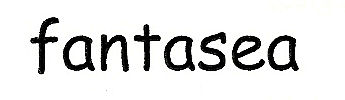
Roland Packer’s Poem, “fantasea,” featured here yesterday, is a “pwoermd,” or one-word poem. Is it also a haiku? It seems to be presented as one, sharing a page with conventional haiku (in French) in a magazine specializing in haiku. It’s a juxtapositioning of two images in a sort of tension with each other, which is the best superficial description of what a haiku is, I think. It’s about nature, and extremely compact. Some would call it a senryu, taking it as a joke. Iwouldn’t be upset by that, but I find it serious. It reminded me of Keats’s “faery seas forlorn” (if I have that right), which those familiar with the Mind of Grumman will know is one of the few poetic ingots I continually return to in my poetry and criticism. The Packer poem verysimply tells us of the vast sea that fantasy is–for me, splendid sea, although it might also be a harmful sea for those lost in it rather than in command of it.
I think it worth noting that its last syllable brings what it mainly denotes out of the pure vague. A sea is not a very specific detail but it is real, and sensually rich in local particulars to just about anyone encountering the word for it. What most makes the poem a good one, though, is its freshness–the unexpectedness of its infraverbal twist. What about its archetypal core? I have to admit that a big problem with such a thing is that one can use ingenuity to find an example of it in almost any poem. So an archetypal core I find in a poem may not be there for another reader, who may be as right, or righter, than I. He may be wrong, too, for some covert archetypal cores will exist in poems their best readers find them in, as the one I found in the poem by Pamela Cooper. The one I claim for “fantasea” is simply “man’s inexhaustible imagination”–or “the power (for good) of the human imagination.” I suspect there are much better ways of putting that. Maybe I’ll find one of them someday.
Having to do with the same thing, for me, is the other haiku I posted yesterday, George Swede’s “bottomless, the well/ of dreams–a chickadee/ on the sill.” Its imagined portion is its “well,” its reality its “chickadee.” Fantasy and sea, imaginary garden and frog. One of the best things of this is the contrast of the chickadee with the ultimate size of the well of dreams. But also the suggestion of the fragility of life’s best partly dreamed, partly genuinely experienced moments–since the chickadee is apt to take flight at any moment. I find the well in it fascinating, too–real enough for a bird to perch on a tiny part of it–projecting, that is, into full reality. Note also that, as a well, it is something to draw from, which empasizes it as a source of the liquid from which the imagination creates the arts, without which life would not be worth living for most of us.

Entry 541 — Haiku Canada Review, Oct. Issue
Sunday, October 23rd, 2011
I just got the latest issue of Haiku Canda Review, long edited by my friend LeRoy Gorman. The first poem in it that caught my eye was this, by Roland Packer:
And here’s a nice variation (it strikes me) on Yeats’s description of “imaginary gardens with real frogs in them” (and quoted by Marianne Moore):
bottomless, the well
of dreams–a chickadee
on the sill
It’s by George Swede. Discussion tomorrow of both, and–perhaps–others.
.
Entry 433 — Graham vs. Grumman, Part 99999
Monday, April 25th, 2011
It started with David Graham posting the following poem to New-Poetry:
. Mingus at The Showplace
.
. I was miserable, of course, for I was seventeen,
. and so I swung into action and wrote a poem,
. and it was miserable, for that was how I thought
. poetry worked: you digested experience and shat
. literature. It was 1960 at The Showplace, long since
. defunct, on West 4th St., and I sat at the bar,
. casting beer money from a thin reel of ones,
. the kid in the city, big ears like a puppy.
. And I knew Mingus was a genius. I knew two
. other things, but as it happened they were wrong.
. So I made him look at the poem.
. “There’s a lot of that going around,” he said,
. and Sweet Baby Jesus he was right. He glowered
. at me but he didn’t look as if he thought
. bad poems were dangerous, the way some poets do.
. If they were baseball executives they’d plot
. to destroy sandlots everywhere so that the game
. could be saved from children. Of course later
. that night he fired his pianist in mid-number
. and flurried him from the stand.
. “We’ve suffered a diminuendo in personnel,”
. he explained, and the band played on.
.
. William Matthews
. Time & Money
. Houghton Mifflin Company
.
I Liked it for the same reasons I like many of Charles Bukowski’s poems, so I said, “Good poem. Makes me wonder if he was influenced or influenced Bukowski. Seems like something by Bukowski, Wilshberianized.”
Mike Snider responded that “Matthews was a far better poet than Bukowski thought himself to be, and he did indeed know his jazz. At the other end of some cultural curve, I love his translations of Horace and Martial.
“And I love your work, Bob, but ‘Wilshberia’ is getting quite a bit past annoying.”
I may be unique among Internetters in that when I post something and someone (other than a troll) responds to it, I almost always carry on the discussion. I did that here: “I think Bukowski at his rawest best was equal to Matthews, but extremely uneven. One of his poems about a poetry reading has the same charge for me that this one of Matthews’s has. I haven’t read enough Mattews to know, but suspect he wrote more good poems than Bukowski did.
“(As for my use of ‘Wilshberia,” I’m sorry, Mike, but it can’t be more annoying to you than Finnegan’s constant announcements of prizes to those who never work outside Wilshberia are to those of us who do our best work outside of it, prizelessly. Also, I contend that it is a useful, accurate term. And descriptive, not derogatory.”
At this point David Graham took over for Mike with some one of his charateristics attempts at wit: “Sorry, Mike, but I have to agree with Bob here. Just as he says, ‘Wilshberia’ is a useful, accurate term, in that it allows someone to see little important difference between the work of Charles Bukowski and William Matthews.
“Think how handy to have such a term in your critical vocabulary. Consider the time saved. Sandburg and Auden: pretty much the same. Shakespeare and Marlowe: no big diff. Frost and Stevens: who could ever tell them apart?
“It’s like you were an entomologist, and classified all insects into a) Dryococelus australis (The Lord Howe Stick Insect) and b) other bugs.”
Professor Graham is always most wittily condescending when he’s sure he has ninety percent of the audience behind him, which was sure to be the case here.
Needless to say, I fired back: “Seeing a similarity between those two is different from seeing “little important difference between” them, as even an academic should be able to understand.
“Wilshberia, for those who can read, describes a continuum of poetry ranging from very formal poetry to the kind of jump-cut free association of the poetry of Ashbery. The sole thing the poets producing the poetry on it have in common is certification by academics.
“No, David, (it’s not like being an entomologist who “classified all insects into a} Dryococelus australis [The Lord Howe Stick Insect] and b} other bugs). Because visual poetry, sound poetry, performance poetry, cyber poetry, mathematical poetry, cryptographic poetry, infraverbal poetry, light verse, contragenteel poetry, haiku (except when a side-product of a certified poet) and no doubt others I’m not aware of or that have slipped my mind are meaninglessly unimportant to academics as dead to what poems can do that wasn’t widely done fifty or more years ago as you does not mean they are the equivalent on a continuum of possible poetries to a Lord Howe Stick Insect in a continuum of possible insects.” Then I thanked the professor for “another demonstration of the academic position.”
My opponent wasn’t through: “A rather nice nutshell of my oft-expressed reservation about Bob’s critical habits above. Note how in his definition of Wilshberia above, ‘the sole thing’ that characterizes such poetry is ‘certification by academics.’ I think we all know what ‘sole’ means. OK, then, it has nothing whatsoever to do, say, with technical concerns. There is no meaningful aesthetic distinction involved. And thus it is obviously not definable according to whether it is breaking new technical ground, because “the sole thing” that defines it is whether academics ‘certify’ it, whatever that means. And as we well know, academics tend to appreciate a spectrum of verse, from the traditional forms and themes of a Wilbur to the fragmentation and opacity of various poets in the language-centered realm.
“But look at the second paragraph above. What are academics being accused of? Oh, it seems we don’t appreciate poetry that breaks new technical ground or challenges our aesthetics. We don’t like poetry of various aesthetic stripes recognized as important by Bob.
“Whether or not that accusation is even true (another argument), does anyone else see a certain logical problem here?”
I didn’t say much. Only that he was wrong that “There is no meaningful aesthetic distinction involved” involved in my characterization of Wilshberia because aesthetic distinctions are involved to the degree that they affect academic certifiability, which they must–as must whether the poetry of Wilshberia is breaking new technical ground.
I proceeded to say, “The meaning of academic certification should be self-evident. It is anything professors do to indicate to the media and commercial publishers and grants-bestowers that certain poems are of cultural value. Certification is awarded (indirectly) by teaching certain poems and poets–and not others; writing essays and books on certain poems and poets–and not others; paying certain poets and not others to give readings or presentations at their universities; and so forth. What (the great majority of) academics have been certifying in this way for fifty years or more is the poetry of Wilshberia.” “Only,” I would now add.
I also noted that I had I previously defined Wilshberia solely as academically certified poetry. “Implicitly, though,” I claimed, “I also defined it as poetry ranging in technique from Wilbur’s to Ashbery’s. Since that apparently wasn’t clear, let me redefine Wilshberia as “a continuum of that poetry ranging from very formal poetry to the kind of jump-cut free association of the poetry of Ashbery which the academy has certified (in the many ways the academy does that, i.e., by exclusively teaching it, exclusively writing about it, etc.)”
Oh, and I disagreed that ” . . . as we well know, academics tend to appreciate a spectrum of verse, from the traditional forms and themes of a Wilbur to the fragmentation and opacity of various poets in the language-centered realm.”
“My claim,” said I, “remains that the vast majority of them think when they say they like all kinds of poets from Wilbur to Ashbery that they appreciate all significant forms of poetry. I have previously named many of the kinds they are barely aware of, if that.”
That was enough for the professor. He retired to an exchange with New-Poetry’s nullospher, Halvard Johnson, about not having a certificate indicating he was a poet in good standing.
Entry 426 — A New Chapbook by Beining
Monday, April 18th, 2011
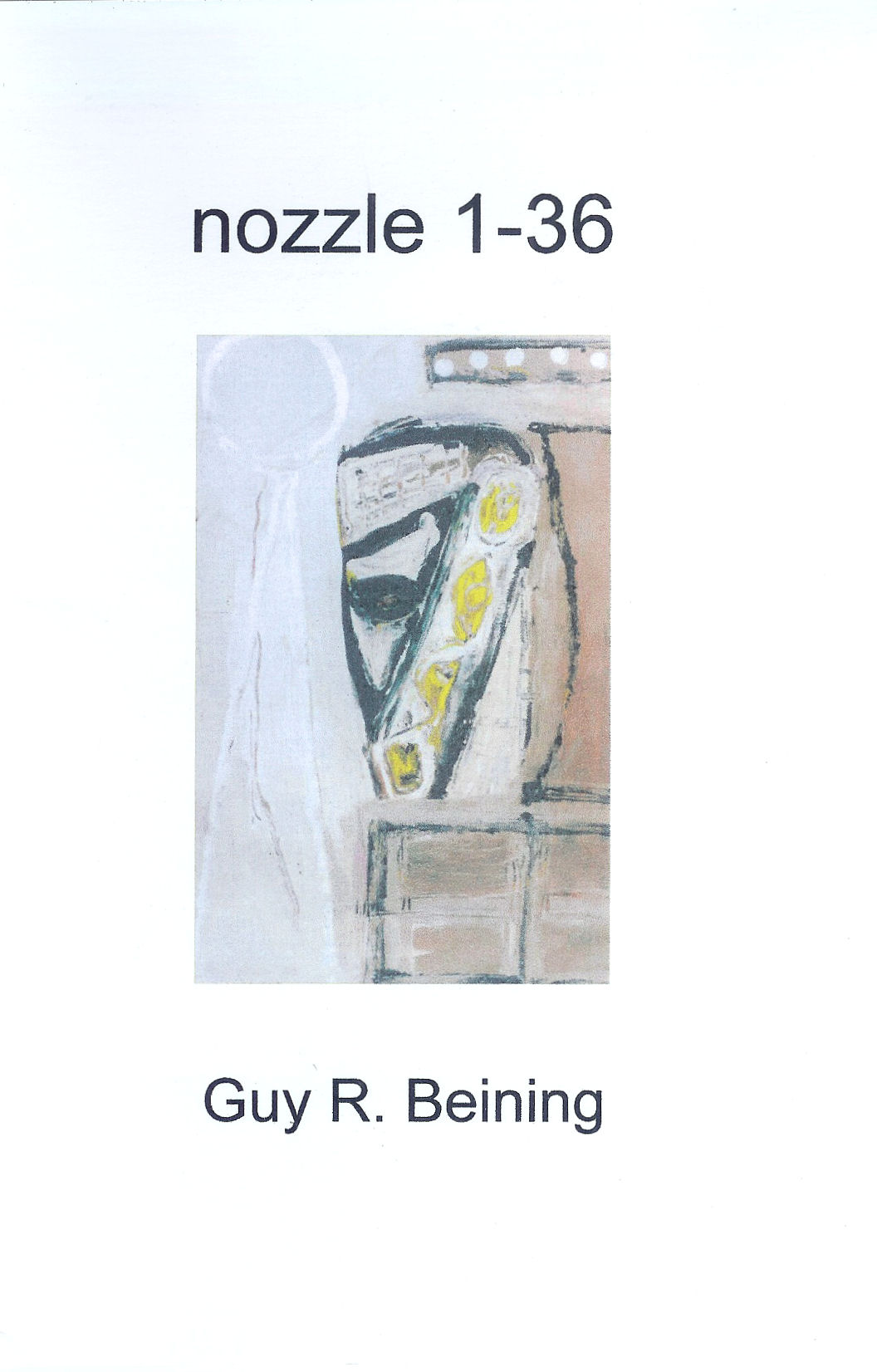
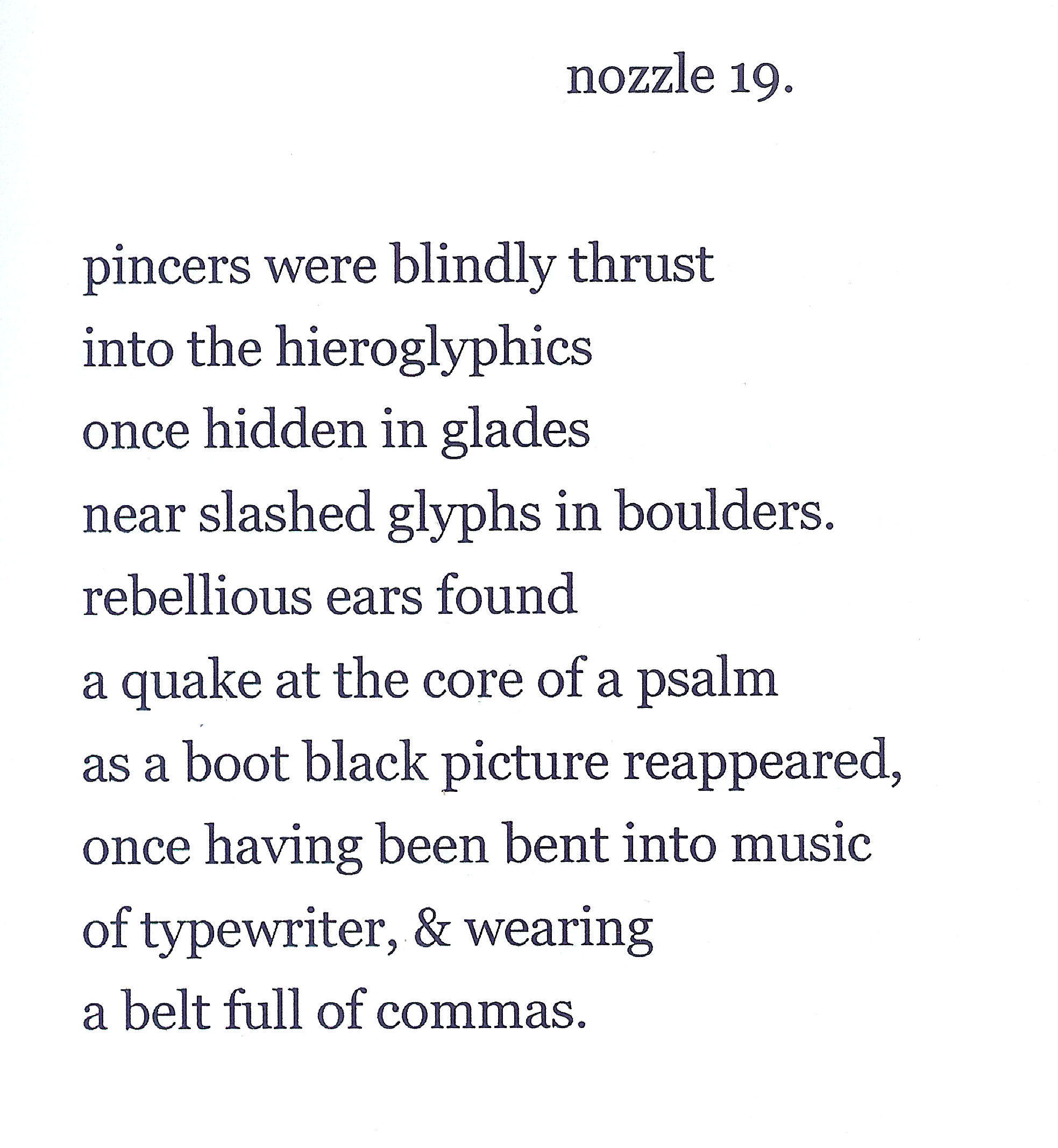
There are a fair number of excellent visual poets who are excellent linguexpressive poets, as well: Karl Kempton, Sheila Murphy, Geof Huth, Crag Hill, to mention just a few. Another is Guy R. Beining, who is also a wonderful pure visimagist (i.e., maker of visual art), as my top image of his painting for the cover of nozzle 1 – 36, his recent collection of linguexpressive poems, proves. Following it are two of the poems in the book. As I always wonder, as practically the only one who has discussed his work (too seldom I fear, and too worn out to do so here), why he is not better known.

Entry 387 — 2006 Discussion of a Poem by Crag Hill
Wednesday, February 23rd, 2011
Recently, I’ve been going through the files with the graphics but not the texts of entries I made to my previous blog in search of mathemaku of mine. I want to number them all, so need a complete list of them. I think I posted just about all of them to my blog. In any event, yesterday I brought up a file for an entry (Blog959) whose visits was recorded as close to 200. Rarely did my old entries get more than 20 visits. Curious to see what was in the blog, I then brought up the file that had its text, which I think worth quoting here:
17 September 2006: Among the many intriguing items at Crag Hill’s Poetry Scorecard is this found poem of Crag’s that he posted 3 September:
From Index of First Lines Selected Poems Charles Olson
. I come back to the geography of it,
. I don’t mean, just like that, to put down
. I have been an ability–a machine–up to
. I have had to learn the simplest things. I live underneath
. I looked up and saw
. Imbued / with the light
. I met Death–he was a sportsman–on Cole’s. In cold hell, in thicket, how
. In English the poetics became meubles–furniture–
. is a monstrance,
. I sing the tree is a heron. I sit here on a Sunday
. It’s so beautiful, life, goddamn death
. it was the west wind caught her up, asAmazing poem, this. I’m not a big fan of Olson’s, though I believe he is a major poet, and that some of his poems are A-1. Surely, these lines could only have been from a poet, though. I recognize one or two, but in this discussion will not look up any of them. (Oops, I realize I couldn’t look up very many of them; I do have The Maximus Poems, and several of my anthologies have poems by Olson, but I don’t have the Selected Poems.)
“I come back to the geography of it,”
Anyway, what a beginning, this return to some geography. Olson was probably only returning to a genuine geography, of the locale I feel he jabbered too much about, but here–dislocated by the line-break–”geography” can wing us to the terrain of all kinds of things, including the memory of a breakfast, banking procedures, 3 A.M., everything having a geography. Less surlogically, the word brings us to fundamentals, to the earth, to reality seen large, solid, inanimate . . .
What, I suddenly wonder, would the geography of geography be? Poems like this– effective jump-cut poems, that is–can flip us into such questions. Questions that resonate for the person flipped into them, I mean–as this one will surely not for everyone.
“I don’t mean, just like that, to put down”
Now a jump-cut leaving “geography” to simmer unconnected to any specific, and making the poem’s narrator more than a pronoun through his attempt to explain himself better. His explanation is broken off before getting anywhere, which effectually explains all the better his state of being at loose ends. A main interest is in whether he has just dropped one activity to return to the geography of whatever he’s involved in, and/or inadvertantly “put down” whatever he was doing because superficial or the like compared to geographical questions. “I have been an ability–a machine–up to”
The narrator continues trying to explain himself without finishing any of his ventures into self-analysis. I take this line to mean he’s not been personally/emotionally involved in whatever it is he’s talking about, “up to (now).” Note, by the way, how this line, with its pronounced metaphor, disturbs the quotidian tone of the previous (which, in turn, had demotically countered the academic tone of the first line).
“I have had to learn the simplest things”
Wow, no longer able (I guess) to let his machinery run his life without his involvement, the narrator has to concentrate, start from a sort of zero.
“I live underneath”
We’ve come to a new stanza. That the narrator says he lives underneath, which the lineation compels us to consider, rather than underneath something, opens a world for me. Certainly, we’re with a narrator deepening through himself (as we would expect from the poem’s consisting entirely of lines in the “i” section of an index).
“I looked up and saw”
This line seems planned to follow the one before it. This sudden strong logic out of the chaos of existence as if to reassure us that life does make sense is one of the virtues of found poetry. Again, a line-break re-locates us, in this case keeping us from a transitive verb’s object, compelling us to consider “saw” as an intransitive verb. The narrator has experienced illumination, not just seen some detail of ordinary life. No big deal if the context set us up for this sort of heightened seeing, but something of a (good) jolt in this zone of reduced context.
“Imbued / with the light”
Yikes, this sentence carries on trouble-free from the previous one.
“I met Death–he was a sportsman–on Cole’s”
The grammar now shatters the logic we seemed for a while to be in, just as “Death” shatters the text’s positive bright ambiance. I can’t help, by the way, thinking of Emily at this point. Death, however, is an absurd, trivial figure, some guy pursuing some conventional sport at some named who-cares-where.
“In cold hell, in thicket, how”
After the intrusion of a line with something of the effect of the famous porter scene in Macbeth, a new stanza, and high rhetoric electrifyingly bleakening the scene. Fascinating how “Cole” quickly colors into “cold hell,” by the way. “In English the poetics became meubles–furniture–”
Another weird shift–to the cold, densely thicketted geography of poetics (in English). “Furniture.” Something inanimate, stupid–but comfortable, for our convenience, to be used. . . . I don’t know the meaning of “meubles” but assume it’s some kind of furniture. Somehow, we are now in a man trying to explain himself in a geography/text trying to explain itself. At least, according to my way of appreciating language poems of this sort, which is partially to take them as exposures of mental states.
“is a monstrance,”
I guess we aren’t meant to sit on the chairs or put anything on the tables in the poem. We are definitely in a darkness and a confusion. “I sing the tree is a heron”
But the narrator can sing. He sings (presumably) of a tree’s resemblance to a heron. In other words, something dark (probably) and solid and motionless, like furniture, has something undark and capable of flight in it. Thus, the stanza ends hopefully, to set up the final one, which begins:
“I sit here on a Sunday”
The tone has gone quiet, conventional–but implicitly celebratory, Sunday being generally a day-off, and devoted to (generally happy) religious services. “It’s so beautiful, life, goddamn death”
The chaos of the poem is resolved with this line. The fragments we’ve been stumbling through, dark and light, are life–which is beautiful in spite of the presence of death.
“it was the west wind caught her up, as”
Because of the line before this one, I’m prepared to read this to be about a woman turned magically into a weightless angel the pleasant west wind is going to give a ride to. Chagall, at his undrippiest. I also read the awe of a man beholding a beautiful woman into the line. An image illustrating the climactic previous statement.
Okay, that was a preliminary once-through I hope some reader will get something out of. I did! Don’t know if I’ll return to it. Probably, so I can use it in a book. Don’t know if I’ll have anything better to say about it then, though.
* * * * *
I’m not ready to say more about the poem now–except that I wondered when I looked at my entry whether I’d mentioned the importance of Crag’s poem’s foundness when I discussed it. I saw I hadn’t. In my megalomaniacal opinion, I think I may be the only critic who has ever discussed the full aesthetic value of foundness. I did this in my discussion, possible two decades ago by now, of Doris Cross’s work–wonderful visual poems brought into being by painting or otherwise defacing, deleting, meddling with dictionary paintings. (I love Nietzsche not only for all he said, brilliantly, that I agree with, but for the megalomaniacal boasts he made about his accomplishments that have turned out to be valid.)
What I said in my Cross piece isn’t handy, so my comments now will probably be a bit incomplete and not as sharply expressed as what I said in it. First off, as anyone would agree and as many I’m sure have said, the quotations from Olson, add his life and writings to Crag’s poem. This is important. But what I think effective appropriation of found materials most importantly does is celebrate the essential logic of the universe. It reminds us that God is in his heaven allowing accidents to make affirmations–even for someone like I who doesn’t believe in God, and understands that accidents don’t really make affirmations, only happen so often that some of them, especially when a keen discoverer has an eye out for them, are bound to do what Crag’s collection does. Another, better way of putting it, is that we are reminded of who wonderfully well the human brain finds ways to give existence meanings, meanings that suggest Meaning.
Okay, not a view you’d think anyone would feel like a demigod for having, but it’s more than anyone else has said about foundness that I know of. And I can’t see how anyone could say it’s wrong.
.
. Poem Consults the Vseineur
.
. However seldom the vseineur
. said “universe” in Poem’s hearing,
. he accepted it,
. however clear it always was
. that it had misspoken.
.
Entry 378 — A Poem by Elizabeth Bishop
Monday, February 14th, 2011
.
Over 2,000 Illustrations and a Complete Concordance
Thus should have been our travels:
serious, engravable.
The Seven Wonders of the World are tired
and a touch familiar, but the other scenes,
innumerable, though equally sad and still,
are foreign. Often the squatting Arab,
or group of Arabs, plotting, probably,
against our Christian empire,
while one apart, with outstretched arm and hand
points to the Tomb, the Pit, the Sepulcher.
The branches of the date-palms look like files.
The cobbled courtyard, where the Well is dry,
is like a diagram, the brickwork conduits
are vast and obvious, the human figure
far gone in history or theology,
gone with its camel or its faithful horse.
Always the silence, the gesture, the specks of birds
suspended on invisible threads above the Site,
or the smoke rising solemnly, pulled by threads.
Granted a page alone or a page made up
of several scenes arranged in cattycornered rectangles
or circles set on stippled gray,
granted a grim lunette,
caught in the toils of an initial letter,
when dwelt upon, they all resolve themselves.
The eye drops, weighted, through the lines
the burin made, the lines that move apart
like ripples above sand,
dispersing storms, God’s spreading fingerprint,
and painfully, finally, that ignite
in watery prismatic white-and-blue.Entering the Narrows at St. Johns
the touching bleat of goats reached to the ship.
We glimpsed them, reddish, leaping up the cliffs
among the fog-soaked weeds and butter-and-eggs.
And at St. Peter’s the wind blew and the sun shone madly.
Rapidly, purposefully, the Collegians marched in lines,
crisscrossing the great square with black, like ants.
In Mexico the dead man lay
in a blue arcade; the dead volcanoes
glistened like Easter lilies.
The jukebox went on playing “Ay, Jalisco!”
And at Volubilis there were beautiful poppies
splitting the mosaics; the fat old guide made eyes.
In Dingle harbor a golden length of evening
the rotting hulks held up their dripping plush.
The Englishwoman poured tea, informing us
that the Duchess was going to have a baby.
And in the brothels of Marrakesh
the littel pockmarked prostitutes
balanced their tea-trays on their heads
and did their belly-dances; flung themselves
naked and giggling against our knees,
asking for cigarettes. It was somewhere near there
I saw what frightened me most of all:
A holy grave, not looking particularly holy,
one of a group under a keyhole-arched stone baldaquin
open to every wind from the pink desert.
An open, gritty, marble trough, carved solid
with exhortation, yellowed
as scattered cattle-teeth;
half-filled with dust, not even the dust
of the poor prophet paynim who once lay there.
In a smart burnoose Khadour looked on amused.Everything only connected by “and” and “and.”
Open the book. (The gilt rubs off the edges
of the pages and pollinates the fingertips.)
Open the heavy book. Why couldn’t we have seen
this old Nativity while we were at it?
–the dark ajar, the rocks breaking with light,
an undisturbed, unbreathing flame,
colorless, sparkless, freely fed on straw,
and, lulled within, a family with pets,
–and looked and looked our infant sight away.1955
I like this poem. I especially like the line, “Everything only connected by ‘and’ and ‘and.’” The book sounds like a wonderful one. Too bad that Bishop is negative about so much in the book. But I love the homage to “andness” that I consider her poem best to be–so much and more and more is out there!”
Entry 323 — Rhyming Fun, Part 10
Thursday, December 23rd, 2010
.
. A Visit to Poem, Continued
.
. Except, of course, appealing to
. a different taste than these,
. which lack an edifying view
.
. of tortured sinners’ agony
. and like felicities
. of serious morality.
.
This is probably my dumbest set of stanzas, but I really don’t like Dante very much.
Entry 322 — Rhyming Fun, Part 9
Wednesday, December 22nd, 2010
.
. A Visit to Poem, Continued
.
. My age was two times greater than
. the Florentine’s had been
. when his peculiar climb began
.
. in three-line stanzas similar
. to these I now was in
. for who knows how damned long a tour.
.
Click this to visit The Pedestal Magazine where the review I had to do this month is. I found it difficult to write, and–chee, I keep wanting to keep everything in this paragraph iambic; that dumb rhyme of mine has really gotten to me–and I don’t think I did a terrific job. I hope it’s not too bad, though, and that the poet treated doesn’t get too upset with me.
I should be in good spirits now. My hip is no longer keeping me from playing tennis reasonably well, for my age, and my health seems otherwise okay. My financial picture has improved, for I’ve recently been able to consolidate some of my debts and lower my interest rates a good deal. I got the review done, and my latest column for Small Press Review. My booklet about the taxonomy of poetry is ready for printing. Yet, I’m weary, and can’t seem to get anything consequential done. Oh, well, maybe it’s just holiday blues. And the continuing cold weather (in a house with a heating system barely able to keep the house at sixty when it’s less than that outside–except here in my computer room where I have a space heater). And I no longer have a cat . . .
Entry 321 — Rhyming Fun, Part 8
Tuesday, December 21st, 2010
.
. A Visit to Poem, Continued
.
. He spat, then shimmered more surreal
. than he had been before,
. his torso now a golden wheel,
.
. his his my dead cat burning bright,
. his her an open door
. to Blake’s most cruelly tygered night,
.
These two were tough to write. I tried to add to the poem twice, once before tennis, once after, and got nowhere. Only after a nap, and sitting at my keyboard for a half-hour, did I get anything down. I’d been close to taking my first day off from the poem. The secret to continuing, of course, is constantly to increase one’s irresponsible as a narrator. But the latest stanzas, believe it or not, seem to me to be going somewhere seriously interesting.
Entry 320 — Rhyming Fun, Part 7
Monday, December 20th, 2010
. A Visit to Poem, Continued
.
. The farmer laughed
. at my unhappiness,
. then quickly shot a feathered shaft
.
. that passed completely through my head.
. He shrugged off my distress
. “Naught I’d not do to rhyme,” he said.
.
. “Too much of that is going on!”
. I screamed. “This text is vile!”
. “Not so,” the farmer lisped, “for Khan
.
. it hath, from distant Xanadu,
. and other marks of style
. not evident to fools like you.”
.
.
Dang, rhyming is easy if you don’t care what you’re saying.
