Jerry McGuire « POETICKS

Archive for the ‘Jerry McGuire’ Category

Entry 1203 — More Boilerplate About Academics

Wednesday, September 4th, 2013

According to Gary Soto’s bio, his poem, “Oranges,” is the most antho-logized poem in contemporary literature.  When Jim Finnegan reported this to New-Poetry, I replied, “Sounds like something an academic would say after checking six or seven mainstream anthologies.  I may be wrong, but I doubt anyone can say what poem is more antholo-gized than any other, mainly because I don’t think anyone can know about all the anthologies published.”

Jerry McGuire responded to this and that resulted a little while ago (3 P.M.) in the following:

On 9/4/2013 2:41 PM, Jerry McGuire wrote:

Bob, does it really take an academic to persuade you that a particular instance doesn’t prove a general claim? Even averaging things out, I suspect, people who write poetry for their own purposes–which are enormously varied and not in dispute–don’t strike me as “more adventurous” though I can’t for the life of me figure out what kind of “adventure” you have in mind) than academics who write poetry, some of whom are conservative, some middle-of-the-road, and some well out there beyond the fringe. If you mean, by the way, that academic writers are more likely to respect more elements of the history of poetry and include a greater historical variety among their preferences, perhaps I’d agree with you, intuitively, but I can’t prove it and I doubt you can either. As for “academics are in charge of poetry, and I include many people not employed by colleges as academics.  An academic is, by my definition, by innate temperament, an automatic defender of the status quo,” your definition strikes me as self-serving and petty. What you know about my “innate temperament” (“for instance”?) hardly qualifies you to determine what’s “automatic” in my preferences, loves, hates, and particular decisions. As so often, you seem to be nurturing some sort of long grudge, and using the list to air your brute generalizations. Some of us do read these things, you know.  And while crude prejudices don’t hurt my feelings–hardened over the years by the contempt of 18-year-olds for their elders–they sadden and disappoint me.

Jerry

On 9/4/2013 1:01 PM, Bob Grumman wrote:

I would claim that academics are much less adventurous (for good or bad) than non-academics–in general.  Compare, for instance, the anthology that I would edit if allowed to the anthology David Graham would.  Or, hey, compare the one he did edit (on conversational poetry, if my memory hasn’t completely died) with one I edited (on visual poetry).  Ignoring which was better (and believe it or not, I would certainly be willing to say they were equal but different in spite of my preference for the poems in mine), consider only which would be considered more adventurous.

Jerry, I used a particular instance to illustrate a general claim.  Maybe if I was able to find everything I’ve written on the subject, I could present a fairly persuasive case for my academic/non-academic division but I’m not, so for now will simply have to leave my opinion as just another Internet unsupporthesis.  I’ll not be able to get into what adventurous is, either, except to say that Columbus was more adventurous than Captain Shorehugger because he went where none or almost none went while the cap’n went where many had been.  The comparison holds even if the latter had found many things of value that had been overlooked by other shorehuggers (which is what the best academics are good at) and Columbus had sunk a hundred miles west of the Azores.

(Note, I can’t lose this argument because I define those you would call academics who are “well out there beyond the fringe as non-academics” since I believe that one employed by a college isn’t necessarily an academic, John M. Bennett and Mike Basinski, two Ph.D. college librarians [but neither of them with any clout at all in the poetry establishment] being cases in point.)

modestly yours, the World’s SUPREME Poventurerer

* * *

 Jerry also wrote:

As for “academics are in charge of poetry, and I include many people not employed by colleges as academics.  An academic is, by       my definition, by innate temperament, an automatic defender of the status quo,” your definition strikes me as self-serving and petty. What you know about my “innate temperament” (“for instance”?)hardly qualifies you to determine what’s “automatic” in my preferences, loves, hates, and particular decisions. As so often, you seem to be nurturing some sort of long grudge, and using the list to air your brute generalizations. Some of us do read these things, you know. And while crude prejudices don’t hurt my feelings–hardened over the years by the contempt of 18-year-olds for their elders–they sadden and disappoint me.

Jerry

in a second post, I wrote:

I skipped the above, mistaking it for just a repeat of what I’d said in my post. I definitely have a long grudge, but when you ask what I know about your innate temperament, I’m afraid a possibly over-sensitive buzzer of yours made you take my words as personal.  If you read what I say with care, you will see that I say nothing that would indicate that I consider you an academic, by my definition.  I would say offhand that you are surely more of an academic than I.  From what I’ve read of what you’ve written, I am sure, too, that you are much less of an academic, by my definition, than the people at the top of the poetry establishment.  Just as I am, from some points of view, a terrible academic, since I believe artworks with no words of aesthetic significance cannot be poetry; that a good poem HAS to have some unifying principle (although it may be very difficult to discover and may even be chaos), that what I call otherstream poetry is just a different kind of poetry, not a better kind; that literary criticism is as valuable as poetry; and many other opinions.

Now for a little snarkiness: the belief that academic are not automatic defenders of the status quo is as crude as the belief that they are.  And my belief that the majority of those making a living in college English departments are automatic defenders of the status quo is not a prejudice but the result of quite a bit of study and thought, however misguide others may think it.  So there. True, an academic study of academics would be helpful if thorough and honest.  How about a comparison of all the poetry critics on a list of poetry critics with writings in publications almost everyone would agree are mainstream, like Poetry and The New Yorker and those on a list of those who have written a reasonably large amount of poetry criticism just about never in such publications–like I.  You could include the language poetry critics active before 1990, when language poetry became what I called “acadominant,” meaning widely accepted by academics as important, even by the many against–who showed they thought it important by campaigning against it.  It proved me right by being confirmed as the right edge of Wilshberia around 1900 with the acceptance of a language poet into the American academy of poets, and mainstream anthologies of language poetry. Something of the sort will eventually be done, but not for several decades, I suspect.

–Bob

.

Entry 941 — Pronouncements and Blither, Part 3

Monday, December 3rd, 2012

An acadumbot had asserted that some poet his very commercially-oriented small press had published was one of the recent NEA grant winners. Countering a post of mine doubting that anyone doing otherstream work would have much chance of winning such a grant, he said her work was “experimental.” When I asked him to say why it was, he told me to use Google to find out.  After I snapped back at him about his being satisfied with empty assertions, I got into a more intelligent discussion with Jerry McGuire and Barry Spacks.  Barry started it off (yesterday) with a complaint:

“Not to rein on Ms. Mangold’s euphormium-moment (Mangold being the poet described as experimental by the acadumbot I mentioned), but it happens to summon my hobbyhorse, so I mount up again (we each have our own, Bob) — namely to cite poetry’s Gresham’s Law, that impossibly arbitrary stuff that’s passed off — God knows why — as the brave new thing drives out work of actual value such as Wilbur’s and Ashbery’s Great Experiments.  Proof? Proof lies in the fact that It’s just so unspeakably easy to mix up a word salad and sit back awaiting the prize.  I’d bet there’s not a single person on this list who couldn’t, in 3 minutes, run up a jump-cut piece at least as good (i.e. bad) as the me-me self-indulgencies that often pass for meriting attention in our perverse day.  Poor poetry — talk about The Art of Sinking!  Or, to put it in a more prize-winning way:

Three Minutes by Clock Driving the Ghost of A. Pope Nuts
man gold gal gold echestamy
warrants the B-cleft glockinspiel —
hath reverence then a zealand smirk
on the upper West side? or in excelsis?
‘Zads, Mary, taunt the tale in creatures, Joyce’s Christ!
Do not impale the rectuary, do not
o-noble me, sly shrubbery,
quontom-phantom heliovort!
I come to bury Ceasar, and in my day,
I maketh the sweats in thirds,
do offer up yon plangent potato
please, please relequate the nose factor
can’t somebody give an ahem?
(no time left, but that’s just because
Google went so slow on the spelling checks
and 3 minutes is really hardtack, Jeb).

“Send the check to the Belize address.

“with a song in my heart, Barry”

Jerry replied to this as follows:

“My teacher, Al Cook, in talking about Koch’s Wishes, Lies, and Dreams (it’s a book about teaching kids to write poetry, for those of you it missed), used to say that if you tell ten-year-olds often enough (rewarding them the while) that “My sister is a rubber moon” is something good for them, they’ll crank out that kind of line by the bushel. But Al never suggested that surrealism was therefore self-evidently bad. You can’t be saying, Barry (can you?) that what you’re calling “jump-cut” pieces can’t be any good because many of them are bad, right? That there’s no difference between Clark Coolidge’s bizarreries and your awkward little sprint? (Or did you have a slight twinge, there, when I called it “awkward”? Maybe some small part of you believes that the skills you’ve developed over the years must make  your effort actually worth a second look?)

“I mean, most of us can also crank out a dozen lines of rhymed verse (as John Ciardi pointed out years ago in distinguishing poetry from “poesy”). That doesn’t mean that rhyming or other dimensions of sound-play are a dead end, I think–just that it ordinarily takes years of practice (and don’t get me started on that hack, Rimbaud!) to synchronize the ear and brain to any technical resource: rhyme, enjambment, shape-on-the-page, syntactic disruption, font color, extra-linguistic symbol, multilingual portmanteaux, etc. Really, Barry, I can’t Belize you!”

Then I said, “Jerry, I think the difference between the anybodies writing crappy rhyming verse and the anybodies writing crappy jump-cut verse is that the former aren’t getting published and reviewed in the mainstream, and the latter are—along with the few jump-cut poets who sometimes write good poems (but also get away with pretty bad ones) like Ashbery. I wouldn’t call Coolidge’s stuff jump-cut, by the way, but don’t know his large ouevre well enough to say he doesn’t do it Your hobbyhorse is a secondary hobbyhorse of mine, Barry—some jump-cut stuff is terrific, and even conventional poems can profit by judicious use of the jump-cut, but there seem to be a great many poets just irresponsibly throwing words and asemic texts together with or without graphics and winning attention. Few consider my call for a poem’s having a unifying principle anything but a sort of fascism.

“I think the Mangold poem is reasonably unified, although not as unified as I’d prefer. But there are books full of what Barry calls word salads, published and reviewed by mainstreamers.”

Jerry: “Yeah, in fact, Bob, I’m not comfortable with the jump-cut terminology. It comes from film, where the continuity of one’s identification with the cinematically-constructed gaze (what the camera “sees,” usually through a perspective borrowed from an onscreen character) is suddenly disrupted in ways that violate ordinary perceptual expectations–we’re precipitated, outside ordinary spatial and/or temporal possibility, into another cinematically-constructed gaze. That’s quite a bit different, cognitively (though film critics like to talk about its operations as part of film’s grammar) from the variety of linguistic operations involved in

“Ashbery’s or Coolidge’s referential, syntactical, or identificatory continuities. (The ancients [as always] had a word for such stuff, by the way: anacoluthon, in which a sentence veers within itself from one grammatical structure to a different one.)

“As for your idea that legions of minor-league Ashbery’s are dominating poetry publication and prizes, I’d say two things: (1) I don’t believe it; I believe that most poetry published and rewarded with prizes is still more middle-diction than Ashberian, Coolidgean, or Rimbaudesque; and (2) to the extent (fairly limited, I think) that more such poetry is being published and rewarded, it’s a sign of a gesture towards a paradigm shift, as what seemed baffling and antipoetic thirty years ago accumulates acolytes until it edges first towards a kind of scruffy respectability and then downright normalcy. Maybe in 2167 everyone will be complaining that the stodgy old math poets are hogging the prizes.

“As for crappy this and crappy that, sour grapes.

“And a confession, of sorts: for about twenty years now I’ve been exploring (“experimenting with,” I’d say) stategies of disrupting diction, syntax, reference, phonology, etc. that, twenty-five years ago, I had only the barest awareness of, and that only slowly and grudgingly became part of my repertoire, and that, when I realized what I was doing, took shape in my work in ways that now seem crabbed, amateurish, and even embarrassing, but that, eventually, began to reveal to me dimensions of my language and experience that I don’t think I could have discovered in any other way–I want to emphasize the “me”s, “my”s, and “I”s in that clause–until I’m at last proud (probably over-proud) of a body of work that I produced under that impulse and that, finally, after scores of submissions, rejections, rewritings, and reorganizations, will be published in the spring. Even if you (or Barry, or anyone else) doesn’t like it (and I realize that that’s beside the point, and so should you), it’s very clear to me that I’ve wrestled with my own limitations, used certain technical resources to expand my capabilities, and been true to the impulse that got me into this stinking difficult art in the first place. So I’m saying that this casual dismissal of mechanical troping–what you’re calling “jump-cut poetry”–seems to me to miss the point entirely: that some people work very hard to get it right, even if some people don’t, or don’t seem to; and far from being easier to master just because it seems easier to approximate, the fact that anyone can scramble semantics or syntax in a casual way (and remember, anyone can put sentences together, too! that doesn’t mean it’s easy to write a novel) may make it _harder_ to see the value in trying to do that in ways that press towards the expression of hard-to-speak parts of our experience.”

Me, again: “Thanks for as-ever thoughtful comment, Jerry. I think you misread me a little, and I disagree with you about some things, but not up, right now, to a full response, just a few quick thoughts, but I hope to return for more.

“I’m uncomfortable with jump-cut terminology, too, but can’t think or or find better. I mean it specifically for poetry that jumps completely out of a train of a developing train of thought into a seemingly entirely different one, not what anacoluthon is a term for, in my understanding of it. It has nothing to do with linguistics but with narrative. Narrative in a wide sense that would include adventures of a concept, perhaps. This is not an area I’ve given what I would call proper scholar attention, just something I needed to know something about to get my taxonomy of poetry right. Anacoluthon seems something pertinent to language poetry, which I consider very different from what I call jump-cut poetry.

“I may have given the impression of speaking of “legions of minor-league Ashberys,” but I’m only speaking of a visible portion of Wilshberia that I’ve been noticing as a reviewer, and here at New-Poetry that’s becoming stronger and stronger. Certainly the ratio of  published&reviewed&rewarded Iowa plaintext poetry, which still dominates Wilshberia, to published&reviewed&rewarded Ashbery-influenced poetry is much lower than the ratio of the latter to what I call otherstream poetry.

“I reject the idea that I suffer from sour grapes: resentment is not the same as jealousy. I used “crappy” simply as a tag for “inferior,” and I believe almost everyone would agree that some inferior poetry is being published&reviewed&rewarded.

“Seems I’m making a semi-full response, after all, so will keep going. Aside from wishing you luck with your book (and saying I will definitely be looking forward to reading it), I only want to say that I, for one, am not guilty of ‘casual dismissal of mechanical troping—what (I’m) calling jump-cut poetry,’ for I consider it a highly important kind of poetry equal to visual poetry, and more important than Iowa plaintext poetry because that’s just a school, and subclass of free verse (or whatever my taxonomy calls it, which I can’t remember). I’m just expressing resentment of those using it (poorly, in my view) to fast-lane into prominence, because it is definitely the top intellectually fashionable kind of poetry now, however more popular among middle-brow poetry-lovers Iowa plaintext poetry remains.

“And now a small wail at my stronger and stronger realization, after observing how little I’ve said above, that I probably won’t ever put together the book I want to write to clarify all my thinking on the varieties of poetry.”

Nothing new posted to this discussion since then

.

Entry 834 — More of My Boilerplate at New-Poetry

Saturday, August 18th, 2012

On 8/15/2012 7:42 AM, bob grumman wrote:

Perhaps it’s wrong of me to be bothered by a mainstream critic’s being ignorant of or indifferent to the only significant thing I believe has happened in American poetry over the past century, the discovery and increasingly interesting use of (relatively) new techniques, but I am.

Sent: Wednesday, August 15, 2012 2:31 PM
Subject: Re: [New-Poetry] Hass’ What Light Can Do: Essays on Art,Imagination and the Natural World
.
Of course it’s not “wrong,” Bob–by all means, be bothered.
.
I still don’t have time for you, Jerry, but I’m going to reply, anyway! (Feel honored.)
.
Me, I’m inclined to write my own manifesto, “On Indifference” (let’s make it a book-length piece, On Indifference and Other Life-Affirming Virtues),

.
An individual can’t avoid indifference about some things (like my indifference to the squabbles of the republicrats), but no field’s establishment (and every field has one) should be indifferent about something like visual poetry that a sizable number of people in its field think is important. It took me a long time to accept language poetry (genuine language poetry such as Clark Coolidge’s) as anything but nonsense (although not as long as it took me earlier to accept free verse—although I instantly accepted Cummings’s visual poetry very early when shown what it was doing), but I finally did, because so many people to me were enthusiastic about it. Not that I can accept every poet’s work that others find terrific, but I try to. I’m still working on Gertrude Stein’s.
.
taking the position that there are always people eager to pursue possibilities at the margins (or borders, or frontiers–whatever suits one’s fantasies) of any ensemble of creative forms, while others make the best of their own engagement with the history of that ensemble (including its hidden history, perhaps),

.
Some even do both! At the same time! You’d never know it from reading any of the books of criticism Finnegan tells us about.
.
and that there’s nothing wrong with either exploration of one’s energies. It would be important to note, in such a screed, that there are huge loads of crap deposited both at the margins and in the center.

.
Definitely.
.
(If I did the book-length version, I’d certainly want to include a chapter [titled “One’s Ceiling is Another’s Floor”?] about how spatial descriptions of “ensembles” is a stupid way to go about describing the antics of artists. My bad.)

.
Not sure what you mean by “ensembles.”
.
And there, the manifesto’s done, and I, too, lack a contract to publish it.

.
I suspect you’d have any easier time getting one (from a “real” publisher) than I would for any book of mine. I was just reading about Brad Thor, a thriller writer, who was sitting next to a woman on a plane with whom he got talking literature. Toward the end of the flight, he mentioned he was thinking about writing a novel. She told him she was a salesrepresentative of Simon and Schuster, and she’d like to read his manuscript when he was done with it. He did send it to her and it got published by Simon & Schuster, and now he’s making big bucks. I can just see you or me having a conversation with the sales rep. . . .
.
Oh, and the book I spoke of hoping to write on the last hundred years or so of American poetry would not be a manifesto. The changes I want are very limited: only that the Poetry Establishment notice my kind of poetry—even if they trash it. And that a poet should do his best to master every kind of poetry he can during a lengthy apprenticeship; then focus on his favorite kind, but keep in touch with as many of the other kinds as he can. Too many “advanced” poets are as foolishly indifferent to traditional poetry, particularly formal verse, as traditional poets are to visual poetry and the like.
.
I thought I had a third demand of the poetry world, but can’t think of it now.
.
As to “the only significant thing” (and thank goodness for that “I believe,” Bob, which feels refreshingly humane and sensible), you’ve made it fairly broad, haven’t you, by describing it as “the discovery and increasingly interesting use of (relatively) new techniques”? So whatever else you could say about really good writing (of course, my “good” is up for grabs, as much as your “interesting”) that is (ostensibly) indifferent to marginal experimentation, you couldn’t claim it was “significant” in any, uh, significant way? Well, that’s a mouthful, whether you digest it or spit it out.

.
You have me there, Jerry. But it’s as much a problem with the language as with me. I was bringing up my standard belief in the difference I find between “effective” poems and “important” poems. I need different words. My point is simply that even great poems as the one by Hass you mention may be do not significantly enlarge the field of poetry because they add nothing significantly new to it. They will add a new outlook and style, since every poet has a unique outlook and style, and perhaps new subject matter. But new subject just doesn’t seem significant to me. One painter is the first to depict some new species of butterfly, so what? Or a novelist is first to tell us what the life of an Australian aborigine juggler is like. Ditto.
.
I think the best examples of what I mean are in classical music: I think a case could be made for the view that Brahms’s symphonies equal in effectiveness to Beethoven’s, but Beethoven’s were far more important than Brahms’s. I prefer Richard Straus’s Der Rosenkavalier to any of Wagner’s operas (I think) but Wagner’s operas are unquestionably more important in the way I’m speaking of than Straus’s. Wagner and Beethoven advance their art, Brahms and Straus did not, they “merely” contributed brilliantly to it.
.
I’ll let you know when I have the right two words or phrases needed to distinguish the two kinds of artists.
.
And by the way, just as Philip Levine might be best positioned in relation to his little fantasy about Lorca meeting Hart Crane in New York, Hass is most ilmpressive for me when I think of his work as positioned relative to his beautiful poem about Mandelstam and Vallejo, “Rusia en 1931.” (I can’t find it online–it’s in _Human Wishes_ [and, since I don’t own Human Wishes, somewhere else as well–sorry that I can’t track it down right now.]) It’s full of kinds of emotion most writers are too careful to allow into their poems (someone would make a snotty crack about it in any graduate workshop), making it emerge from a subtle drift among prose statement, deep image, and a kind of journalistic impulse. It positions itself between ardent political aspirations (Vallejo) and the brutal annihilation of a unique imagination by a related political ardency (Mandelstam). And it doesn’t reduce itself to any answer of convenience: it hangs you there, caught among its ideas and forms and characterizations. It’s not the idea, exactly, that makes it so fine, and certainly not its exploration of tonal qualities caught up in manipulations of formal dynamics: it’s the overall effect (and the decision) of that hanging. Here’s the key, for me: it’s not just wistful (Hass, like a great many 20th-century poets of much less skill, can be accused of slipping more wist into his poems than is quite decorous); it’s more a sign of desperation and outrage, hung out to bleed. So when I think of Levine, Crane, and Lorca, I think: it’s great that he wrote that poem about his betters. And when I think of Hass, Vallejo, and Mandelstam, I think: they constitute a very interesting set, made available by Hass’s insight and skill.
.

l suspect he made use of haiku, too. But however effective you do a good job of showing he was, he wasn’t “significant” in my special sense.

best, Bob

.

Marjorie Perloff « POETICKS

Archive for the ‘Marjorie Perloff’ Category

Entry 1167 — Another Null Poetry Discussion

Tuesday, July 30th, 2013

What follows is a response of mine to what some academics are saying about contemporary poetry here.

What I find interesting about the discussion is how representative it is of academics’ discussions of what they take to be the State of Contemporary Poetry–wholly blind, that is, to ninety percent of the various kinds of superior innovative poetry being fashioned outside of university-certified venues–the various kinds of poetry I call “otherstream,” that is.  Perloff rather beautifully demonstrates this when she writes, “you can’t very well oppose the Penguin canon by bringing up the names of what are, outside the world of small-press and chapbook publishing, wholly unknown poets.”

Why on earth not?!  A competent, responsible critic would be able to find and list whole schools of poets “who are, outside the world of small-press and chapbook publishing, wholly unknown” and show with judicious quotation and commentary why the work of those in them is superior to 95% of the work of living poets in the Penguin.  But no, with academics it’s never the superior ignored poets and schools of superior poets that are left out of mainstream anthologies that matter, only certain favored poets already accepted by the academy that have been.

Meanwhile, needless to say, neither Perloff nor her opponent defines her terms nor provides helpful details about the poetry under discussion.  In short, one more discussion by people of limited understanding of contemporary poetry, for people with even less knowledge–presented in such a way, alas, as to convince members of the general public that they are actually finding out about the most important poetry of today.

.

Entry 960 — Jump-Cut Poetry

Saturday, December 22nd, 2012


The following is a passage from John Cage’s “Writing for the first time through Howl” (1986) which I appropriated from Marjorie Perloff’s essay at The Boston Review website:
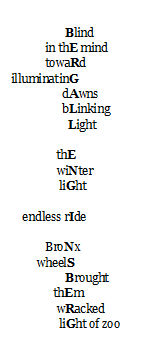
I think Perloff considers this a conceptual poem.  To me it’s a simple jump-cut poem, a “jump-cut” in my poetics being defined as “a movement in a text from one idea, image or the like to another with no syntactical bridge between the two.”  Thinking about it, I came to the (tentative) conclusion that there are two kinds of (effective) jump-cut poems: (1) procedure-generated ones and (2) moodscape-generated ones.  There is just one kind of ineffective jump-cut poem, ones that are neither (1) or (2).  Wholly random or essentially random because excessively hermetic crap, in other words.

While into a classifying mood, I divided All of Poetry into (1)  Subject-Centered Poetry  (what a poem is about) and (2) Technique-Centered Poetry  (how a poem is made), with “subject” defined as a combinationof the nature of the subject and the poet’s attitude toward it (tone).  Style I consider a technique.

While thinking about many of the comments at The Boston Review website about binaries, I formed one of my own: “Dichotiphobia vs. Rationality.”  Further thinking about a few of those comments, and many I’ve been assaulted by, inspired the following observation: “What I notice more and more in discussions of poetry or poetics is how many involved in them prefer not to attack opinions they oppose but the motives of those expressing those opinions.”

I don’t have a high opinion of the Cage passage, by the way.  Amusing, and occasionally a juxtapositioning makes something fun happen, but . . .   Perloff makes a big deal of its use of appropriation, and it is true that a good deal of what effectiveness it has is due to the way it procedure leads to the randomization of the order of its little locutions–which nonetheless make surprising off-the-wall sense.  This, as I suggested long ago while discussing Doris Cross, a superior employer of appropriations Perloff should be more familiar with than she seems to be, conveys a reassuring sense of Nature’s being rational, of something’s being behind it all that unifies our existence’s apparent meaninglessness.  No matter how you cut up and re-organize something like Ginsberg’s “Howl,” you’ll never get rid of words’ magical ability to mean.  Nor, analogically, of the universe’s.

.

Visitor Counter
Media Center Computer

Entry 958 — A Boston Review Symposium

Thursday, December 20th, 2012

A post at New-Poetry sent me to Marjorie Perloff’s essay at the Boston Review website –no doubt not for the first time, for I vaguely remember reading it and not thinking much of it.   This time, I quite liked it.  Here’s the comment I left about it:  “I’ve always faulted Marjorie Perloff for the limited range of the poetry she writes about, but what other poetry critic read by more than a few hundred people would ever write about the poetry of John Cage, Susan Howe and Srikanth Reddy, much less write penetratingly about it as she has in this essay?

“Her choice of appropriation as a center or one of the centers of contemporary “advanced” poetry is interesting but a little off as far as I can see.  I, like Christopher M., at once thought of “The Waste Land” when Perloff began speaking of appropriation as something significantly new.  But appropriation wasn’t the key device of “The Waste Land”: textual collage was, appropriation being merely a preliminary operation required to make a collage.  The jump-cut poetry which resulted due to the influence of “The Waste Land,” which included Ashbery’s work has long been with us.

“What is notable about Susan Howe’s work is not appropriation, but her choice of kinds of material to appropriate, making her, for example, a partly visual poet at times, and it is the mixing of expressive modalities in contemporary poetry where the main action has been for many years, albeit ignored by all the certified critics but Perloff, but rarely more than mentioned in passing even by her.”

Most of the comments made by others to this post seemed to me rather stupid.  There were more at another location at the Boston Review website where the Boston Review (which I have not yet put on my list of Enemies of Poetry, but have been close to doing for quite a while) invited 18 poetry-people to:

A Symposium on the Poetic Limits of Binary Thinking

Marjorie Perloff’s essay “Poetry on the Brink” in the May/June 2012 issue rekindled conversation about innovation and canonization in contemporary poetry. To continue and extend the discussion, we cast a wide net and invited 18 poets to address the following question: what is the most significant, troubling, relevant, recalcitrant, misunderstood, or egregious set of opposing terms in discussions about poetics today, and, by extension, what are the limits of binary thinking about poetry? Their responses range from whimsy to diatribe, with meditation, appraisal, tangent, touchstone, anecdote, drollery, confection, wit, and argument in between.

My quick expectation was that the “wide net” would be from sub-mediocre to mediocre . . . but so far, after looking at just four of the contributions to the symposium, I’ve found an intelligent comment. It’s by Ange Mlinko (whom I believe to be a favorite of the Boston Review.) I did not find the comment by Vendler-certified Stephen Burt intelligent, though it prettily plays around the theme. More, I hope, soon.
.

Entry 794 — Uljana Wolf’s “The Applicant [4]”

Monday, July 9th, 2012

I’m analyzing poems by poets Marjorie Perloff deems “experimental” to show how unexperimental they actually are. I find I’m also in the process learning quite a bit about the mainstream’s “cutting edge.” A lot that’s going on there is better than I thought it was–it’s just not poetically adventurous. Here’s one, which is by Uljana Wolf, a poet new to me whose work I had trouble finding on the Internet:

The Applicant [4]    blew the interview. Cracked window        over a chest too baroquely  open for business. Mollusk of rancor        in a throat saying should've  let him do the talking. Should've left        them a foretaste of the whole  amalgam. What doesn't kill me        makes me wonder. Whatever it was  must have tramped off an afternoon        laughing so hard it forgot what I looked like  with my hat down and left me        ghost of infinite back rent to pay.

This is another example of “experimental poetry” that’s nothing but one oddly not-quite-right sentence or partial sentence jump-cutting to another—but doing so musically, with splashfuls of vivid visual imagery.  The intent (which may be unconscious) is to engage a reader’s curiosity long enough for the unifying mood the poem is expressing to sink in.  It’s interestingly complex, this mood—which includes among much else, what-I-shoulda-done regret, hostility toward the rejecting interviewer (and, it seems to me, the “whatever it was” ultimately in inimical charge of the interviewee’s life), objectivity about the comedy of it all, and melancholy at the thought of the back-rent that will not be paid).

Nothing new here—just a different personality bouncily disdaining transitions.  But concluding with a genuine keeper of a pay-off image in the poem’s last four-and-a-half lines.

I’m thinking a good name for the rather large school of Ashberians is “the Neo York School of Poets.”

.

Entry 785 — the Otherstream and the Universities

Saturday, June 30th, 2012

As I said in another entry, Jake Berry has an article in The Argotist Online, edited by by Jeffrey Side, that’s about the extremely small attention academia pays to Otherstream poetry you can read here. I and these others wrote responses to it: Ivan Arguelles, Anny Ballardini, Michael Basinski, John M. Bennett, John Bradley, Norman Finkelstein, Jack Foley, Bill Freind, Bill Lavender, Alan May, Carter Monroe, Marjorie Perloff, Dale Smith, Sue Brannan Walker, Henry Weinfield.  A table of contents of the responses is here. I hope eventually to discuss these responses in an essay I’ve started but lately found too many ways to get side-tracked from.   The existence of the article and the responses to it has been fairly widely announced on the Internet.  Jeff Side says they’ve drawn a lot of visitors to The Argotist Online, ” 23,000 visitors, 18,000 of which have viewed it for more than an hour.”  What puzzles both him and me is that so far as we know, almost no one has responded to either the article or the responses to the article.  There’s also a post-article interview of Jake that no one’s said anything about that I know of.  Why?

What we’re most interested in is why no academics have defended academia from Jake’s criticism of it.  Marjorie Perloff was (I believe) the only pure academic to respond to his article, although Jeff invited others to.  And no academic I know of has so much as noted the existence of article and responses.  I find this a fascinating example of the way the universities prevent the status quo from significantly changing in the arts, as for some fifty years they’ve prevented the American status quo in poetry from significantly changing.  Here’s one possible albeit polemical and no doubt exaggerated (and not especially original) explanation for the situation:

Most academics are conformists simply incapable of significantly exploring beyond what they were taught about poetry as students, so lead an intellectual life almost guaranteed to keep them from finding out how ignorant they are of the Full contemporary poetry continuum–they read only magazines guaranteed rarely to publish any kind of poetry they’re unfamiliar with, and just about never reviewing or even mentioning other kinds of poetry.  They only read published collections of poems published by university or commercial (i.e. status quo) presses and visit websites sponsored by their magazines and by universities.  Hence, these academics come sincerely to believe that Wilshberia, the current mainstream in poetry, includes every kind of worthwhile poetry. 

When they encounter evidence that it isn’t such as The Argotist Online’s discussion of academia and the otherstream, several things may happen:

1. the brave ones, like Marjorie Perloff, may actually contest the brief against academia–albeit not very well, as I have shown in a paper I will eventually post somewhere or other;

2. others drawn in by the participation of Perloff may just skim, find flaws in the assertions and arguments of the otherstreamers, and there certainly are some, and leave, satisfied that they’ve been right all along about the otherstream;

3. a few may give some or all the discussion an honest read and investigate otherstream poetry, and join the others satisfied they’ve been right all along, but with better reason since they will have actually investigated it; the problem here is that they won’t have a sufficient amount of what I call accommodance for the ability to basically turn off the critical (academic) mechanisms of their minds to let new ways of poetry make themselves at home in their minds.  In other words, they simply won’t have the ability to deal with the new in poetry. 

4. many will stay completely away from such a discussion, realizing from what those written of in 1., 2. and 3 tell them. that it’s not for them. 

A major question remains: why don’t those described in 2. and 3. comment on their experiences, letting us know why they think they’ve been right all along.  That they do not suggests they unconsciously realize how wrong they may be and don’t want to take a chance of revealing it; or, to be fair, that they consider the otherstream too bereft of value for them to waste time critiquing.  This is stupid; pointing out what’s wrong with bad art is as valuable as pointing out what’s right with good art.  Of course, there are financial reasons to consider:  a critique of art the Establishment is uninterested in will not be anywhere near as likely to get published, or count much toward tenure or post-tenure repute if published as another treatise on Milton or Keats.  Or Ashbery, one of the few slightly innovative contemporary poets of Wilshberia.

But I think, too, that there are academics who unconsciously or even consciously fear giving any publicity at all to visual or sound or performance and any other kind of otherstream poetry because it might overcome Wilshberia and cost them students, invitations to lecture and the like–and/or just make them feel uncomfortably ignorant because incapable of assimilating it.  Even more, it would cost them stature: it would become obvious to all but their closest admirers that they did not know all there is to know about poetry.

Note: I consider this a first draft and almost certainly incomplete.  Comments are nonetheless welcome.

 .

Free Counter
Newegg Promo Codes

Entry 774 — The Otherstream, Part One

Tuesday, June 19th, 2012

The Argotist Online has Jake Berry’s essay, Poetry Wide Open: The Otherstream (Fragments In Motion) online and a collection of responses to it including one by me at The Argotist Online.  Most of my fellow responders did a good job and are worth reading,  John M. Bennett’s was eswpecially good, its only flaw being is shortness.  More than half seemed fuzzy to me, and I disagreed fairly strongly with two or three, one of them Marjorie Perloff’s.  I’ve always considered Professor Perloff the only visible American critic who has written about poets in the otherstream, and she deserves credit for responding to Jake’s essay–great credit, for keeping aloof from discussions with or about marginals is almost a part of the definition of an academic.  She’s written very little about the otherstream, though, and only considered one small portion of it, language poetry (rather poorly, I fear).  She’s gotten the toes of one foot into the otherstream, but with her shoe still on, and seems entirely ignorant of those of us wholly immersed in it.  Unsurprisingly, I quickly wanted to attack her response.  The first thing I did was research the poets she mentioned as “experimental”–about a dozen–on the Internet.  Among them was Craig Dworkin.  I’d come across his name more than a few times but knew very little of him.  It turns out that he is, by my standards, an “experimental” artist–if we take “experimental” to be a synonym for “otherstream,” as Professor Perloff does, but I don’t, “experimental” having become, for me, a uselessly loose “polysemic” word for criticism.  Here’s what my search on Dworkin’s name got me:

Fact

By Craig Dworkin

Ink on a 5.5 by 9 inch substrate of 60-pound offset matte white paper. Composed of: varnish (soy bean oil [C57H98O6], used as a plasticizer: 52%. Phenolic modified rosin resin [Tall oil rosin: 66.2%. Nonylphenol [C15H24O]: 16.6%. Formaldehyde [CH2O]: 4.8%. Maleic anhydride [C4H2O3]: 2.6%. Glycerol [C3H8O3]: 9.6%. Traces of alkali catalyst: .2%]: 47%): 53.7%. 100S Type Alkyd used as a binder (Reaction product of linseed oil: 50.7%. Isophthalic acid [C8H6O4]: 9.5%. Trimethylolpropane [CH3CH2C(CH2OH)3]: 4.7%. Reaction product of tall oil rosin: 12.5%. Maleic anhydride [C4H2O3]: 2.5%. Pentaerythritol [C5H12O4]: 5%. Aliphatic C14 Hydrocarbon: 15%): 19.4%. Carbon Black (C: 92.8%. Petroleum: 5.1%. With sulfur, chlorine, and oxygen contaminates: 2.1%), used as a pigmenting agent: 18.6%. Tung oil (Eleostearic acid [C18H30O2]: 81.9%. Linoleic acid [C18H32O2]: 8.2%. Palmitic acid [C16H32O2]: 5.9%. Oleic acid [CH3(CH2)7CH=CH(CH2)7COOH]: 4.0%.), used as a reducer: 3.3%. Micronized polyethylene wax (C2H4)N: 2.8%. 3/50 Manganese compound, used as a through drier: 1.3%. 1/25 Cobalt linoleate compound used as a top drier: .7%. Residues of blanket wash (roughly equal parts aliphatic hydrocarbon and aromatic hydrocarbon): .2%. Adhered to: cellulose [C6H10O5] from softwood sulphite pulp (Pozone Process) of White Spruce (65%) and Jack Pine (35%): 77%; hardwood pulp (enzyme process pre-bleach Kraft pulp) of White Poplar (aspen): 15%; and batch treated PCW (8%): 69.3%. Water [H2O]: 11.0%. Clay [Kaolinite form aluminum silicate hydroxide (Al2Si2O5[OH]4): 86%. Calcium carbonate (CaCO3): 12%. Diethylenetriamine: 2%], used as a pigmenting filler: 8.4%. Hydrogen peroxide [H2O2], used as a brightening agent: 3.6%. Rosin soap, used as a sizer: 2.7%. Aluminum sulfate [Al2(SO4)]: 1.8%. Residues of cationic softener (H2O: 83.8%. Base [Stearic acid (C18H36O2): 53.8%. Palmitic acid (C16H32O2): 29%. Aminoethylethanolamine (H2-NC2-H4-NHC2-H4-OH): 17.2%]: 10.8%. Sucroseoxyacetate: 4.9%. Tallow Amine, used as a surfactant: 0.3%. Sodium chloride [NaCl], used as a viscosity controlling agent: .2%) and non-ionic emulsifying defoamer (sodium salt of dioctylsulphosuccinate [C20H37NaO7S]), combined: 1.7%. Miscellaneous foreign contaminates: 1.5%.

NOTES: “Fact” is an exact list of ingredients that make up a sheet of paper that has been written or printed on, hence the blunt title of the work. It’s a self-reflexive, deconstructed meditation on the act of writing and of publishing, with an emphasis on the materiality of language. Each time Dworkin displays the poem, he researches the medium on which it’s being viewed, changing the list of ingredients. It’s a flexible work in progress, sometimes manifesting itself as a list of the ingredients that make up a Xerox copy, other times listing the composition of an lcd display monitor. (Italicized portion my addition–BG)

Source: Poetry (July/August 2009)

This text presents an interesting challenge to my poetry-taxonomy-in-progress. It is not a poem, by my criteria. But it doesn’t seem to me to be evokature, either. That’s what I call prose that attempts to evoke images and/or emotions the way poetry does but has no lineation, or anything like lineation. What it clearly is, is a work conceptual art (which I consider inspired). For now I will consider it “conceprature,” a sibling of “evokature” (what “prose poems” are) and, like the latter, a subcategory of prose.

My pluraphrase (i.e., full expression of what a poem is, does and says) of it is inchoate right now, or less than inchoate. I’ll kick it into my under-consciousness, for now. With luck, it’ll turn into something I can work at least a tentative appreciation of “Fact” into. In the meantime, I have to acknowledge that a top-level member of the American Poetry Establishment has done a good deed for me (I mean Professor Perloff, not Craig Dowrkin, also an academic who has done a good deed for me). Not sure I can get over that.

.